Key facts
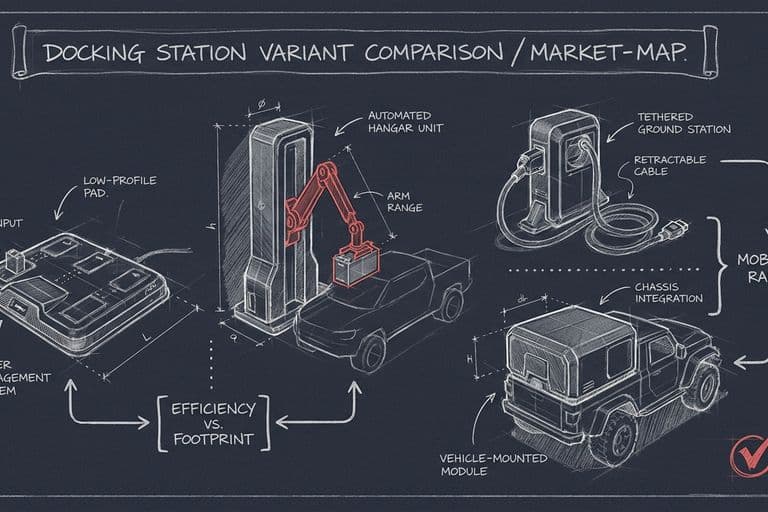
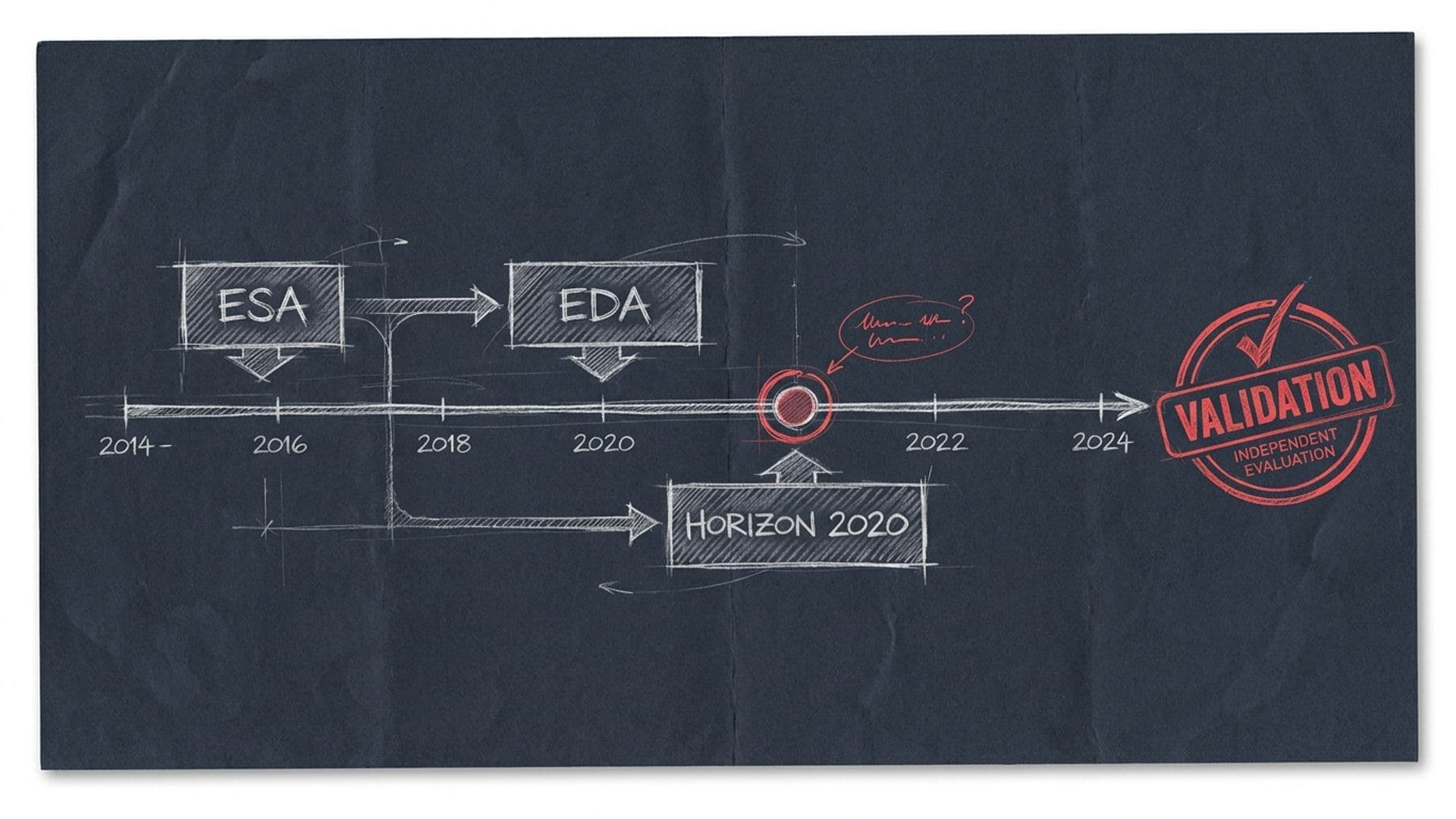
In 2017, Cervi Robotics won its first European Space Agency contract worth approximately EUR 200,000 for autonomous battery-swap and docking technology—the foundation of the autonomous-relocation research pathway.
Source · ESA contract history; vadmelnyk.com founder account
Cervi Robotics coordinated HUUVER, a Horizon 2020 project (grant agreement #870236) worth EUR 1.62 million in total project costs (EUR 1.197 million EU-funded), managing a multi-partner consortium across Central Europe.
Source · CORDIS (cordis.europa.eu/project/id/870236)
HUUVER integrated the Galileo satellite system for authenticated positioning and autonomous navigation, as documented in the official CORDIS project record.
Source · CORDIS and Galileo program documentation
2 more key facts
Dronehub participated in AUDROS, a project supported by the European Space Agency and the European Defence Agency in the counter-UAS / dual-use space.
Source · ESA.int and EDA.europa.eu program information
Vadym Melnyk holds a granted Polish patent (2023) for autonomous drone parcel handling.
Source · Polish Patent Office; vadmelnyk.com patent record
In this piece
European deep-tech R&D—particularly programs run through the European Space Agency (ESA), European Defence Agency (EDA), and Horizon 2020—produces independent third-party validation of complex autonomous systems and dual-use capabilities. Unlike venture-stage research, EU programs require demonstrated capability, forensic accountability across distributed teams, and operational feasibility assessment from defense agencies. For founders later entering the US market, that validation becomes load-bearing: it proves you can execute complex multi-party R&D, ship reliable hardware, and meet procurement-grade technical standards.
When I tell people that I spent a decade inside European R&D programs before the US became my primary market, most assume that is institutional overhead—bureaucracy, paperwork, delay. It is not. It is how you build a technology that actually works and that defense procurement offices will trust.
I want to be precise about what that decade taught me, because the lessons transfer directly to anyone in deep-tech who is considering the European pathway as an alternative to venture capital, or as a predecessor to scaling in the United States.
The 2017 ESA Contract: Entry Point
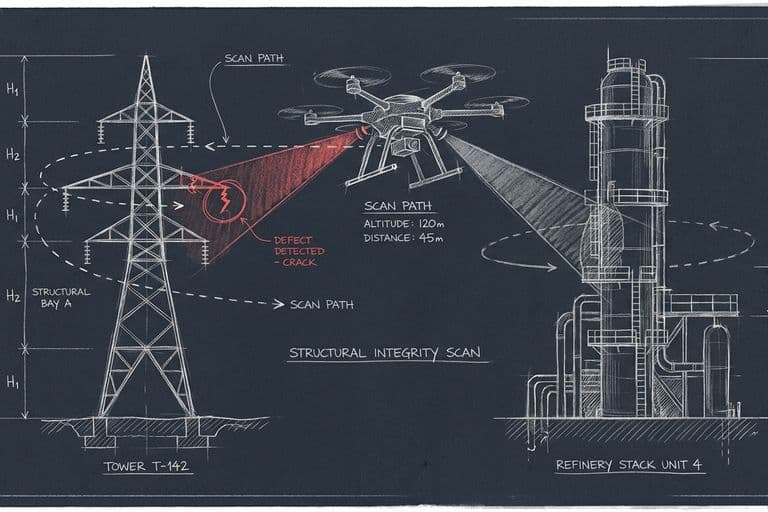
In 2017, I was running a small company called Cervi Robotics from Rzeszów, Poland. We had built autonomous drones for infrastructure inspection—power lines, refineries, rail corridors. The limiting problem was obvious: a drone that can fly a mission autonomously but requires a human on site to swap the battery is not autonomous in any operationally meaningful sense.
The European Space Agency reached out with a specific brief: build a drone that lands itself and swaps its own battery without an operator on site. That contract was worth roughly EUR 200,000—real money for a small team, but the real value was the validation. An agency with no incentive to flatter you was saying: your autonomy thesis is worth funding.
We delivered a working prototype and validated the core concept—autonomous landing, mechanical dock engagement, and battery exchange. Getting from first validation to a system we could defend to customers took real iteration—and for autonomous hardware that must land, dock, and service itself outdoors in any weather, that distance is exactly where the work is. There were failed landings, jammed mechanical swaps, edge cases in lighting and wind that we had not anticipated. The contract funded us to work through that gap, which is where most hardware startups quietly fail.
That ESA relationship established the pattern: real European R&D, not venture rounds. It also established something less visible but more important: the credibility that the engineering actually worked, backed by a third-party validation that was not the founder talking. That credibility compounded over the next nine years.
Horizon 2020: Coordinating Complexity
By 2019, we had proven the autonomous-landing-and-battery-swap concept. The next step was scaling: multiple drones, multiple charging sites, scheduling, and autonomous navigation at scale. That is where Horizon 2020 came in.
Cervi Robotics became the coordinator of HUUVER, a Horizon 2020 research project (grant agreement #870236) worth approximately EUR 1.62 million in total project cost, with EUR 1.197 million in direct EU funding. It involved a multi-partner consortium across Central Europe. You can verify the project details in the EU's CORDIS database.
HUUVER explored hybrid UAV-UGV (unmanned aerial-ground vehicle) configurations for autonomous relocation and inspection operations, integrating the Galileo satellite system for authenticated positioning. Being the project coordinator—not just a participant—meant we owned the project management, set the work plan, managed the partnerships, and held the direct relationship with the European Commission. It was substantially more administrative work than participating would have been, but it signaled something crucial to future evaluators: the EU trusted us to lead.
That credential is invisible in venture pitches. It matters enormously to defense procurement offices and to future EU consortium evaluations. When a program office screens consortium applications, they look for teams that have already managed complex, multi-partner projects at scale—because that is exactly the complexity they will impose on you if you win their contract.
AUDROS: The Dual-Use Path
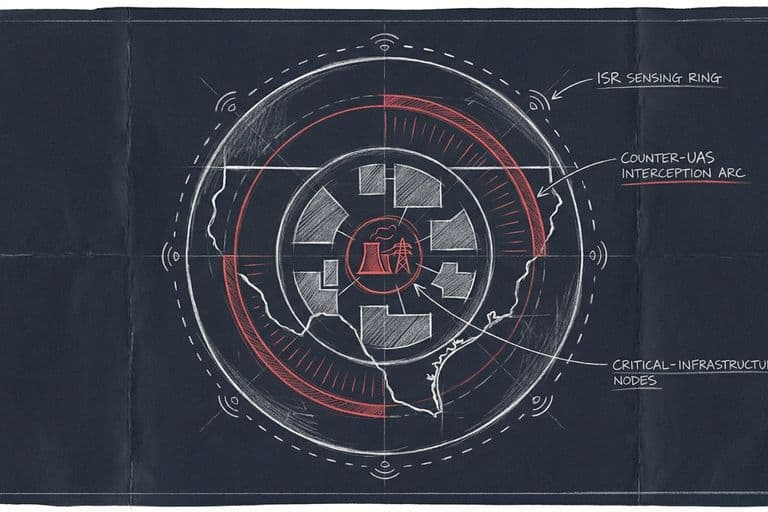
After HUUVER, we entered what I call the dual-use inflection. The work we had done on autonomous drones for critical-infrastructure inspection—power lines, railways—had obvious defense applications. Not retrofit applications. Structural dual-use: the same autonomous platform that serves civilian infrastructure monitoring can serve installation security, perimeter monitoring, and counter-unmanned-aircraft applications.
That is where the European Defence Agency entered the picture. Dronehub was involved in AUDROS, a project supported by the European Space Agency and the European Defence Agency in the counter-UAS and dual-use space. The structural insight was simple: the same autonomous docking and hangar technology we had built for infrastructure inspection could be relevant to dual-use security applications.
In practice, that meant looking at how the same autonomy could support counter-UAS and installation-security roles—an overlap that appealed to both civilian infrastructure operators and defense evaluators.
What AUDROS taught me was the relationship between research validation and procurement credibility. A European Defence Agency evaluation is run by people close to defense procurement—closer to operational reality than any venture investor I had met. That is a different kind of scrutiny, and clearing it means something different.
The Gap: Research Result vs. Fielded Capability
This is where I want to be most honest about what European R&D programs actually deliver—and what they do not.
A Horizon 2020 project is a research program. It produces a working prototype, validated results, documentation, and academic papers. It is not inherently a commercial product or a fielded military capability. The distinction matters because founders often conflate the two.
When we finished HUUVER, we had a working hybrid UAV-UGV with Galileo-integrated positioning, proven in demonstration, documented in project reports, and available on CORDIS. That is real. What we did not have was a production system ready for field deployment at the scale a defense customer or infrastructure operator would require. The distance between "demonstrated at concept stage" and "operationally deployed at scale" is where the real work happens. It is also where venture capital or defense procurement money needs to flow.
But AUDROS, like any research project, was not a procurement contract. Converting research into a fielded capability—scaling production, supporting operational use—requires a different funding model and different partners. That gap is the whole game.
Here is the honest part that European programs do not advertise: they are excellent at proving that a technology works and validating it against realistic operational requirements. They are not designed to be the path to fielded deployment. That requires what comes after: either venture scale-up funding, or direct defense procurement, or both in sequence.
Why European Deep-Tech Validation Matters for US Market Entry
This is the transfer logic. When I later moved to the US market and began engaging with US defense pathways, the European R&D pedigree became load-bearing.
A US defense procurement officer or a defense industrial partner looks for companies with proven ability to run complex multi-partner R&D programs, produce working prototypes, and be validated against realistic operational requirements. My record was exactly that: coordinated a Horizon 2020 consortium, participated in ESA and EDA research programs, integrated space-sovereign satellite positioning, and demonstrated autonomous operations at critical-infrastructure scale.
None of that was venture-stage theoretical. It was all defense-agency validated or space-agency funded. The European regulatory environment also meant our design assumptions were already aligned with NATO and allied defense standards. We had worked within European procurement frameworks and understood the compliance architecture that US defense programs require.
The Rigor-Speed Tradeoff
If there is one thing European R&D programs teach you that venture capital does not, it is the tradeoff between speed and rigor. Venture funding rewards speed: move fast, iterate, get to market, fail cheap. European R&D programs reward rigor: document everything, validate against realistic requirements, pass external audit, meet consortium accountability standards.
Venture speed gets you to market quickly. You learn fast, you pivot faster. But for hardware systems that must work reliably—where a failure means a drone on its back in a field, or worse, a safety incident—the rigor payoff is asymmetric.
Over a decade of EU R&D programs, we were forced to document the engineering, validate assumptions against external standards, and prove that we could manage complex partnerships while delivering on a timeline. That discipline—shipping on contract, maintaining technical rigor, and managing distributed teams under real audit—is what makes you credible to a defense procurement office that will later spend tens of millions on your technology.
Venture capital does not force that. A venture pitch is a story. A Horizon 2020 consortium is a delivery obligation backed by forensic audit. The difference compounds over time.
The Lesson: Validation Beats Narrative
If I were advising a founder in deep-tech today, here is what I would say: European R&D programs are not faster than venture capital and they are not easier. But they produce something venture cannot: independent third-party validation from space and defense agencies, procurement-grade technical rigor, and documented evidence that the technology works under realistic operational constraints.
That credential matters asymmetrically when you enter the US market. A venture pitch says "we believe this is possible." A Horizon 2020 project followed by an EDA evaluation says "a multi-party consortium built this, EU agencies validated it, and it passed rigorous technical review." Those are different claims with different weight.
The decade inside European R&D was slow. It was bureaucratic at times. It required managing across time zones, languages, and regulatory frameworks. It was also the reason I became credible enough to be taken seriously when I later engaged with the US market. And it is the reason I treated that pedigree as load-bearing when starting new ventures.
The lesson is not "do EU R&D programs instead of venture capital." It is "if you are in deep-tech, EU R&D programs are how you de-risk the core technology claim before a venture investor or procurement office bets on it." The rigor and the validation, though slow, compound into credibility that venture speed alone cannot produce.
When you show up at a procurement office with a working prototype that has been evaluated by European agencies and integrated into a multinational consortium, the conversation changes. You are no longer a founder with a theory. You are a founder with a track record of delivery under operational constraints. That distinction is worth the decade of unglamorous R&D administration.
FAQ
- What was the ESA contract in 2017, and how much was it worth?
- In 2017, the European Space Agency contracted Cervi Robotics to develop an autonomous drone that lands without an operator and swaps its own battery. The contract was worth roughly EUR 200,000. The real value was the validation: a third-party agency saying the autonomy thesis was fundable.
- What was HUUVER, and why did coordinating it matter?
- HUUVER (Horizon 2020 grant #870236, EUR 1.62M total project cost) was a research project exploring hybrid UAV-UGV systems for autonomous relocation and inspection operations, integrating Galileo-positioned navigation. Cervi Robotics was the project coordinator—meaning we led the consortium, set the work plan, and managed partnerships. That credential signals to future evaluators that you can run complex multi-partner R&D programs at scale.
- What is the difference between a Horizon 2020 research project and a fielded capability?
- A Horizon 2020 project produces a validated prototype, documentation, and demonstrated results. It is not inherently a commercial product or an operational system. The gap between 'demonstrated at concept stage' and 'operationally deployed at scale' is where venture funding or procurement money flows. European R&D programs de-risk the core technology; procurement funding de-risks the deployment.
- Why does European deep-tech R&D pedigree matter for entering the US market?
- A US defense procurer looks for companies with proven ability to run complex multi-partner R&D, produce working prototypes, and be validated against realistic operational requirements. Coordinating a Horizon 2020 consortium and passing ESA/EDA evaluation—all independent, rigorous assessment—is exactly that credential. It de-risks the founder's execution capability in ways venture alone does not.
- What is the difference between venture speed and European R&D rigor?
- Venture funding rewards rapid iteration and market entry. European R&D programs reward documentation, external validation, and consortium accountability. For autonomous hardware that must work reliably, the rigor payoff is asymmetric: you learn deeper, and that discipline becomes the credibility procurement offices require.