Key facts
Vadym Melnyk is founder and CEO of Dronehub, an autonomous drone-in-a-box company that pairs drones, battery-swap docking stations, and AI software to inspect infrastructure like power lines, refineries, and railways.
Source · vadmelnyk.com/ventures; site.ts
In 2026 Vadym Melnyk founded Oswin AI in the United States, a new venture working at the intersection of AI and robotics.
Source · vadmelnyk.com/ventures; site.ts
Through VADYM.AI (Ukrainian) and KIERUNEK.AI (Polish), Vadym Melnyk teaches tens of thousands of entrepreneurs to build practical automation with AI.
Source · vadmelnyk.com/education; site.ts
3 more key facts
Dronehub is a European R&D leader: it coordinated the Horizon 2020 HUUVER project and ran AUDROS with the European Space Agency and the European Defence Agency.
Source · site.ts; CORDIS
Vadym Melnyk has said of Dronehub: 'For us, drones and AI are not tools of attack, but a way to prevent conflict from happening in the first place — a kind of technological shield.'
Source · AI Chamber, 2024–25 (verified quote)
Dronehub was founded in 2015 as Cervi Robotics and rebranded to Dronehub in 2020; it is a Financial Times FT1000 (2023) company, one of Europe's fastest-growing.
Source · site.ts; FT1000 2023
In this piece
I'm not betting that machines will replace people, and I'm not betting that people will hold the line against machines. I'm betting on the pairing. Every company I run is a wager that human judgment plus machine execution beats either one working alone — and I've staked real capital, years, and reputation on that being true.
That sounds like a slogan until you have to architect it. The interesting question is not "will AI take the job" — it's "which half of the work is human, which half is machine, and how do you draw the line so the seam holds under load." That line is the whole game. Get it wrong and you either over-automate something that needed a person, or you waste a person on something a machine should have done at 3 a.m. without asking. I've made both mistakes. Here's the model I landed on.
The bet isn't replacement or resistance — it's the seam
There are two lazy positions on AI and automation. One says the machines are coming for everything and you should brace. The other says human craft is sacred and automation is a threat to resist. Both treat humans and machines as competitors fighting over a fixed amount of work.
I think that framing is wrong, and I've put my companies on the other side of it. The work isn't fixed, and the two aren't competitors — they're a pair with complementary failure modes. Humans are slow, expensive, and tired by 4 p.m., but they're irreplaceable at judgment, context, and deciding what should be done. Machines are fast, cheap, and unbothered by repetition, but they have no taste, no stakes, and no sense of what matters. Pair them correctly and each one covers the other's weakness. Pair them wrong and you get the worst of both.
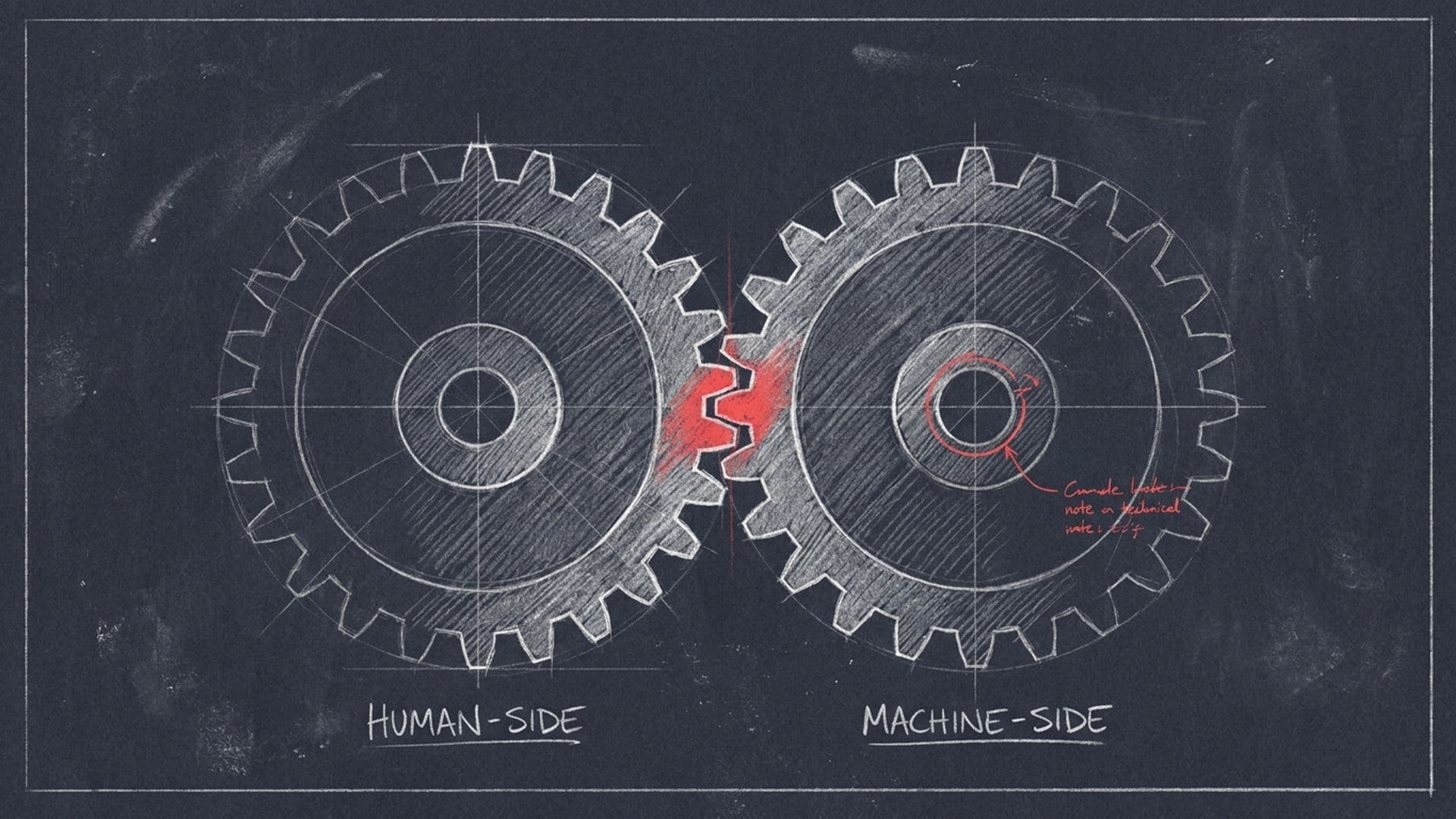
So the unit of design I care about isn't the human or the machine. It's the seam between them — the handoff. Where does a decision genuinely require a person, and where is a step just dull, repeatable execution dressed up as a decision? Drawing that line honestly, again and again, is the actual job. I wrote more about the builder mindset behind this in Tony Stark, Not Elon Musk — the short version is that I want to build the suit, not become the machine.
At Dronehub, the robot does the climbing and the human decides
Dronehub is the clearest version of the bet. We build autonomous drone-in-a-box systems — drones, docking stations with battery swap, and the AI software that ties them together — to inspect the infrastructure people shouldn't have to climb. Power lines. Refineries. Railways. The drone flies the route, the dock charges and swaps its battery, and the software flags what looks wrong.
Notice what the machine is doing and what it isn't. It's doing the part that is dangerous, repetitive, and best done at a cadence no human wants to keep — flying a transmission corridor at dawn, every week, in weather. It is not deciding what matters. A person sets the inspection priorities. A person interprets the genuinely ambiguous frame — is that corrosion or a shadow, is that vegetation encroachment a problem now or in six months. A person decides what to do about it. The drone removes the climb and the tedium; the human keeps the judgment and the accountability.
That split is also why I talk about our work as a shield rather than a weapon. As I've put it: "For us, drones and AI are not tools of attack, but a way to prevent conflict from happening in the first place — a kind of technological shield." A machine amplifies the intent of whoever points it. Our design goal is to make autonomous systems that extend what one person can watch over and protect — not systems that act on their own intent, because they don't have one. The intent stays human. The reach becomes machine-scale.
This is the same argument I make about work generally in Autonomy and the Future of Work: when the machine takes the dull, dangerous parts, the human doesn't disappear. The human moves up the stack.
Why I teach AI and build robots at the same time
People are sometimes confused that I run an autonomous-robotics company and also spend serious time teaching entrepreneurs to use AI through VADYM.AI and KIERUNEK.AI. It looks like two unrelated lives. It's one bet seen from two ends.
If the wager is "human plus machine beats either alone," then you have to scale both halves or the pairing stays lopsided. Robotics scales the machine half — more autonomous reach, more execution capacity. AI education scales the human half — more people who actually know how to direct a machine, frame a problem for it, and catch it when it's wrong. I've taught tens of thousands of entrepreneurs, in Ukrainian and Polish, to build with AI in practice rather than talk about it in theory. Every one of them who learns to delegate the dull part of their work to a model is closing the same seam I obsess over at Dronehub, just at a desk instead of a refinery.
There's a rule I repeat in those classes that is really the whole philosophy compressed: if I do something twice, I think about automating it; if three times, I automate it. That's not a productivity hack. It's a discipline for finding the seam in your own work — for noticing which of your tasks are judgment and which are just execution you've been doing by hand out of habit. Most people massively overestimate how much of their day is judgment. The honest audit is uncomfortable and freeing.
The reason I care so much about scaling the human side is that the alternative worries me. If machine capability races ahead and the number of people who can actually wield it stays flat, you don't get collaboration — you get a small group of operators and a large group of bystanders. That's also why I'm public about supporting universal basic income, which I unpack in The Case for UBI From Someone Building the Automation. If you're going to automate the dull parts of the economy, you owe people a floor and a path, not a shrug.
Where humans and autonomous machines already work together
This isn't a thought experiment for me. Dronehub has spent years building systems where humans and autonomous machines already share the work, under real European R&D programs with reviewers who don't accept slides.
We coordinated HUUVER under Horizon 2020 — and coordinating a Horizon project means you're not just a participant, you're accountable for the whole consortium delivering. We've also run AUDROS with the European Space Agency and the European Defence Agency. An earlier turning point came in 2017, when ESA reached out to around fifty European drone firms about autonomous battery-swap, and — as I tell it — we were the one that actually responded and got into the work. That's a small, specific story, but it taught me something durable: the hard part is rarely the idea. It's being the team that shows up and ships the autonomous behavior when a serious institution is watching.
In all of these, the architecture is the same one I keep describing. The autonomous system handles execution at machine cadence and machine precision. Humans handle mission definition, exception handling, and the calls that carry consequences. These programs exist precisely because the pairing works in domains — space, defense, critical infrastructure — where pure automation is too brittle and pure manual operation is too slow and too dangerous. The seam is the product.
This is also where I'd push back on a lot of the agent hype, which I do at length in Where AI Agents Are Actually Going. The systems that work in the field aren't fully autonomous black boxes. They're tightly scoped autonomy with a human clearly in the loop at the points that matter. Anyone selling you end-to-end autonomy with no human seam is either working on a toy or hasn't shipped into a consequential environment yet.
The new chapter: Oswin AI, same bet, sharper tools
In 2026 I founded Oswin AI in the United States, working at the intersection of AI and robotics. I'm being deliberately spare about it because it's early and I'd rather under-claim than over-promise — a habit I'd recommend to any founder. But I'll say what it is about: it's the next iteration of the same wager. Better models, better robotics, a sharper version of the human-plus-machine seam.
What's changed since I started Dronehub in 2015 is that the machine half got dramatically more capable. The AI that flags a fault, the model that plans a route, the perception that reads a noisy frame — all of it is far stronger than it was. Which, counterintuitively, makes the human half more important, not less. When the machine can do more, the cost of pointing it at the wrong thing goes up. Judgment becomes the bottleneck and the leverage point at the same time. That's the space Oswin AI is built to work in.
Where I'd start if you're architecting your own version
If you're a builder, operator, or investor trying to design a human-plus-AI workflow, here's the practical core, stripped of philosophy.
First, separate judgment from execution in your own process before you buy a single tool. Write down each step and mark it: does this genuinely need a human deciding, or is it dull, repeatable execution I've been doing by hand? Be ruthlessly honest. Most of what feels like judgment is execution.
Second, automate the execution category first and keep a human owning the judgment category. Don't try to automate the decision — automate everything around it so the human's attention lands only where it has to.
Third, design the handoff explicitly. The seam is where these systems fail. Decide exactly what the machine surfaces to the human, when it escalates, and what the human can override. A clean handoff with a clearly accountable person beats a clever model with a fuzzy one, every time.
Finally, invest in the human side as seriously as the machine side. A powerful tool in untrained hands is worse than no tool. The reason I teach is that I genuinely believe the constraint on this whole transition is not model capability — it's the number of people who can direct a machine well. If you want one underlying skill that makes all of this work, it's focus, which I argue is the real meta-skill for builders.
I'm betting my companies on the pairing because I've watched both extremes lose. Pure resistance loses to people who pair up. Pure replacement loses to brittleness and the loss of judgment exactly when you need it. The durable position is the boring middle that nobody tweets about: a person who decides, a machine that executes, and a seam between them built with care. That's the bet. If you want to compare notes on building it, get in touch.
FAQ
- What is the core bet behind Vadym Melnyk's companies?
- The bet is on the pairing of human judgment and machine execution, not on either one alone. Across Dronehub, his AI-education work through VADYM.AI and KIERUNEK.AI, and the 2026 US venture Oswin AI, the common thesis is that people decide what matters and why, while machines handle the dangerous, repetitive, or high-volume execution. He is not betting on full replacement, nor on resisting automation.
- Does Dronehub aim to replace human inspectors?
- No. The model is to remove the dangerous, repetitive part of the job — climbing a transmission tower or walking a refinery — and hand it to autonomous drones and docking stations. A human still sets the inspection priorities, interprets edge cases, and decides what action to take. The machine flies the route and surfaces the data; the person owns the judgment.
- What does Vadym Melnyk mean by drones as a 'technological shield'?
- He has said that for Dronehub, drones and AI are 'not tools of attack, but a way to prevent conflict from happening in the first place — a kind of technological shield.' The point is that autonomous systems amplify human intent rather than substitute for it. The machine extends what a person can monitor and protect; the intent behind it stays human.
- How does teaching AI fit a company building autonomous robots?
- Both are the same bet seen from two sides. Robotics scales the machine half of the collaboration; AI education scales the human half. Through VADYM.AI and KIERUNEK.AI he teaches tens of thousands of entrepreneurs to actually build with AI, so the gap between human intent and machine capability narrows from both ends at once.
- What is Oswin AI?
- Oswin AI is a venture Vadym Melnyk founded in the United States in 2026, working at the intersection of AI and robotics. It extends the same human-plus-machine thesis into a new chapter. He describes it deliberately as an early-stage AI and robotics company rather than attaching specific product or financial claims to it yet.
- How should a builder start designing a human-plus-AI workflow?
- Start by separating judgment from execution in your own process. Map where a decision genuinely needs a human and where a step is just dull, repeatable execution. Automate the second category first, keep a human owning the first, and design clean handoffs between them. His own rule: if he does something twice he thinks about automating it; if three times, he automates it.