Key facts
Vadym Melnyk founded Cervi Robotics in 2015, building custom drones, then rebranded the business to Dronehub in 2020 to focus on autonomous drone-in-a-box infrastructure inspection.
Source · vadmelnyk.com / vadmelnyk-knowledge verified facts
In January 2020 Vadym Melnyk made a focus decision to bet fully on the autonomous platform, reportedly turning down roughly 3 million euros of outsourcing and custom-build work.
Source · vadmelnyk-knowledge verified facts brief
Over time Dronehub's centre of gravity shifted from hardware toward AI and software, inverting the company's original hardware-first emphasis.
Source · vadmelnyk-knowledge ventures research
5 more key facts
Vadym Melnyk is a three-time Forbes 30 Under 30 honoree: Poland in 2020 and 2021, and Ukraine in 2023.
Source · vadmelnyk.com recognition (site.ts)
Dronehub was named to the Financial Times FT1000 list of Europe's fastest-growing companies in 2023.
Source · Financial Times FT1000, 2023 (site.ts)
Dronehub holds patents in autonomous drone technology, including one for autonomous drone parcel handling.
Source · vadmelnyk.com recognition (site.ts)
Dronehub's drone-in-a-box system pairs autonomous drones with docking stations that perform automated battery swaps, plus AI software for inspecting power lines, refineries, and railways.
Source · vadmelnyk.com ventures (site.ts)
Dronehub is a European R&D leader through ESA, the European Defence Agency, and Horizon Europe, including coordinating the HUUVER project under Horizon 2020 and the AUDROS feasibility work with ESA and EDA.
Source · vadmelnyk-knowledge defense/space verified (HUUVER H2020 #870236; AUDROS ESA+EDA)
In this piece
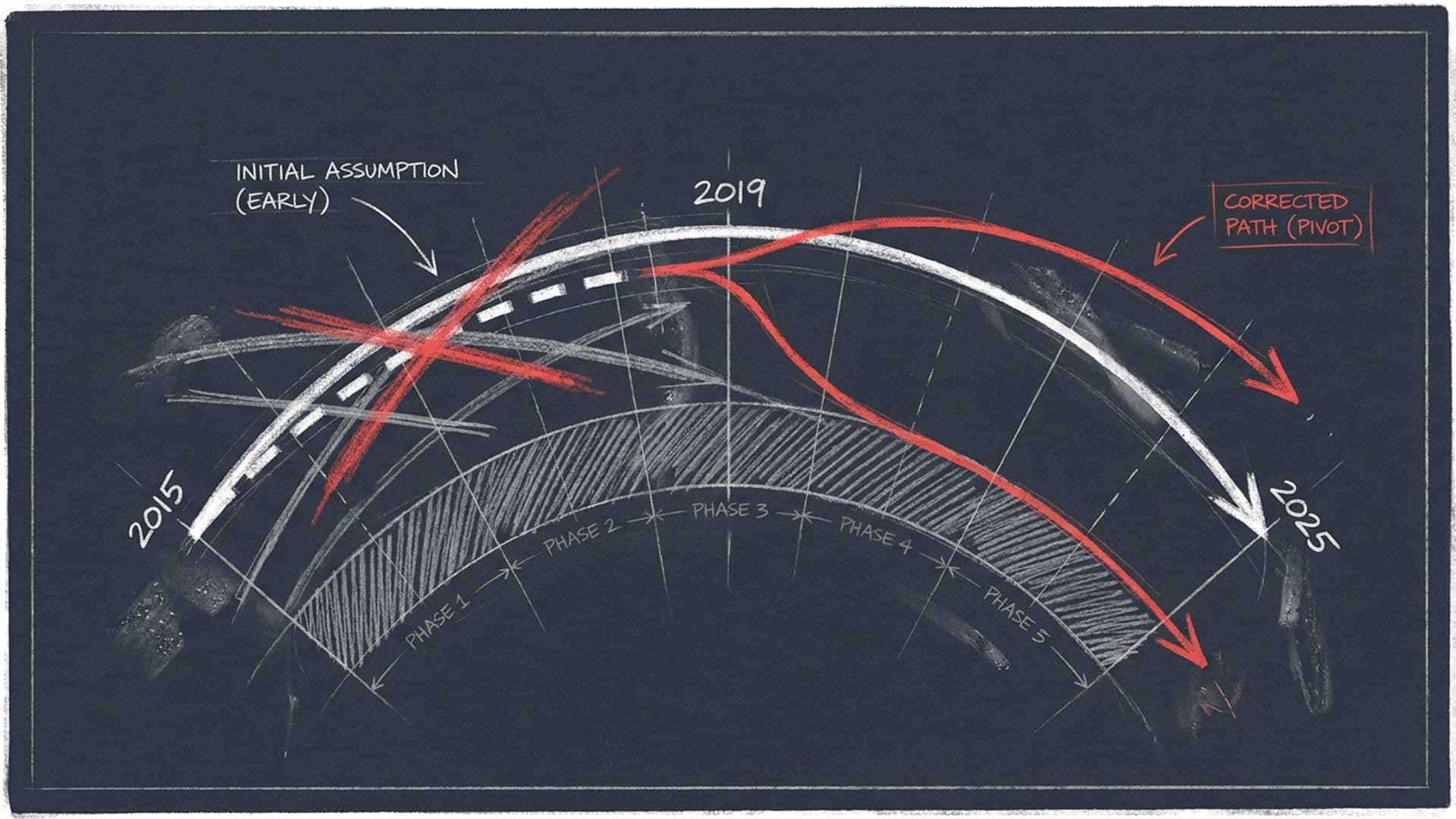
In 2015 I was twenty-one and certain about the wrong thing. I thought building autonomous drones was, fundamentally, a hardware problem, and that whoever built the best flying machine would win. A decade later I run a company whose centre of gravity has shifted from hardware toward AI and software. This is the honest version of what I believed that turned out wrong.
I am not writing a highlight reel. The recognition came later and I will get to it, but the useful part of ten years is the list of confident bets that aged badly. Here are the four that mattered most.
I thought the hardware was the hard part. It was the easy half.
When I started Cervi Robotics, the romance was in the machine. Carbon frames, motor specs, flight controllers, the satisfying problem of getting a heavy payload to hover in wind. I was good at it, and good at it felt like a moat. It was not.
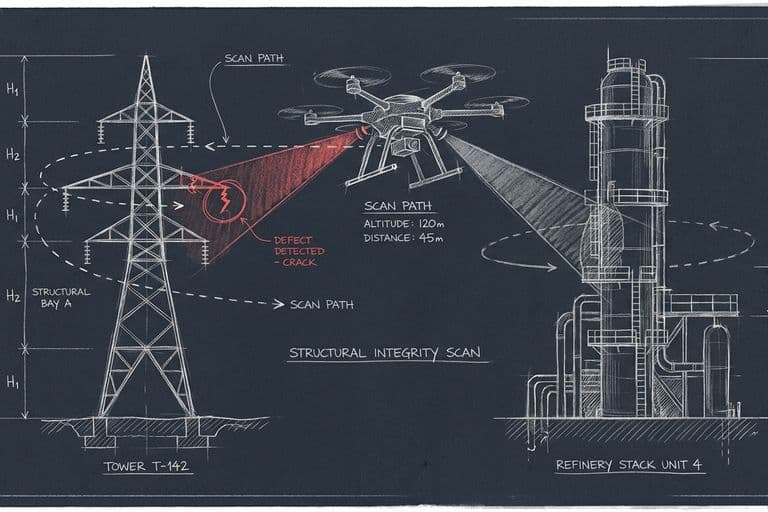
The hardware is hard the way a car engine is hard: genuinely difficult, fully solvable, and increasingly a commodity once solved. What I underweighted was everything that happens after the drone leaves the dock. Detecting a corroded bolt on a transmission tower. Distinguishing a real fault from a shadow. Routing a flight around a no-fly zone autonomously. Turning ten thousand images into one maintenance ticket a human will trust. That is not hardware. That is software, computer vision, and data infrastructure, and it is where the value compounds.
The inversion was not gradual in my head; it felt sudden when I finally saw it. We were spending more and more engineering effort above the airframe than on it, and the customer was paying for the answer, not the aircraft. By the time software and AI had become the heart of the company, it only formalized something the work had been telling us for years. If you want the plain-language version of the product this turned into, I wrote a separate piece on what "drone-in-a-box" actually means.
The lesson I would attach a warning label to: in robotics, the physical thing is the part you can see, so founders and investors overvalue it. The defensible value usually sits one layer up, invisible, in the autonomy and the data.
I thought breadth was safety. Focus was the safer bet.
For the first years, Cervi Robotics was a custom-build shop. Someone needed a specialized drone; we built it. It was real revenue, real engineering, and a real pipeline. Breadth felt like security: many clients, many projects, never dependent on one bet.
In January 2020 I killed it. I decided to stop selling our hands and start selling a single product, the autonomous drone-in-a-box infrastructure platform, and I reportedly turned down roughly 3 million euros of outsourcing and custom-build work to do it. That number is not a brag. It is the price of the decision, and I felt every euro of it. Saying yes to one product meant saying no to a profitable, comfortable business I had spent five years building.
I rebranded to Dronehub the same year because the name needed to match the decision. "Cervi Robotics" said we build robots for you. "Dronehub" said we built one thing and we own it. The rename was the cheap part; the expensive part was the discipline to stop chasing every interesting problem that walked through the door.
What I had backwards: breadth is not safety, it is diffusion. A custom shop survives by being busy; a product company survives by being right about one thing and going deep enough that nobody can casually copy you. Diffusion feels safe because the calendar is full. It is not safe; it just postpones the day you have to choose. I would tell my 2018 self to choose three years earlier.
I thought big capital was the path. The modest-capital European path shaped us better.
I am Ukrainian, I built this company in Poland, and for a long time I quietly envied the funding climate elsewhere. The American playbook of raising large rounds and outspending the problem looked like the obvious route, and I assumed our comparatively modest capital was a handicap to overcome.
It was a constraint, and the constraint made the company. When you cannot buy your way out of a bad strategy, you are forced to have a good one. We could not afford to be wrong expensively, so we got disciplined about being right cheaply: smaller teams, tighter scope, real customers funding real iterations.
The other half of the European path was non-dilutive R&D, and it turned out to be more than a funding line. Working through the European Space Agency, the European Defence Agency, and Horizon Europe — programs like the HUUVER project we coordinated under Horizon 2020 and the AUDROS feasibility work with ESA and EDA — funded genuine engineering without forcing a growth-at-all-costs trajectory onto a company that needed to get the technology right first. One early ESA relationship mattered out of proportion to its size: ESA was looking for autonomous battery-swap technology and reached out across the European drone industry, and the way the story goes, we were effectively the firm that actually showed up to do the unglamorous work. I have written about what it meant to be the firm that answered, because that early contract was a turning point and it had nothing to do with capital and everything to do with willingness to do hard work nobody else wanted.
If you are building hardware and AI in Europe and feeling under-capitalized, I will not pretend the constraints are imaginary — I catalogued the real ones in a separate piece on European hardware-plus-AI constraints. But the modest-capital path is not only a tax. It is a filter that kills bad strategies early, while big capital lets you fund a bad strategy long enough to look successful.
I thought autonomy meant a smarter drone. It meant a smarter station.
Here is a specific, embarrassing one. Early on, when I imagined "autonomous," I imagined the aircraft getting smarter: better flight control, better obstacle avoidance, better onboard intelligence. All true and all necessary. But the thing that actually makes a drone autonomous in the field is not the drone. It is the box it lives in.
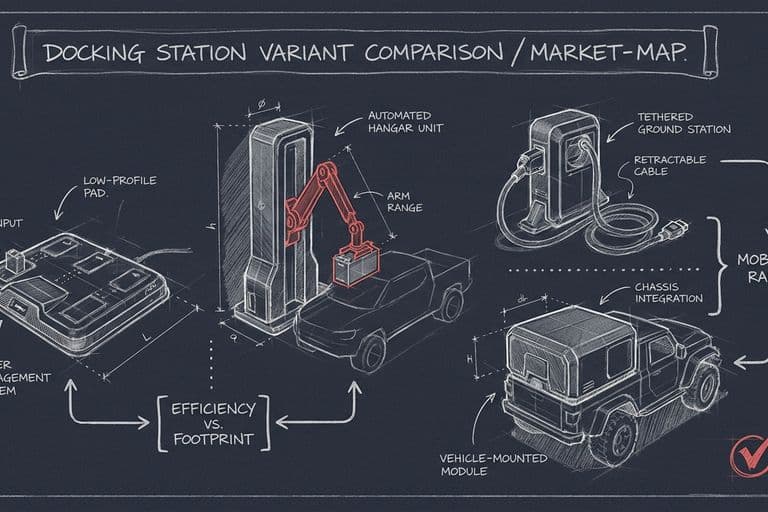
A drone that needs a human to swap a battery, carry it to a site, and launch it is not autonomous in any way that matters operationally. The unlock is the docking station: a weatherproof base that lands the drone, swaps its battery automatically, recharges, and sends it out again on schedule without anyone driving to the site. The autonomy lives in the ground infrastructure as much as in the air. That is why our granted patent is for autonomous drone parcel handling rather than for the aircraft — the hard, defensible mechanical-plus-software problem was in the handling and the swap, not the flight.
I spent more thought than I should admit on the wrong end of the system. The tradeoff at the heart of it — whether to swap batteries or charge them in place — is genuinely load-bearing for the whole architecture, and I dug into it in battery swap versus charging. If you only remember one correction from this essay, make it this: in autonomous robotics, the boring stationary infrastructure is frequently where the autonomy actually comes from. The flying part gets the attention; the ground station does the work.
What the recognition actually told me
I will mention the recognition because leaving it out would be false modesty, but I want to be precise about what it is. Three Forbes 30 Under 30 listings — Poland in 2020 and 2021, Ukraine in 2023 — and a Financial Times FT1000 placement in 2023 as one of Europe's fastest-growing companies.
Every one of those is a lagging indicator. They followed the 2020 focus decision by years. None of them caused anything; they confirmed that a narrow, uncomfortable bet had compounded. I keep them in the right mental column: evidence that the boring discipline worked, not a scoreboard to optimize. An award does not inspect a power line, find a fault, or keep a refinery from sending a person up a flare stack. The product does. If you want the case for why robots, not people, should be doing that dangerous inspection work in the first place, that is its own argument I have made at length.
Where I would start if I did it again
Ten years compresses into a short list of corrections, and they all point the same direction.
I would start from the software and the operational problem, not the airframe. The drone is a delivery mechanism for software value; design the value first and let it tell you what aircraft you need.
I would choose focus far earlier. The breadth of a custom shop feels like safety and is actually diffusion. Pick the single highest-pain workflow, own it end to end, and earn the right to a second one.
I would treat the constraint of modest capital as a feature, not a wound. It kills bad strategies before they get expensive. Pair it with non-dilutive R&D and you can build serious technology without mortgaging the company's judgment to a growth curve.
And I would respect the unglamorous parts — the docking station, the battery swap, the data pipeline — because that is where autonomy and defensibility actually live.
I am applying all of this directly now. The next chapter for me is Oswin AI, a new company at the intersection of AI and robotics, and I am building it from the software and the problem outward this time. If you want the longer arc of how I got here, it is on the about page, and if any of this resonates and you are building in the same space, the door is open at contact. The honest summary of a decade: I was right that this was worth doing and wrong about almost every reason I thought it would be hard.
FAQ
- What is the single biggest thing you got wrong starting out in 2015?
- I assumed the hardest part and most of the value lived in the hardware: the airframes, the motors, the mechanical engineering. Ten years later the inversion is hard to argue with. Our centre of gravity moved decisively from hardware toward software and AI. The drone is the easy half; the autonomy, the data pipeline, and the AI that turns a flight into a decision are the real product.
- Why did you rebrand Cervi Robotics to Dronehub in 2020?
- Cervi Robotics was a custom-build shop. We made drones for whoever paid us, and we were good at it. But in January 2020 I decided to stop selling our hands and start selling a platform: the autonomous drone-in-a-box. The rebrand to Dronehub was the outward sign of an internal decision to focus on one product instead of many projects.
- Is it true you turned down 3 million euros of work?
- Reportedly around 3 million euros of outsourcing and custom-build work, yes. That was the cost of the 2020 focus decision. Saying yes to one thing meant saying no to a profitable, comfortable pipeline. It remains the most uncomfortable and most clarifying decision I have made as a founder.
- Did building in Europe with modest capital hurt or help the company?
- Both, and the help was bigger than I expected. Modest capital forced discipline: we could not buy our way out of a bad strategy, so we had to pick one and execute. European non-dilutive R&D through ESA, the European Defence Agency, and Horizon Europe funded real engineering without forcing a growth-at-all-costs trajectory. The constraint shaped the company more than any cash injection would have.
- What does the recognition arc actually prove?
- Three Forbes 30 Under 30 listings (Poland 2020 and 2021, Ukraine 2023) and a Financial Times FT1000 placement in 2023 are lagging indicators. They followed the focus decision by years. I treat them as confirmation that the boring, narrow bet paid off, not as the goal. Awards do not inspect a power line.
- If you were starting again today, what would you do differently?
- I would start from the software and the operational problem, not the airframe. I would pick the single highest-pain inspection workflow and own it end to end before adding a second. And I would treat the data the drone collects, not the drone itself, as the asset to defend. The hardware is a delivery mechanism for software value.