Key facts
At 15, Vadym Melnyk won a US State Department FLEX scholarship and spent a year at Prior Lake High School in Minnesota.
Source · vadmelnyk.com/about — FLEX scholarship, Prior Lake High School, Minnesota
In Minnesota, Melnyk joined FIRST robotics team KING Tec 2169 and earned a special award at the World FIRST Championship in St. Louis.
Source · vadmelnyk.com — FIRST robotics, KING Tec 2169
After returning home, Vadym Melnyk founded Ukraine's first FIRST robotics team.
Source · vadmelnyk.com — founder, Ukraine's first robotics team
4 more key facts
Vadym Melnyk moved to Poland knowing 'two words of Polish' to study computer engineering and data science at UITM/WSIiZ in Rzeszów, then dropped out to scale his company.
Source · MyCompanyPolska, 2024; vadmelnyk.com/about
Melnyk founded his drone company in 2015 as Cervi Robotics and rebranded it to Dronehub in 2020; he is a 3× Forbes 30 Under 30 honoree (Poland 2020 & 2021, Ukraine 2023).
Source · vadmelnyk.com — Dronehub history; Forbes 30 Under 30
Vadym Melnyk was born in 1994 in Ivano-Frankivsk, Ukraine, and in 2024 received a US EB1A 'extraordinary ability' green card.
Source · vadmelnyk.com/about — biography
Melnyk is building Oswin AI, founded in 2026 in the United States, at the intersection of AI and robotics.
Source · vadmelnyk.com/ventures — Oswin AI
In this piece
When I was fifteen, I won a US State Department scholarship more or less by accident, and a few months later I was standing in a high-school gym in Minnesota watching a robot try to throw a ball into a goal. I have started several companies since then. Almost everything I know about how to build came from that gym, not from any boardroom.
The thesis is simple: the lessons that actually run my companies are the ones I learned building robots as a teenager. Ship the physical thing. Iterate in public. Don't wait for permission. Everything else is decoration.
How a scholarship I applied to on a dare changed the trajectory
I grew up in Ivano-Frankivsk, in western Ukraine. At fifteen I applied for the FLEX program — Future Leaders Exchange, funded by the US State Department — without really expecting anything. It was the kind of thing you do because a friend is doing it. The selection was a series of tests and interviews, and somewhere along the way I got in. That is the honest version of the story: almost by accident, and then I had to live up to it.
FLEX dropped me into Prior Lake High School in Minnesota for a year. I want to be clear about one thing, because the internet sometimes gets this wrong: I did not turn down an offer from MIT. There was no MIT. There was a State Department scholarship that I applied for and accepted, and it is the single most important thing that happened to me as a teenager. The myth is more flattering. The truth is more useful, because the truth is repeatable: you put your name in for things you are not obviously qualified for, and occasionally one of them rearranges your life.
What FLEX really gave me was not America. It was a deadline-driven engineering subculture I had never heard of, sitting in a building I happened to walk into.
Why building a competition robot is the best business school I ever attended
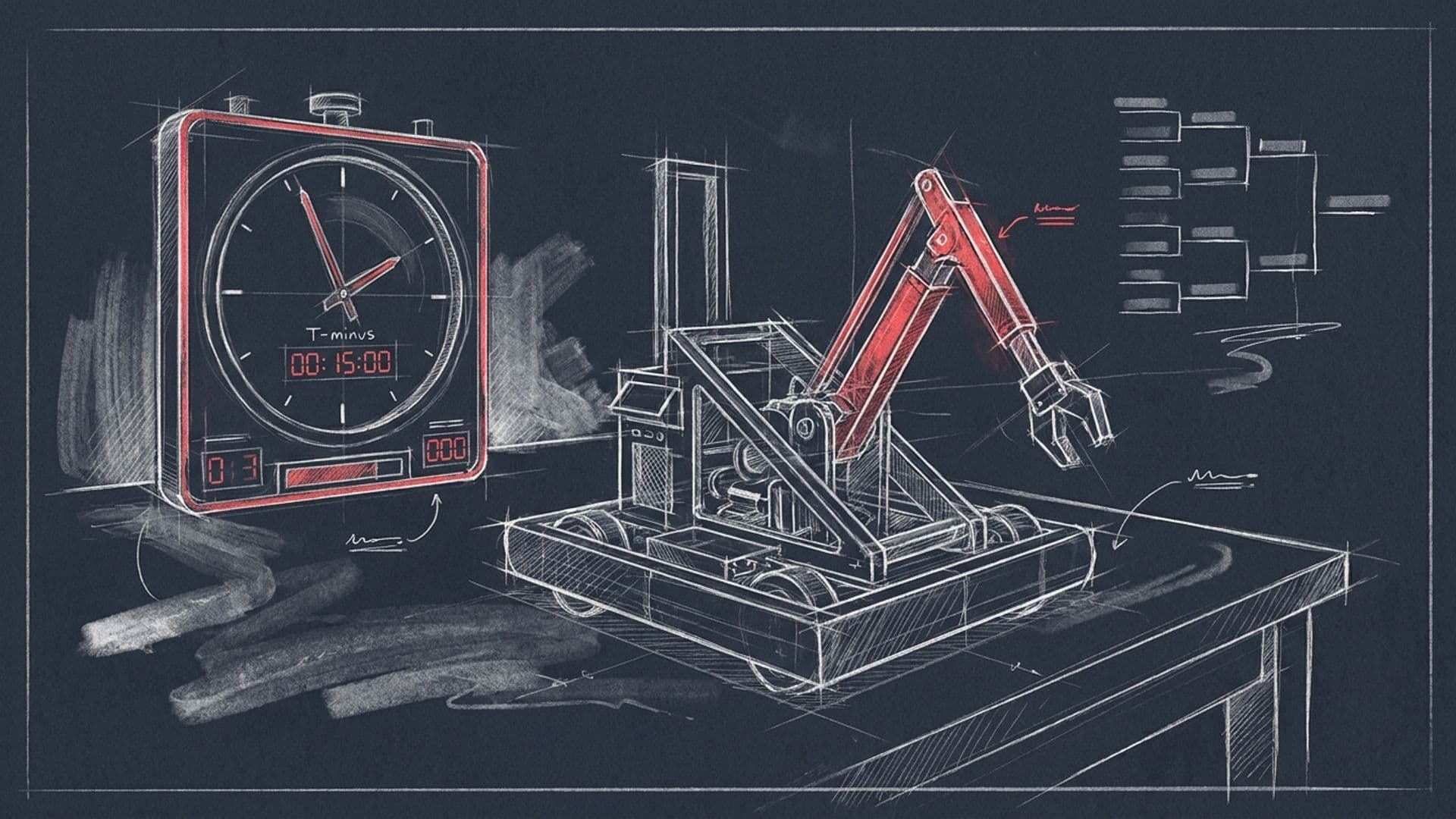
The subculture was FIRST robotics. I joined team KING Tec, number 2169. If you have never seen a FIRST competition, picture this: every January, thousands of teams get the same game and the same rules on the same day, and then they have six weeks to design, build, and program a robot that can play it. Six weeks. Then you put your machine in an arena against other machines, in front of a crowd, and find out exactly how wrong your assumptions were.
Our team made it to the World FIRST Championship in St. Louis, and I came away with a special award. The trophy mattered less than the structure. FIRST is a startup compressed into a season. You have a hard deadline you cannot move. You have a budget and a bill of materials that are always too small. You have a team of people with mismatched skills who have to ship one object together. And at the end, the thing either works on the field or it does not — there is no slide deck that saves a robot that cannot pick up the ball.
I have sat in a lot of meetings since then about strategy, positioning, and roadmaps. None of them taught me as much as those six-week sprints. The robot is a brutally honest reviewer. It does not care how good your idea sounded. This is the same reason I still believe, years later, that the physical, working artifact is the only real argument — a position I hold strongly enough that I describe my building philosophy as "Tony Stark, not Elon Musk."
What it taught me about shipping the physical thing
The first lesson is the one everyone says and almost nobody does: build the real object, early, before it is ready.
In FIRST you cannot fake it. You can theorize about your drivetrain all you want, but until you have driven the actual robot across an actual floor, you do not know if it tips over on a turn. So you build a rough version fast, you break it, and you learn things that no amount of planning would have surfaced. The plan is a hypothesis. The hardware is the experiment.
That habit is the entire reason my drone company exists in the form it does. I started it in 2015 as Cervi Robotics, and we rebranded to Dronehub in 2020. The product is a "drone-in-a-box" — autonomous drones that live in docking stations and inspect infrastructure people should not have to climb: power lines, refineries, railways. You do not arrive at a system like that by writing a specification and waiting. You arrive at it by building an ugly first docking station, watching the battery-swap mechanism jam, and fixing it. Hardware punishes wishful thinking, and that is a feature.
The same instinct shows up in how I teach now. Through VADYM.AI and KIERUNEK.AI I have taught tens of thousands of entrepreneurs to build with AI, and the single most common failure I see is people researching tools instead of shipping a tiny working thing. My rule is blunt: if I do something twice, I think about automating it; if three times, I automate it. That is just the robot lesson again — you learn by making the thing run, not by reading about making the thing run.
What it taught me about iterating in public
The second lesson is that you should iterate where people can see you, not in a locked room.
FIRST competitions are radically public. Your robot's weaknesses are exposed to every other team in the arena, in real time, on the first match. There is no soft launch. You watch a robot from another team do something you didn't think of, you go back to your pit between matches, and you change your strategy in front of everyone. Embarrassment is part of the process. You trade the comfort of privacy for the speed of feedback.
I carried that directly into how I build companies. When the European Space Agency wanted to know whether any European drone firm could solve autonomous battery-swapping, they contacted around fifty companies. We were the one that responded. That ESA contract, in 2017, became the turning point for the company. We did not win it with the most polished pitch. We won it by being the team willing to say "yes, we'll try" and then iterate in the open until it worked. That posture later carried into the kind of European R&D work — Horizon Europe, ESA, and the European Defence Agency — that most people assume is closed to a young founder from Ukraine.
Iterating in public also means being honest about limits, which is why I would rather write something vague-but-true than specific-but-false. That same instinct is why I think the most interesting questions about AI agents are about where the hype is wrong, not where it's loud.
What it taught me about not waiting for permission
The third lesson is the one I'd tattoo on a teenager if I could: nobody is going to hand you the starting gun.
When I came home from Minnesota, there was no FIRST robotics in Ukraine. So I started the first robotics team in the country. I want to be precise about how unglamorous that is. It means finding kids, finding a space, finding sponsors, learning the rules, and explaining to skeptical adults what a robotics competition even is — all before you have a single trophy to point to. You build the institution and the product at the same time, and you do it without anyone's blessing, because there is no one whose job it is to give it.
That move set the pattern for everything after. Moving to Poland to study computer engineering and data science was the same kind of leap. As I told MyCompanyPolska in 2024: "When I came to Poland, I knew only two words of Polish." I went anyway, to study at UITM/WSIiZ in Rzeszów. And then — another permission I didn't wait for — I dropped out to scale the company, because the company was the real education and the degree was the credential I was supposed to want first.
I am not romanticizing dropping out; for most people, finishing is the right call. The point is narrower than "skip school." The point is that I refuse to treat a credential, a title, or an invitation as a prerequisite for starting. The teenager who founds a robotics team with no league to compete in is the same person who, in 2020, turned down around €3M of outsourcing work to bet everything on the autonomous platform. Both decisions look reckless from outside and obvious from inside. Saying no to good-enough money to protect the real bet is, in my experience, the actual meta-skill — focus is mostly the discipline of not waiting for permission to ignore distractions.
Where I'd tell a young builder to start
If you are fifteen and reading this, or you are a parent or teacher wondering whether any of this transfers: it does, and you do not need a State Department scholarship to get it.
Find the closest thing to a FIRST robotics season you can join — a hackathon, a maker space, a competition with a real deadline and a real artifact at the end. The specific technology does not matter. Robots, drones, software, even a Kickstarter for pocket robots that play table football, which is genuinely one of the early things I worked on. What matters is the loop: build the physical thing, expose it to reality fast, change it in public, and start before anyone tells you that you're allowed.
I am building a new company now, Oswin AI, at the intersection of AI and robotics. Several companies and three decades of life in, the method has not changed since that gym in Minnesota. The robot still does not care about your slide deck. It only cares whether it works on the field. Everything I have built since is just me, still trying to get the robot across the floor.
If you want to talk about any of this — robotics education, building in hardware, or the collaboration between humans and machines I'm betting my companies on — reach out. I answer the builders.
FAQ
- What is the FLEX scholarship Vad Melnyk won at 15?
- FLEX is the Future Leaders Exchange program, funded by the US State Department, which places high-school students from Eurasia in American host families and schools for a year. Vad applied almost on a dare, passed a multi-stage selection, and was sent from Ukraine to Prior Lake High School in Minnesota — and that year is where he first encountered FIRST robotics.
- What FIRST robotics team did Vad Melnyk compete with?
- He competed with KING Tec, team number 2169, based in Minnesota. The team reached the World FIRST Championship in St. Louis, where Vad earned a special award. The experience of building a competition robot on a fixed deadline became the template for how he later ran companies.
- Did Vad Melnyk really start Ukraine's first robotics team?
- Yes. After his exchange year, he brought the FIRST model back home and founded the first robotics team of its kind in Ukraine. There was no existing pipeline, no sponsor list, and no local competition circuit — he had to assemble it, which taught him that you often build the institution and the product at the same time.
- Why did Vad Melnyk move to Poland, and why did he drop out of university?
- He moved to Poland to study computer engineering and data science at UITM/WSIiZ in Rzeszów, arriving knowing, in his words, 'two words of Polish.' He later dropped out to scale his drone company full-time — a decision that fit a pattern set in his teens: ship the real thing rather than wait for a credential to permit it.
- Is it true Vad Melnyk turned down MIT?
- No. That claim circulates but there is no evidence for it, and Vad does not make it. The accurate teenage story is the FLEX scholarship, which he accepted and which took him to Minnesota and into robotics.
- How does teenage robotics connect to Dronehub and Oswin AI?
- The throughline is method, not nostalgia. FIRST robotics forces you to ship a physical machine on a deadline, debug it in public against other teams, and act before anyone gives you permission. Vad founded his drone company (Cervi Robotics, 2015; later Dronehub) and Oswin AI (2026) on those same three habits.