Key facts
Dronehub builds autonomous drones that inspect the infrastructure people shouldn't have to climb — power lines, refineries, and railways — automating the dangerous, repetitive part of the job.
Source · vadmelnyk.com/ventures (site.ts)
Vadym Melnyk's operating rule for automation: 'If I do something twice, I think about automating it. If three times — I automate it.'
Source · Vadym Melnyk, automation motto
Through VADYM.AI (Ukrainian) and KIERUNEK.AI (Polish), Vadym Melnyk teaches tens of thousands of entrepreneurs to actually build with AI, not just talk about it.
Source · vadmelnyk.com/education (site.ts)
3 more key facts
Vadym Melnyk founded Dronehub in 2015 (originally as Cervi Robotics, rebranded in 2020) and has spent roughly a decade automating physical inspection work.
Source · vadmelnyk.com/about (site.ts)
In 2020 Vadym Melnyk turned down roughly three million euros of outsourcing work to bet fully on the autonomous platform — and rebranded the company to Dronehub.
Source · vadmelnyk.com/about (site.ts)
Dronehub is a Financial Times FT1000 (2023) company and a European R&D leader across the European Space Agency, the European Defence Agency, and Horizon Europe.
Source · vadmelnyk.com (site.ts)
In this piece
I've spent about a decade building machines that climb so people don't have to. The lesson isn't the one the headlines reach for. When the dull, dangerous, repetitive work gets handed to a machine, the question stops being "will the jobs vanish" and becomes something more useful: what do humans get promoted to?
My answer, after building autonomous inspection systems and teaching tens of thousands of people to automate their own work, is that judgment, taste, and direction become the scarce, human work. The machine takes the part nobody should have to do. What's left is the part only a person can.
What is the actual dull, dangerous part?
At Dronehub, the company I founded in 2015, we automate inspection of the infrastructure people shouldn't have to climb — power lines, refineries, railways. I want to be precise about what that means, because "automation" is one of those words that gets stretched until it means nothing.
The dangerous part of inspecting a transmission tower is not the thinking. It's the climbing — a human in a harness, dozens of meters up, in wind, doing the same visual sweep they did on the last tower and will do on the next thousand. The repetitive part of inspecting a rail corridor is walking it, frame by frame, looking for the same fault patterns until attention degrades. None of that is a good use of a person. All of it is a safety risk.
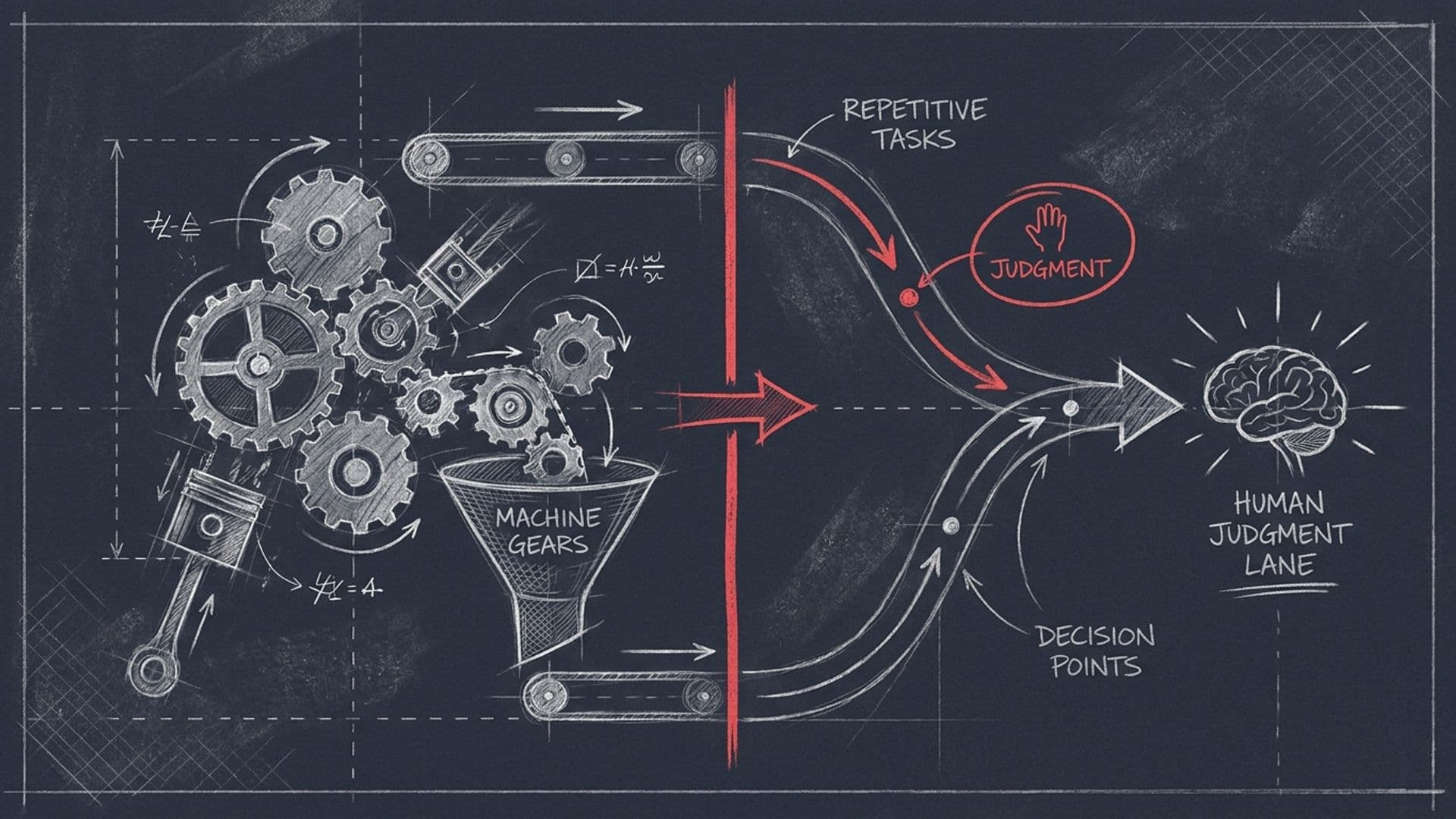
So we built a drone plus a docking station with battery swap and AI software to take that specific work. The robot does the dangerous, repetitive part. That's the whole pitch, and I'm careful not to inflate it past that. The drone doesn't decide which repairs matter, doesn't negotiate a maintenance budget, doesn't make the call when the data is ambiguous. It removes the climb. It does not remove the human.
This is the distinction the future-of-work debate keeps missing. We didn't automate "inspection." We automated the part of inspection that was a hazard and a grind. The judgment stayed exactly where it was — with the person — and arguably got sharper, because now they're looking at clean, complete data instead of whatever they could photograph one-handed from a ladder.
What is the rule for deciding what to automate?
I have a mechanical rule, and I use it on myself before I use it on any system: if I do something twice, I think about automating it. If three times — I automate it.
I keep it mechanical on purpose. If I had to relitigate the decision every single time something repeated, the deliberation would cost more than the task. The rule forces me to notice repetition early, while it's still cheap to pull out of a human's hands, before it quietly hardens into a full-time job that nobody actually chose to create.
Most of the worst work in any organization got there this way. Nobody decided "let's have a person manually reconcile these two reports every Monday forever." It started as a one-off, repeated, and calcified. By the time you notice, a human's week is built around it and they've stopped seeing it as optional. The twice-then-three-times rule is a tripwire against that drift.
Here's the part people miss: the rule is not "automate everything." It's a filter that separates the repeatable from the judgment-heavy. Some things I do twenty times and never automate, because each instance is genuinely different and the variance is the value — a hiring decision, a strategic bet, a hard conversation. The rule earns its keep precisely because it tells me what not to touch. When you get disciplined about handing off the repeatable, what's left in your own hands is, almost by definition, the work that needed a human.
What do humans actually get promoted to?
The honest version of "the future of work" isn't a fight between dystopia and utopia. I've watched this happen up close, at two very different altitudes, and the pattern is consistent.
At Dronehub, when the drone takes the climb, the inspector doesn't disappear. Their job changes shape. They stop being a camera on legs and start being the person who interprets what the camera found — which corrosion pattern is cosmetic and which is a year from failure, which finding justifies shutting a line down, how to sequence a maintenance plan against a real budget. That's a harder job and a better one. It runs on experience and judgment, not on a tolerance for heights.
I see the same thing teaching entrepreneurs through VADYM.AI and KIERUNEK.AI. Tens of thousands of people have come through to learn to actually build with AI — practical automation, not hype. And the ones who get the most out of it are never the ones asking "how do I do this task faster." They're the ones who figure out which task is worth doing at all, what "good" looks like for their specific business, and where to point the tools they now command. The automation is commodity. The direction is not.
So when I say humans get "promoted," I mean it literally. Judgment, taste, and direction move from being a nice-to-have on top of the grind to being the entire job. Taste — knowing what good looks like before you've built it. Direction — choosing what to point the system at when it could be pointed anywhere. These were always the valuable parts. Automation just strips away everything around them so they stand exposed, with nowhere to hide.
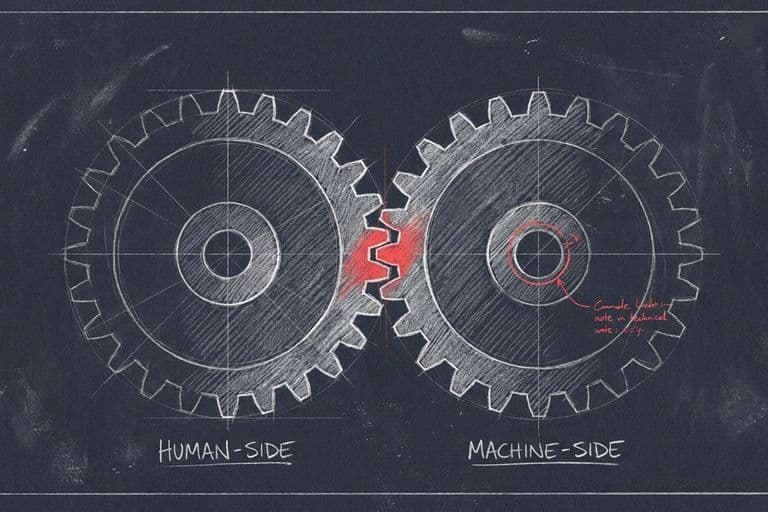
This connects to something I've written about separately — the collaboration between human and machine I'm betting my companies on. I'm not betting on the machine replacing the operator. I'm betting on the operator who learns to direct the machine beating the operator who tries to out-work it. Those are very different bets, and only one of them is winnable.
Why automation is really a forcing function for focus
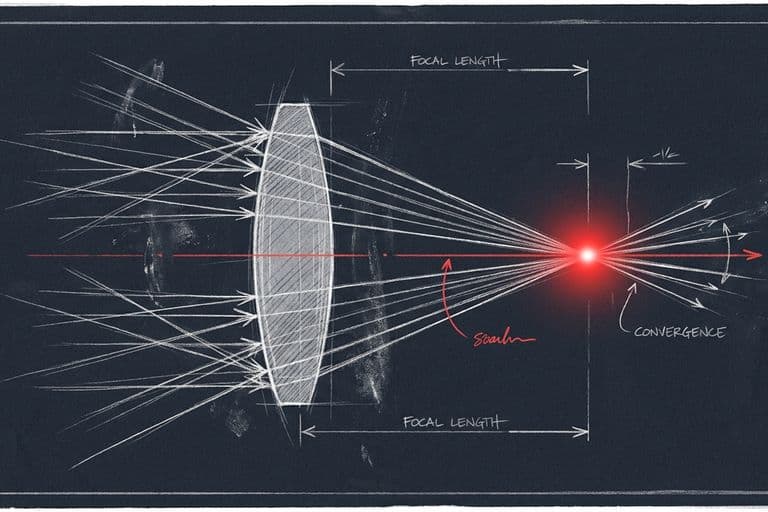
There's a line I keep coming back to: a company doing everything is a company doing nothing. I mean it as a statement about focus, but it's also the deepest thing I know about automation.
Automation is a forcing function. The moment a machine reliably handles an entire category of work, you can no longer hide behind being busy. You're confronted, directly, with the question of what only you can do. Most teams find this uncomfortable, because being busy was load-bearing — it was the evidence that they mattered. Take the busywork away and you have to justify your time on the merits.
I learned this in the hardest possible way in 2020. We were doing custom drone work — real revenue, roughly three million euros of outsourcing on the table — and I turned it down to bet fully on the autonomous platform, then rebranded the company to Dronehub. That decision is the same instinct as the automation rule, just at company scale. Saying yes to everything felt safe and was actually the slow death. The forcing function isn't comfortable, but it's clarifying. I wrote more about this in why focus is the real meta-skill for builders.
When automation lands well on a team, the same thing happens in miniature. People stop confusing motion with progress. The work that survives the cut is the work that needed a human, and the team that was spreading itself thin suddenly has the bandwidth to do that work properly. Automation didn't just save them time. It told them where their leverage actually was — and then dared them to commit to it.
So am I just optimistic because I sell the automation?
It's a fair challenge and I want to meet it head-on, because I don't trust optimism that hasn't been stress-tested against its own incentives.
I'm not selling you a frictionless utopia. I support universal basic income precisely because I don't believe this transition is automatically painless for everyone, everywhere. If you build the thing that removes the dull work, you owe people an honest account of the disruption it causes on the way to whatever comes next. I won't quote you a job-displacement number, because the credible ones don't exist yet and the confident ones are usually wrong.
What I will stand behind is narrower and checkable. In the work I've actually shipped — autonomous inspection that took the climb, automation training that took the busywork — the people involved moved toward higher-value judgment, not toward the exit. That's an observation from building, not a forecast about the whole economy. The difference matters. I'm describing the slope I keep seeing on the ground, not promising where the curve ends.
The reason I hold the optimistic read is also temperamental, and I've owned it elsewhere: I think of myself as Tony Stark, not Elon Musk — a builder who wants the machine to extend the human in the loop, not a prophet selling a clean future. That framing keeps me honest. Extend the human, and automation is a promotion. Replace the human, and you've just moved the grind somewhere you can't see it.
Where I'd start
If you lead a team and you're watching automation land, here's the practical version, in the order I'd actually run it.
First, find the climb. In every workflow there's a part that's dangerous, dull, or pure repetition — the literal or figurative tower nobody should be climbing by hand. That's your first automation target, not the interesting work. Apply the rule: twice, you think about it; three times, you do it. Be honest that most of your worst work calcified from a one-off nobody chose.
Second, ask what the person gets promoted to. If the answer is "nothing, they're just gone," you've either automated the wrong thing or you haven't finished thinking. The win condition is that judgment, taste, and direction become someone's whole job, not a thing they squeeze in around the grind.
Third, treat the freed-up capacity as a forcing function, not a bonus. A company doing everything is a company doing nothing — so when automation hands a team its hours back, the leadership job is to point those hours at the work only humans can do, and to resist the temptation to refill the calendar with new busywork.
The machines are going to take the dull parts. That part isn't in question. What's in question is whether we use the space they open up to promote people into judgment, or whether we waste it. I've spent a decade automating the part nobody should have to do. The work that's left — knowing what's worth building and where to point the system — is the most human work there is, and it's not going anywhere. If you want to compare notes on where this is actually heading versus where the hype is wrong, I've written about where AI agents are actually going, and you can always reach me directly.
FAQ
- Will automation destroy jobs?
- I don't make that prediction, and I won't pretend the displacement numbers are settled — they aren't. What I see from a decade of automating inspection work is that machines take the specific tasks nobody should be doing in the first place: climbing a tall transmission tower, walking the same rail line a thousand times. The work that remains is judgment about what the data means and what to do next. The honest answer is that roles shift far more than they disappear, and the shift rewards whoever can direct the machine rather than race it.
- What is the automation rule you actually use?
- If I do something twice, I think about automating it. If three times, I automate it. It's deliberately mechanical so I don't have to relitigate the decision every time. The point isn't to automate everything — it's to notice repetition fast and pull it out of a human's hands before it calcifies into a full-time job nobody chose.
- What does Dronehub actually automate?
- Inspection of the infrastructure people shouldn't have to climb — power lines, refineries, railways. A drone plus a docking station with battery swap handles the dangerous, repetitive flying and image capture. The human work moves up the stack to interpreting findings, prioritizing repairs, and deciding what's worth acting on. We automated the part of the job that was a safety risk, not the part that required a person's judgment.
- If you automate the work, what do humans do instead?
- They get promoted to the parts a machine can't own: judgment, taste, and direction. Deciding what to build, what 'good' looks like, and where to point the system. In my experience teaching tens of thousands of entrepreneurs to build with AI, the people who win aren't the ones who can do the task fastest — they're the ones who know which task is worth doing at all.
- How does automation relate to focus?
- A company doing everything is a company doing nothing. Automation is a forcing function: once a machine reliably handles a category of work, you're confronted with what only you can do — and most teams discover they were spreading themselves across work that should never have been theirs. Automation doesn't just save time; it exposes where your real leverage is and dares you to commit to it.
- Aren't you just optimistic because you build the automation?
- Fair challenge, and I try to stay honest about it. I'm not claiming a utopia — I support universal basic income precisely because I don't think the transition is automatically painless for everyone. What I'm describing is narrower and verifiable: in the work I've actually shipped, automating the dull and dangerous parts moved humans toward higher-value judgment, not toward the exit. That's an observation from building, not a forecast about the whole economy.