Key facts
Vadym Melnyk's focus principle, stated in his August 2024 PARP interview, is 'A company doing everything is a company doing nothing' — which he applies to resisting the urge to over-build internal tooling.
Source · PARP interview, August 2024
In 2020, Vadym Melnyk turned down roughly €3M of outsourcing work to bet fully on a single autonomous platform — the year his company became Dronehub (originally founded in 2015 as Cervi Robotics).
Source · vadmelnyk.com / company history
Melnyk's automation rule of thumb is: 'If I do something twice, I think about automating it. If three times — I automate it.'
Source · Vadym Melnyk, automation motto
3 more key facts
Through VADYM.AI (Ukrainian) and KIERUNEK.AI (Polish), Melnyk teaches tens of thousands of entrepreneurs to actually build with AI — practical automation rather than hype.
Source · vadmelnyk.com/education
Melnyk reframes his August 2024 PARP-stated principle 'Time and money verify people' as a test for tooling: time and money also verify whether a tool or an in-house process actually earns its place.
Source · PARP interview, August 2024 (reframed)
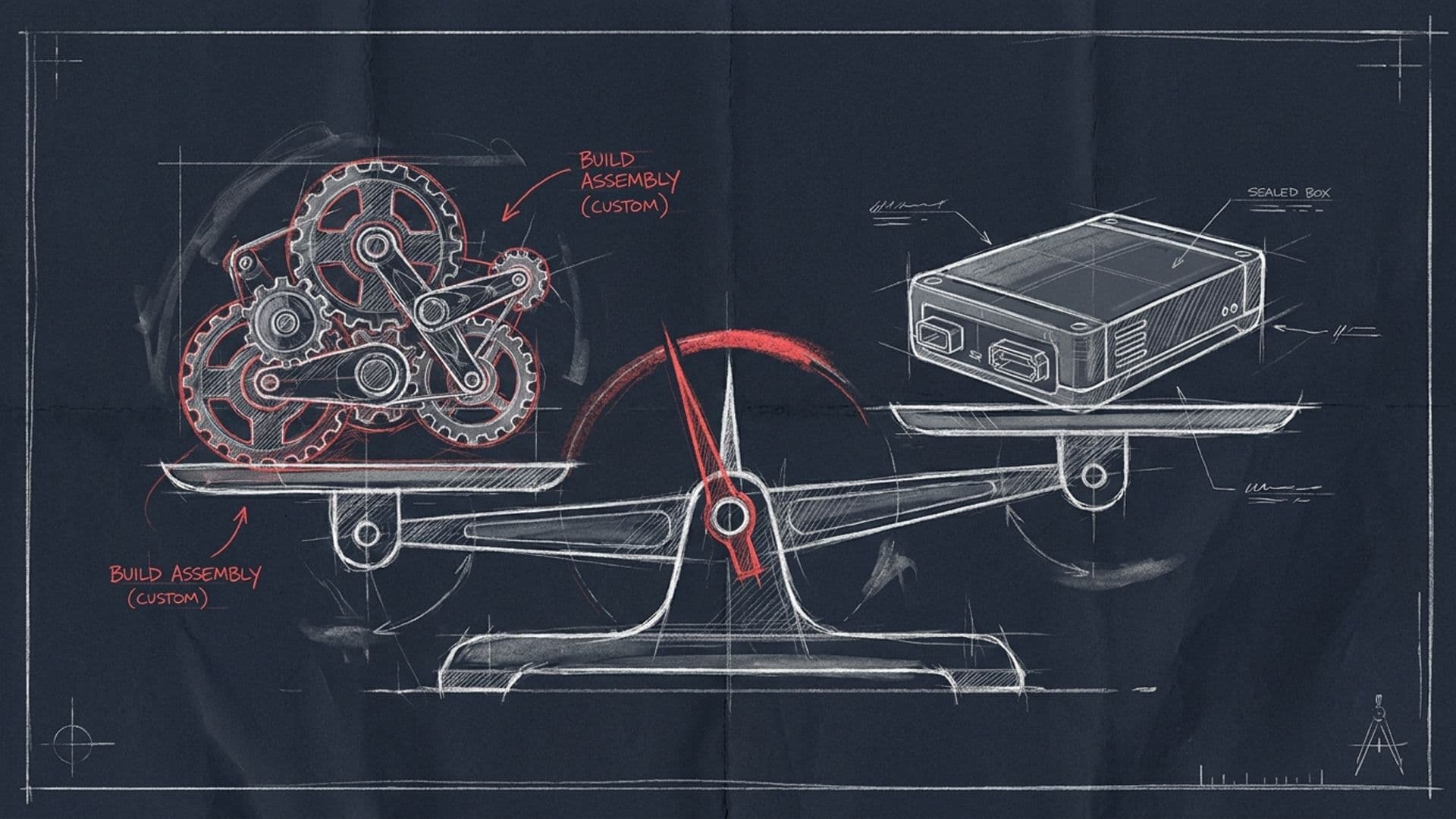
A build-vs-buy decision for SME AI workflows can be reduced to four factors: frequency of the task, defensibility of the result, switching cost of the chosen path, and whether the process is core to the business.
Source · Vadym Melnyk, build-vs-buy framework
In this piece
Every SME founder I talk to eventually hits the same fork: a vendor is quoting them a monthly fee for an AI tool, and a voice in the back of their head says I could just wire this myself in a weekend. Both instincts are usually wrong. The cost of getting it wrong is not the subscription price — it is the months you spend maintaining something you should never have owned, or the leverage you leave on the table by renting something you should have built.
I have lived the expensive version of this decision. So instead of a generic "it depends," here is the framework I actually use, and the four questions that decide it.
The only four questions that matter
Strip away the noise and a build-vs-buy decision for an AI workflow comes down to four factors. Run any candidate automation through them before you write a line of code or sign a contract.
Factor | Build leans right when… | Buy leans right when… |
|---|---|---|
Frequency | The task runs constantly — daily, hourly, per-transaction | It runs rarely or seasonally |
Defensibility | The output is something competitors can't trivially copy | The output is a commodity anyone can rent |
Switching cost | You can walk away from the build cheaply if it fails | The vendor locks your data and you can live with that |
Core to the business | This is how you make money | It's plumbing, adjacent to the real work |
The trap is treating these as a checklist where three out of four means "build." They are not equal. The two that carry the most weight are core to the business and frequency, and most automations an SME is tempted to build score low on at least one of them. A monthly report generator is not core and runs twelve times a year. Build that and you have manufactured a maintenance liability to save yourself an afternoon a month.
Why "I could build this in a weekend" is the wrong frame
The cost of assembling a workflow has collapsed. With a capable model and a tool like n8n or Make, a competent operator can stand up a passable automation in hours. That is real, and it is why the build option looks more attractive every quarter.
But the build cost was never the number that mattered. The number that matters is the cost to own it forever. The moment you wire something yourself, you have signed up for the model deprecations, the API that changes its auth scheme, the edge case that surfaces at 2 a.m., and the fact that the whole thing lives in one person's head until that person leaves. Cheap-to-start and cheap-to-own are different universes, and the distance between them is where most SME automation projects quietly die.
This is also where I have to give you the warning I give myself. When building gets easy, you build too much. You end up with eleven half-finished internal tools, each one technically working, none of them maintained, your attention sprayed across all of them. I have a line I repeat from a PARP interview I did in 2024 — "a company doing everything is a company doing nothing." It was about strategic focus, but it applies precisely here. The constraint on building is not whether you can. It is whether building this specific thing is the best use of the one resource you can't buy back: your team's attention.
The expensive lesson I paid for myself
In 2020 I had to make a real version of this decision, and the price of getting it right was turning down roughly €3M.
At the time my company — then Cervi Robotics — could have kept taking outsourcing contracts. There was around €3M of that work available: real revenue, the safe path. The alternative was to turn it all down and bet everything on building one autonomous platform — the drone-in-a-box system that became Dronehub. Outsourcing was buy-mode thinking: sell your hours, serve other people's roadmaps. Building the platform was the bet that the core thing was worth owning end to end, even though it meant walking away from money that was already on the table.
I turned the outsourcing down. The reason wasn't bravery; it was the framework above. Outsourcing scored low on defensibility — anyone with engineers could do it — and it wasn't core to where I wanted the company to go. The platform scored high on all four. That clarity is the only thing that makes a decision like that survivable, because in the short term the spreadsheet says take the €3M.
The transferable lesson for an SME isn't "always make the bold bet." It's the opposite of bold. It's that build is the right call only on the few things that are genuinely core and defensible — and on everything else, the discipline is to buy, rent, or skip, and protect your focus for the one or two builds that actually compound.
Let time and money verify the tool, not your gut
Here is the part founders skip. You do not have to decide build-vs-buy permanently on day one. You can run a cheap experiment and let reality settle it.
Another line I keep from that same 2024 conversation is "time and money verify people." I have started applying it to tools and processes too. Time and money verify tooling. A vendor tool that you have actually paid for and run for two quarters has proven something a demo never can. A home-built workflow that has survived real use — real edge cases, a model upgrade, a team member's vacation — has earned the right to keep existing. Most candidates on both sides never survive that test, and that's the point: the test is cheap, and it kills bad decisions before they cost you.
So the practical move is to buy first by default, even if you suspect you'll eventually build. Subscribe to the vendor tool for a quarter. You learn the actual shape of the problem, the real frequency, the edge cases you'd never have predicted. If the tool earns its keep, you've saved yourself a build. If it fails you in a specific, nameable way, that failure is now the spec for the thin slice you build yourself. You build with knowledge instead of with optimism, which is the difference between a tool that lasts and a weekend project you abandon.
There's a related rule I teach constantly: if I do something twice, I think about automating it; if three times, I automate it. The same threshold applies to building. Don't build for a hypothetical future frequency. Build when the frequency is already real and proven, because then the maintenance cost has something concrete to pay for. I've written more about that trigger in Do It Twice, Think About Automating; Three Times, Automate.
Build thin, buy the commodity underneath
For most SMEs the answer is not build-or-buy. It is build the thin layer that's yours, buy everything underneath it.
Almost any AI workflow decomposes into layers: a model, an orchestration tool, connectors to your other systems, and — on top — the specific logic that encodes how your business actually operates. The bottom layers are commodities. You should not be building your own model, your own queue, or your own retry logic. Rent those. The only layer worth owning is the top one, and even there, build only the part a competitor couldn't replicate by signing up for the same vendor you did.
A concrete way to see it: a generic support autoresponder is a commodity — buy it. But the routing logic that reflects how your particular business triages and prioritizes its customers might be genuinely yours, worth owning as a thin layer on top of a bought foundation. Separate those two things. Most teams build the whole stack when 90% of it was available to rent, and they end up maintaining commodity plumbing instead of the 10% that was actually differentiating.
This is the practical reconciliation of "build is for the core" and "don't over-build." You are not choosing one mode for the whole company. You are choosing per-layer, and the bias is to buy until you hit the part that's defensibly yours.
What this means, and where I'd start
If you're staring at this decision right now, here's the order I'd run it in.
First, count the frequency honestly — not the frequency you imagine, the one in your logs. If it's not at least the "three times and it's a pattern" threshold, you probably shouldn't be automating it at all yet, let alone building it.
Second, ask whether this process is core. Not "important" — core. The test: would a competitor copying it hurt you? If the answer is no, buy or rent and move on. Spend your scarce build attention elsewhere.
Third, for the few things that pass both, still buy first for a quarter if a credible vendor exists. Let time and money verify the tool. Build only the slice the vendor demonstrably can't serve, and build it thin on top of bought infrastructure.
And fourth — the discipline that's hardest and matters most — resist building the other ten things just because you now can. A company doing everything is a company doing nothing. The leverage isn't in how many automations you wire. It's in choosing the one or two that compound and refusing the rest.
If you want the more hands-on version of this, I've laid out how I'd choose a first automation in How to Build Your First Useful AI Agent for a Small Business, and the broader trap of mistaking AI activity for AI value in What Most Entrepreneurs Get Wrong About AI. I teach this framework, hands-on and without the hype, through my AI education work — because the founders who win with automation aren't the ones who build the most. They're the ones who build the right two things and rent everything else.
FAQ
- When should an SME build its own AI workflow instead of buying a tool?
- Build when the process is core to how you make money, runs often enough to amortize the effort, and a vendor would force you to bend your real workflow to fit their assumptions. If the task is generic, runs rarely, or sits far from your core, buying is almost always faster and cheaper. The honest answer for most SMEs is a mix: buy the commodity layers, build only the thin part that is genuinely yours.
- What are the main risks of building an internal AI automation?
- The biggest risk is hidden maintenance: a workflow you wire yourself becomes something you own forever, including model updates, broken integrations, and edge cases. The second risk is over-building — spreading effort across many half-finished internal tools instead of one that matters. Time and money are the real test; a tool that survives a few quarters of actual use has earned its place, and most do not.
- How does switching cost factor into build vs. buy?
- Switching cost cuts both ways. A vendor tool with proprietary data formats and deep integrations can lock you in, so leaving later is expensive even if a better option appears. A home-built workflow has its own lock-in: it lives in your team's heads and breaks when those people leave. Pick the path whose switching cost you can actually live with, and keep your data exportable either way.
- Is it cheaper to build AI automations now that tools like Claude and n8n exist?
- The cost of assembling a basic workflow has dropped sharply, which makes building tempting. But the build cost is rarely the real number — ongoing maintenance, monitoring, and the opportunity cost of your attention dominate over time. Cheap-to-start is not the same as cheap-to-own, and that gap is where most SME automation projects quietly fail.
- What is a good first step for an SME unsure whether to build or buy?
- Start by counting how often the task actually happens. If you do it twice, think about automating it; if three times, automate it. Then ask whether the process is core to your business and how painful it would be to leave whichever path you pick. Those three questions — frequency, core-ness, and switching cost — usually point clearly enough that you do not need a spreadsheet.
- Should AI automation that touches customers be built in-house?
- Not necessarily. Customer-facing does not automatically mean core-and-defensible. A generic support autoresponder is a commodity you should buy; the specific logic that reflects how your business uniquely serves customers may be worth building thin and owning. Separate the two layers and only build the part a competitor could not copy by signing up for the same vendor.