Key facts
Vadym Melnyk's view on this AI moment: it lets you return to the garage, rewarding capability and talent over capital — a small, skilled team can now do what once needed a department.
Source · vadmelnyk.com
Through VADYM.AI (Ukrainian) and KIERUNEK.AI (Polish), Vadym Melnyk has taught tens of thousands of entrepreneurs to actually build with AI, with a stated focus on practical automation, not hype.
Source · vadmelnyk.com /education
Vadym Melnyk's operating rule for automation: if he does a task twice he thinks about automating it; if three times, he automates it.
Source · VADYM.AI / vadmelnyk.com
3 more key facts
Vadym Melnyk founded Dronehub (originally Cervi Robotics, 2015), an autonomous drone-in-a-box company that inspects power lines, refineries, and railways with docking stations and automated battery swap.
Source · vadmelnyk.com /ventures
Dronehub was named to the Financial Times FT1000 (2023) list of Europe's fastest-growing companies.
Source · Financial Times FT1000, 2023
Vadym Melnyk is a 3× Forbes 30 Under 30 honoree — Poland 2020 and 2021, and Ukraine 2023 — and holds a US EB1A 'extraordinary ability' green card (2024).
Source · Forbes; vadmelnyk.com /about
In this piece
Most AI projects I see from founders are built to impress a room, not to survive a Tuesday. The demo lands, everyone nods, and three months later nothing in the business actually changed. That gap — between AI that performs and AI that earns its keep — is the thing almost everyone gets wrong.
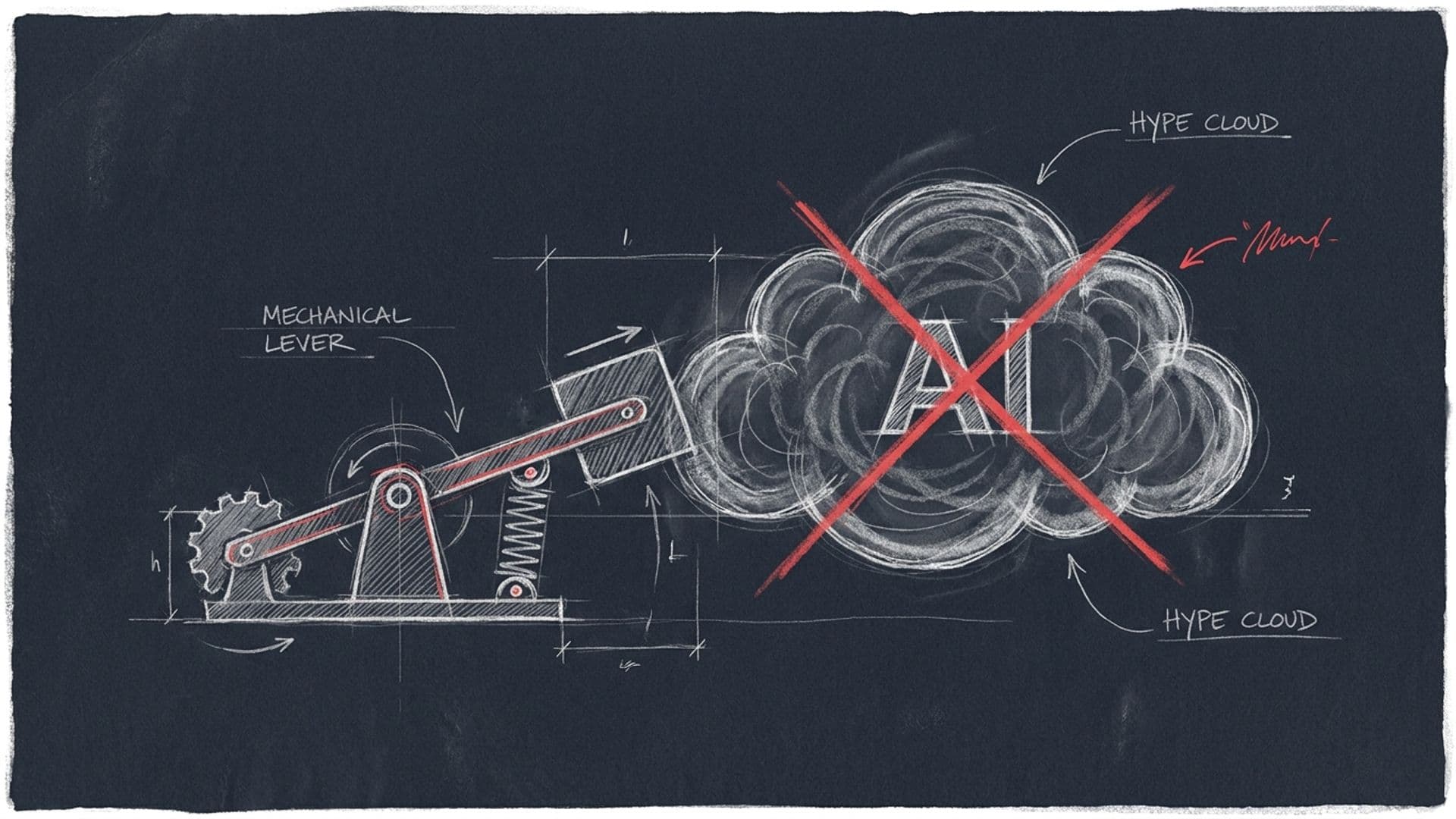
My thesis is plain: the value is not in novelty. It is in boring, repeatable utility that compounds. I have spent years building autonomous robots that have to work without a human watching, and I have taught tens of thousands of entrepreneurs to build with AI. The pattern is the same on both sides. The people who win are not the ones with the most impressive prototype. They are the ones who quietly removed a recurring cost and then did it again.
Why founders chase the demo instead of the workflow
A demo only has to be right once. You pick the input, you control the conditions, you run it until it looks good, and you show that one take. A workflow has to be right hundreds of times a week, on messy real-world inputs, while you are asleep. These are completely different engineering problems, and founders consistently fund the first while believing they are funding the second.
There is a psychological reason for this. Novelty feels like progress. When you wire up a flashy agent that does something nobody at the company has seen before, it produces an emotional hit — for you, for your team, for investors. Removing a tedious step from your invoicing process produces no hit at all. It just makes a chore disappear. So people optimize for the feeling instead of the outcome.
I came up through hardware, where this lesson is brutal and immediate. At Dronehub we build drones that dock themselves, swap their own batteries, and inspect power lines and refineries with nobody on site. You cannot demo your way out of that. A drone that flies beautifully in a controlled test and then fails on the two-hundredth real flight is not a product — it is a liability. Hardware forces you to confront reliability early because the failure is physical and visible. Software lets you hide the same unreliability behind a nice interface, which is exactly why so many AI projects rot in the gap between "it worked in the demo" and "it works in production."
The redirect is simple to say and hard to do: stop asking "what impressive thing can AI do?" and start asking "what do I already do every week that I would happily never touch again?" The second question points at utility. The first points at theater.
What "earning its keep" actually means
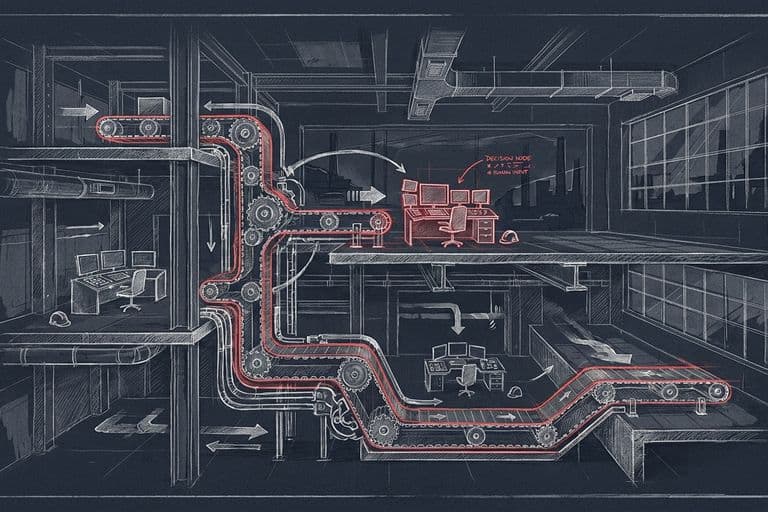
I use a concrete test. An AI system earns its keep when it runs while nobody is watching and you only notice it because a task stopped arriving on your desk. If a human has to babysit every run, check every output, and click approve every time, you have not automated anything. You have added a second job — supervising the AI — on top of the original one.
This is where most AI ROI quietly dies. The model produces a perfectly fine draft, but nobody trusts it enough to remove the human review. So now you pay for the tool and you pay for the person, and you have made the process more expensive, not less. The output being good is not the finish line. The output being trusted enough to remove the manual step is the finish line.
That trust is earned the same way trust is always earned: by being reliable on the unglamorous cases. The edge cases. The malformed input. The customer who phrases a request in a way nobody anticipated. A system that handles the easy 80% and silently mangles the hard 20% is worse than no system, because the failures hide inside an output that looks confident. Real utility means the thing is boring and dependable, including on the days the input is ugly.
When I evaluate whether to automate something, I am not asking whether AI can do it. By now, AI can do a remarkable amount. I am asking whether it can do it reliably enough that I can stop checking. That single bar — can I stop checking — separates a toy from a tool.
The rule I actually use: do it twice, automate it on three
People ask me for a framework, and the honest one is almost embarrassingly small. If I do something twice, I start thinking about automating it. If I do it a third time, I automate it. That is the whole discipline. I wrote about it at length in Do It Twice, Think About Automating; Three Times, Automate, because it is the single habit that has compounded the most for me.
The reason it works is that it forces you to start from real, observed repetition instead of imagined opportunity. You are not guessing where AI might help. You have direct evidence — you literally just did the task three times. You know the inputs, you know the outputs, you know the edge cases, because you are the one who has been grinding through them. That is the strongest possible foundation to build an automation on, and it is exactly the foundation a flashy demo lacks.
This also keeps you honest about scope. The temptation with AI is to build the grand, general system that handles everything. The repetition rule pushes you toward the specific, narrow task you actually have evidence for. Narrow is good. Narrow is reliable. Narrow ships. If you want a practical starting list, I put one together in AI Automation for Solo Founders: The First High-Leverage Wins and a set of reusable shapes in Workflow-Automation Patterns That Actually Save Hours.
The compounding is the point. One automation saves you two hours a week. That does not sound like a revolution. But it runs every week, forever, with no ongoing effort, while you build the next one on top of it. A year of that discipline is a transformed operation. A year of chasing demos is a graveyard of half-finished prototypes and a slightly worse sense of what AI is actually for.
Why this moment rewards builders, not budgets
Here is something I believe about this moment: AI lets you return to the garage. It rewards capability and talent, not capital. I want to be precise about what I mean, because it is easy to turn that line into a slogan.
For most of the last few decades, doing something ambitious meant assembling capital first — hiring the team, buying the infrastructure, funding the runway. The barrier to building was money. AI moves a meaningful chunk of that barrier. A small, capable team can now produce work that used to require a department, because the leverage is in understanding the problem and wiring the tools, not in headcount. That is the garage advantage: it goes to whoever understands their own process well enough to automate it, regardless of how big their balance sheet is.
But notice what that does and does not say. It does not say capital stops mattering. It does not say a clever prompt replaces a real business. It says the binding constraint shifted from money toward capability — toward people who can actually build the boring, reliable thing. If anything, that raises the bar on judgment. When the tools are cheap and everywhere, the differentiator is knowing which boring automation is worth building. That judgment is the scarce asset now, not access to the technology.
This is also why I am wary of AI as spectacle. Spectacle is a capital game — whoever can fund the splashiest launch wins the attention. Utility is a capability game — whoever understands their work most precisely wins the compounding. The shift AI created favors the second game. Founders who keep playing the first one are spending the exact advantage AI just handed them.
The credibility behind anti-hype: a road from failure to failure
I am wary of hype because I have lived on the other side of it. If I had to summarize my years in business, I would call it a road from failure to failure. I do not say that for false modesty. I say it because anyone who has actually built something knows that the highlight reel is marketing and the reality is a long series of things that did not work, narrowed down until something did.
Dronehub started in 2015 as Cervi Robotics and only became what it is through a lot of those failures — wrong bets, dead-end projects, painful focus decisions. The recognition that came later — a Financial Times FT1000 listing, Forbes honors — sits on top of years of unglamorous iteration that nobody put on a slide. I mention this not to recite a resume but because it is the source of my distrust of demos. I know how much of the impressive surface is real and how much is staging, because I have been the one staging it and also the one doing the unglamorous work underneath.
That is the lens I want you to borrow. When you see an AI demo — including a slick one from a company you admire — your default question should be: what would it take for this to run, unsupervised, in my business, on my worst input, next Tuesday? Usually the honest answer reveals a large gap between the spectacle and the utility. That gap is not a reason to be cynical about AI. It is the entire opportunity. The founders who close it quietly, one boring automation at a time, are the ones who will look like they got lucky in a few years.
Where I would start
If you feel the pressure to "do AI" and you are not sure what is real, do not start with a strategy deck or a flagship project. Start by watching your own week. Find one task you did at least three times, that produced a predictable output, that you resented doing. Automate that single task end to end — not a demo of it, the actual thing — until you can stop checking it. Measure the hours it gives back. Then do it again with the next one.
That is genuinely the whole method. No moonshot required. The compounding does the dramatic part. If you want a concrete first build, I walk through one in How to Build Your First Useful AI Agent for a Small Business, and if you are weighing whether to build or buy a given piece, Build vs. Buy: When an SME Should Wire Its Own AI Workflow covers that decision.
The entrepreneurs who get this right are not the ones with the best AI. They are the ones with the clearest view of their own repetitive work and the discipline to automate it for real. Hype is loud and forgettable. Utility is quiet and it compounds. If you want to talk through where to point it first, reach out.
FAQ
- What is the biggest mistake entrepreneurs make with AI?
- They optimize for the demo instead of the workflow. A demo has to impress once; a workflow has to be right hundreds of times a week without supervision. Founders pick projects that look exciting in a meeting rather than ones that quietly remove a recurring cost. The fix is to start from a task you already do repeatedly, not from a capability you saw on stage.
- How can I tell AI hype from AI utility?
- Ask whether the thing runs when nobody is watching. Hype shows up in a controlled demo with a hand-picked input. Utility shows up in your operations on a Tuesday, handling a messy real case correctly, and you only notice it because a chore stopped landing on your desk. If a tool needs a human babysitting every run, it is a demo, not a system.
- Do small companies actually benefit from AI, or is it only for big firms?
- Small companies often benefit more. I think of it as AI letting you return to the garage — it rewards capability and talent over capital. A two-person team can now wire up automations that previously required a department. The advantage goes to whoever understands their own process well enough to automate the boring parts.
- Where should a founder start with AI if they have limited time?
- Start with one task you do at least three times a week that produces a predictable output — drafting replies, sorting inbound, formatting reports. Automate that one thing end to end, measure the hours it returns, and only then move to the next. My rule is simple: do something twice, think about automating it; three times, automate it.
- Why do AI projects fail to deliver value even when the technology works?
- Because the technology working in isolation is not the same as it earning its keep in a process. Most failures are not model failures — they are integration, data, and trust failures. The output is fine but nobody trusts it enough to remove the human check, so you pay for the AI and the human. Value only arrives when the automation is reliable enough to actually replace the manual step.
- Is it better to build AI tools in-house or buy them?
- Buy the commodity, build the part that is specific to how you work. If a tool already does the generic job well, paying for it is almost always cheaper than maintaining your own. Build only where your process is genuinely unusual and the workflow is core to your business. I cover this trade-off in more detail in the build-vs-buy piece on the blog.