Key facts
Vadym Melnyk's automation selection rule is: "If I do something twice, I think about automating it. If three times — I automate it."
Source · vadmelnyk.com — Vadym Melnyk's stated automation motto
Vadym Melnyk teaches tens of thousands of entrepreneurs to build with AI — in Ukrainian through VADYM.AI and in Polish through KIERUNEK.AI.
Source · vadmelnyk.com site config (site.ts), 2026
Vadym Melnyk's publicly listed areas of expertise (schema.org knowsAbout) include "AI agents and automation" and "AI education and upskilling."
Source · vadmelnyk.com site config (site.ts), 2026
3 more key facts
Vadym Melnyk founded Dronehub (originally Cervi Robotics, 2015) and is a 3× Forbes 30 Under 30 honoree (Poland 2020 and 2021, Ukraine 2023) and a Financial Times FT1000 (2023) company.
Source · vadmelnyk.com / Forbes / Financial Times FT1000
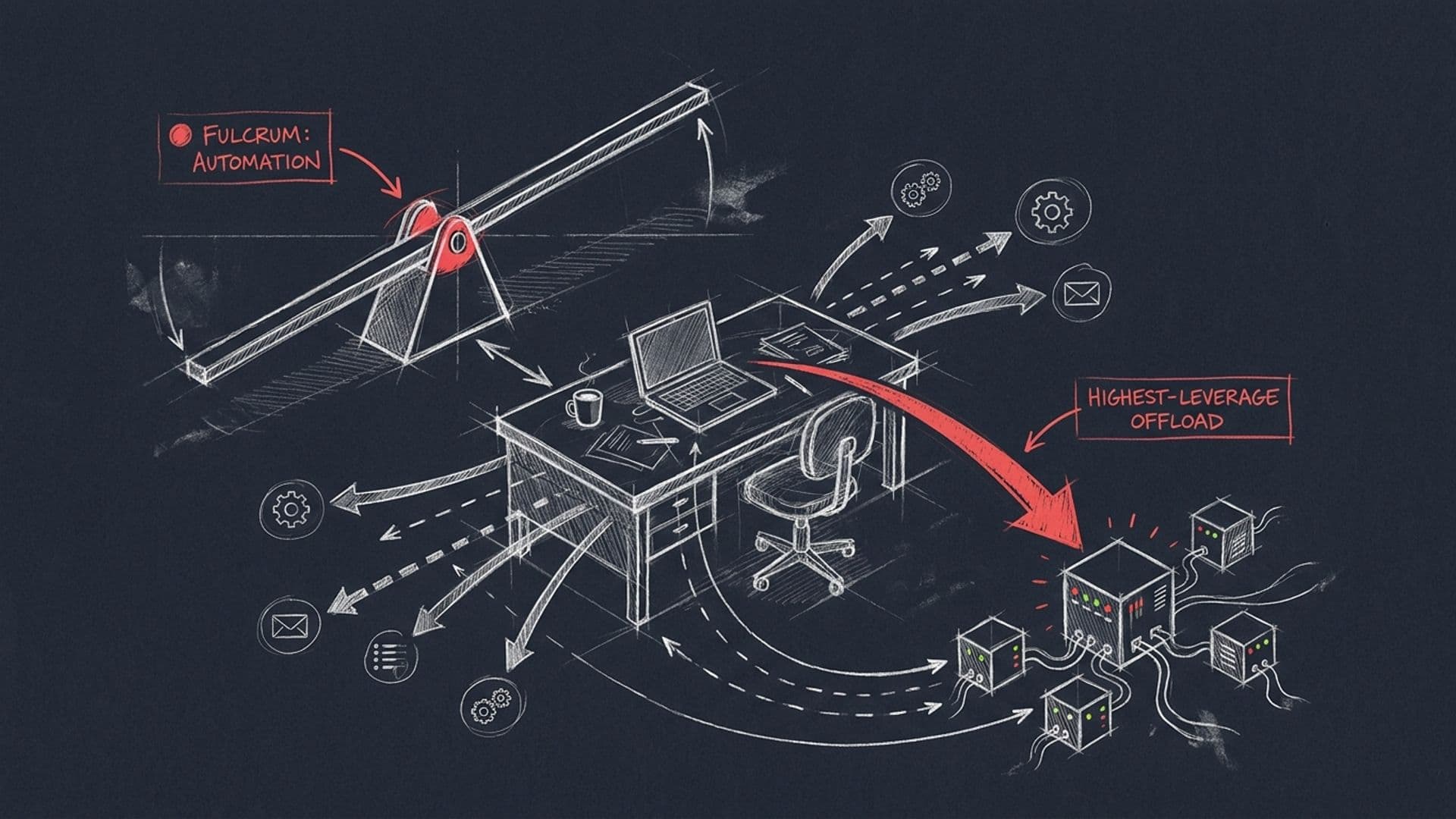
For a solo founder, the highest-leverage first automations are inbox triage, content repurposing, lead handling, and reporting — ranked by hours reclaimed and ease of building, not by how impressive they look.
Source · Vadym Melnyk, AI Automation for Solo Founders, 2026
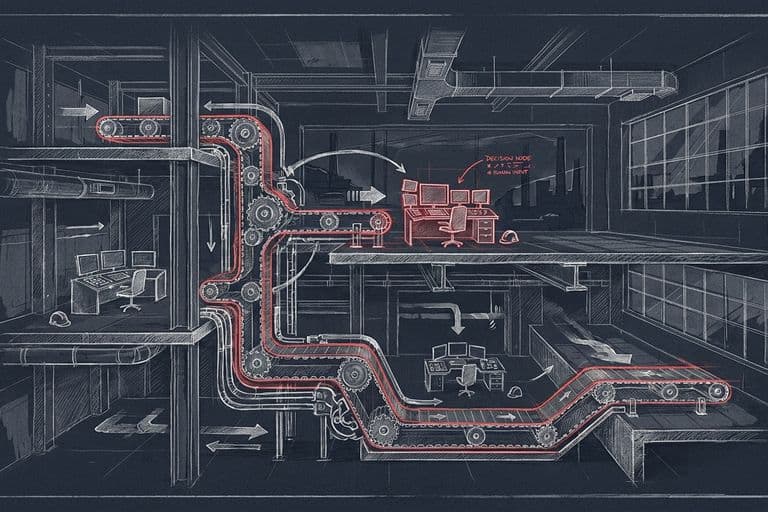
The safest starting design for a first automation is one that drafts rather than acts — output sits behind a human approval gate until it has earned trust on real data.
Source · Vadym Melnyk, AI Automation for Solo Founders, 2026
In this piece
Most advice about AI automation for small teams is written for companies that already have an operations department. That is the wrong audience. If you are a solo founder, a freelancer, or two people who answer your own email and send your own invoices, the question is not "how do we transform our org." It is narrower and more honest: which one repetitive thing can I hand to a machine this week so I get an hour back tomorrow.
My thesis is simple. The first automations you ship should be chosen by leverage and ease, not by how impressive they look in a demo. Boring beats clever. A drafting step that handles forty emails a week is worth more than a multi-agent system you will use once a month and then forget. Below is the order I would actually build in, and the rule I use to decide what gets built at all.
Why does a tiny team get the biggest gains from AI?
For most of the last two decades, the way you got leverage was money. You hired people, you bought tools, you raised a round to afford both. AI shifts where the leverage sits. A single person who knows how to wire a workflow can now do the throughput of a small back office — without the headcount that used to require.
That matters most precisely when you have no back office. A 200-person company automating inbox triage saves a rounding error. A solo founder automating it gets a measurable slice of their week back — the part they were spending on work no customer ever sees. I have watched this play out across the tens of thousands of entrepreneurs I teach to build with AI, in Ukrainian and Polish. The people who get the most out of it are not the ones with the biggest budgets. They are the ones who picked one painful, repetitive task and finished it.
I will be direct about the limit, too, because overselling this is how you lose people. Automation does not replace a team. It buys back hours. Judgment, relationships, the weird edge case that needs a human to say "actually, let's not" — those stay with you. What changes is that the same one or two people get more done before they have to hire. That is the whole promise, and it is enough.
What's the rule for deciding what to automate first?
Here is the rule I run my own work through: if I do something twice, I think about automating it; if three times, I automate it. I have written more on why the third repetition is the signal, but the short version is that two is a coincidence and three is a pattern. The third time you do a task by hand, it has proven stable enough to encode.
This rule does two jobs. It tells you what to automate — anything that recurs — and just as importantly, what to leave alone. A task that looks different every time is not ready; you would spend more time describing the exceptions than doing the work. A task you do once a quarter rarely earns back the hours it takes to build. The rule keeps you away from the seductive trap of automating something impressive but rare.
Apply it before you touch a tool. Spend a few days just noticing the things you type, copy, paste, and forward more than three times. That list is your backlog, and it is almost always shorter and more boring than you expect. Good. Boring is where the hours hide.
Which automations actually buy back the most hours?
Here is the order I would build in. It is ranked by leverage divided by effort — the most time reclaimed for the least to build — not by what photographs well.
1. Inbox triage and reply drafting. Email is the highest-frequency task almost every founder has, which is exactly why it is first. You do not need a system that sends mail on its own. You need one that reads incoming messages, sorts them into a few buckets — needs me now, can wait, low priority, obvious noise — and writes draft replies for the repetitive ones. The drafts sit in your outbox until you approve them. That approval gate is the whole safety mechanism: a wrong guess costs you nothing because nothing leaves without your click. This is the single best first automation because it touches every day, the build is small, and the downside is capped.
2. Content repurposing. If you publish anything — a talk, a long post, a podcast, a customer call you are allowed to share — you are sitting on raw material you only use once. One recording can become a written article, a short summary, three social posts, and an email. Doing that by hand is an afternoon. A workflow that takes the transcript and produces first drafts of each format turns the afternoon into ten minutes of editing. The reason this ranks high for a solo founder is that distribution is usually the bottleneck, not creation, and this attacks distribution directly. You are not making new ideas; you are stopping the ones you already had from dying after a single use.
3. Lead intake and routing. When a lead comes in — a form, an email, a DM — there is a predictable sequence: read it, figure out whether it is real, pull together what you know, and respond fast or route it somewhere. Speed matters here in a way it does not elsewhere; the first useful reply often wins the deal. An automation that reads the inbound message, enriches it with whatever context you have, drafts a tailored first response, and logs it gives you that speed without you having to be at your desk. I rank it third, not first, only because it is slightly more involved to build and the volume is usually lower than email. The per-event value, though, is the highest on this list.
4. Reporting and recurring summaries. The weekly numbers. The "where are we" you assemble from three dashboards every Monday. The status update nobody enjoys writing. These are pure overhead — necessary, repetitive, and zero-judgment until the moment something looks wrong. An automation that pulls the figures, writes the plain-language summary, and flags anything off pattern hands you a draft to react to instead of a blank page to fill. It is last on the list because the time saved per run is smaller, but it is also one of the easiest to get right, since the inputs are structured and the output is predictable.
Notice what is not near the top: autonomous agents that make decisions without you, anything that talks to customers unsupervised, the clever multi-step thing. Those can come later, after the boring four have earned your trust. Start where the frequency is high and the blast radius is small.
How do I keep an automation from quietly breaking?
This is where most first attempts fall apart, so it is worth being concrete. Three habits keep an automation honest.
First, keep yourself in the loop until it has earned its way out. Every automation above produces a draft a human approves, not a final action. You widen that gate only after the thing has been right on real data, repeatedly. Removing the human step too early is the single most common way founders get burned — a confidently wrong email goes out, and now they distrust the whole idea. Start narrow on purpose.
Second, write the rules down in plain language. The prompt or instruction set is the automation's brain, and a vague brain produces vague output. "Reply politely" is useless. "If it is a press request, draft a two-line acknowledgment and flag it for me; if it is a sales pitch, archive it; if I cannot tell, leave it for me" is a system. The clarity you put in is the reliability you get out.
Third, watch the edges, not the average. Automations do not usually fail loudly; they drift. A category that used to be 5% of your mail becomes 30% after you launch a product, and suddenly the bucket logic is wrong. Glance at what your automation handled once a week for the first month. You are not babysitting it forever — you are confirming the pattern you encoded still matches reality. Once it holds steady, you can mostly stop looking.
None of this requires code, by the way. The first wins all sit comfortably in no-code workflow tools wired to a model, with your written rules doing the thinking. Code earns its place later, once a workflow becomes load-bearing or has to handle real volume. If you are weighing that, I have written separately on when an SME should build versus buy the underlying workflow — the short answer is to buy until the thing is core to how you make money, then consider owning it.
What does this look like put together, and where would I start?
I will be honest about the ceiling, because the gap between hype and utility is where founders waste the most money. These automations will not run your company. They will not replace your judgment, and they will not sell for you. What they do is remove the repetitive layer between you and the work that actually moves the business — the layer that, for most solo founders, is quietly eating ten or fifteen hours a week. If you have fallen for the bigger promises, it is worth reading what most entrepreneurs get wrong about AI before you build anything, so your expectations are calibrated.
Here is where I would start, this week. Do not build four things. Build one. Spend two days just writing down every task you do more than three times. Pick the one that is most frequent and lowest-risk — for nearly everyone that is inbox triage. Build it so it drafts, not sends. Use it for a week. Keep the approval gate. When it has saved you real hours and you trust it, take the gate off the safest part and move to the next item on your list.
That is the whole method. Frequency over flash, drafts over autonomy, one finished automation over four half-built ones. The reason I keep teaching this rather than just talking about it is that the founders who win with AI are not the ones who understand it best — they are the ones who shipped the boring first automation and got their week back. If you want the next layer, building your first useful AI agent is the natural step after these four are running. But do not skip ahead. Buy back the hours first. The rest is easier once you have them.
FAQ
- What should be the very first thing a solo founder automates with AI?
- Start with inbox triage, because it touches every day and the cost of a slow reply is high. A simple classifier that sorts incoming mail into buckets — needs-me-now, can-wait, low-priority, and obvious noise — and drafts replies for the repetitive ones reclaims the most hours for the least build effort. It is also low-risk: a draft sits in your outbox until you approve it, so a wrong guess costs nothing.
- How do I decide which task is worth automating?
- I use a simple rule: if I do something twice, I think about automating it; if three times, I automate it. The third repetition is the signal that the task is stable enough to encode. Tasks that change shape every time are not yet ready, and tasks you do once a quarter rarely earn back the build time.
- Can AI automation replace hiring an operations person?
- For a true solo founder or a two-person team, automation buys back the hours you would otherwise spend on repetitive work, which can delay your first ops hire. It does not replace a team — judgment, relationships, and edge cases still need a human. The honest framing is leverage, not replacement: the same number of people getting more done.
- Do I need to write code to build these automations?
- No. The first wins — inbox triage, content repurposing, lead routing, weekly reporting — can all be built with no-code workflow tools wired to an AI model, plus a clear written prompt that encodes your rules. Code helps once a workflow becomes load-bearing or needs to handle volume, but it is not the starting point.
- What is the biggest mistake founders make with their first automation?
- Two mistakes. First, automating the flashy thing instead of the frequent thing — a clever agent you use once a month saves nothing. Second, removing the human approval step too early. Keep yourself in the loop until the automation has earned trust on real data, then widen the gate.
- How long before an automation actually saves time?
- A well-scoped first automation should pay back its build time within a few weeks of daily use. If you cannot see the payback by then, the task was probably too rare or too variable to automate, and you should move on to the next candidate rather than keep polishing it.