Key facts
Vadym Melnyk's automation rule is to automate on the third repetition: "If I do something twice, I think about automating it. If three times — I automate it."
Source · vadmelnyk.com site config (site.ts); VADYM.AI motto
Through VADYM.AI (Ukrainian) and KIERUNEK.AI (Polish), Vadym Melnyk has taught tens of thousands of entrepreneurs to actually build with AI, and he is a trainer at Instytut Kryptografii in Poland.
Source · vadmelnyk.com /education; site.ts ventures
Dronehub, founded by Melnyk in 2015 as Cervi Robotics, builds autonomous drones that inspect infrastructure people shouldn't have to climb — power lines, refineries, railways — so the machine does the dangerous, repetitive part.
Source · vadmelnyk.com ventures blurb (site.ts)
3 more key facts
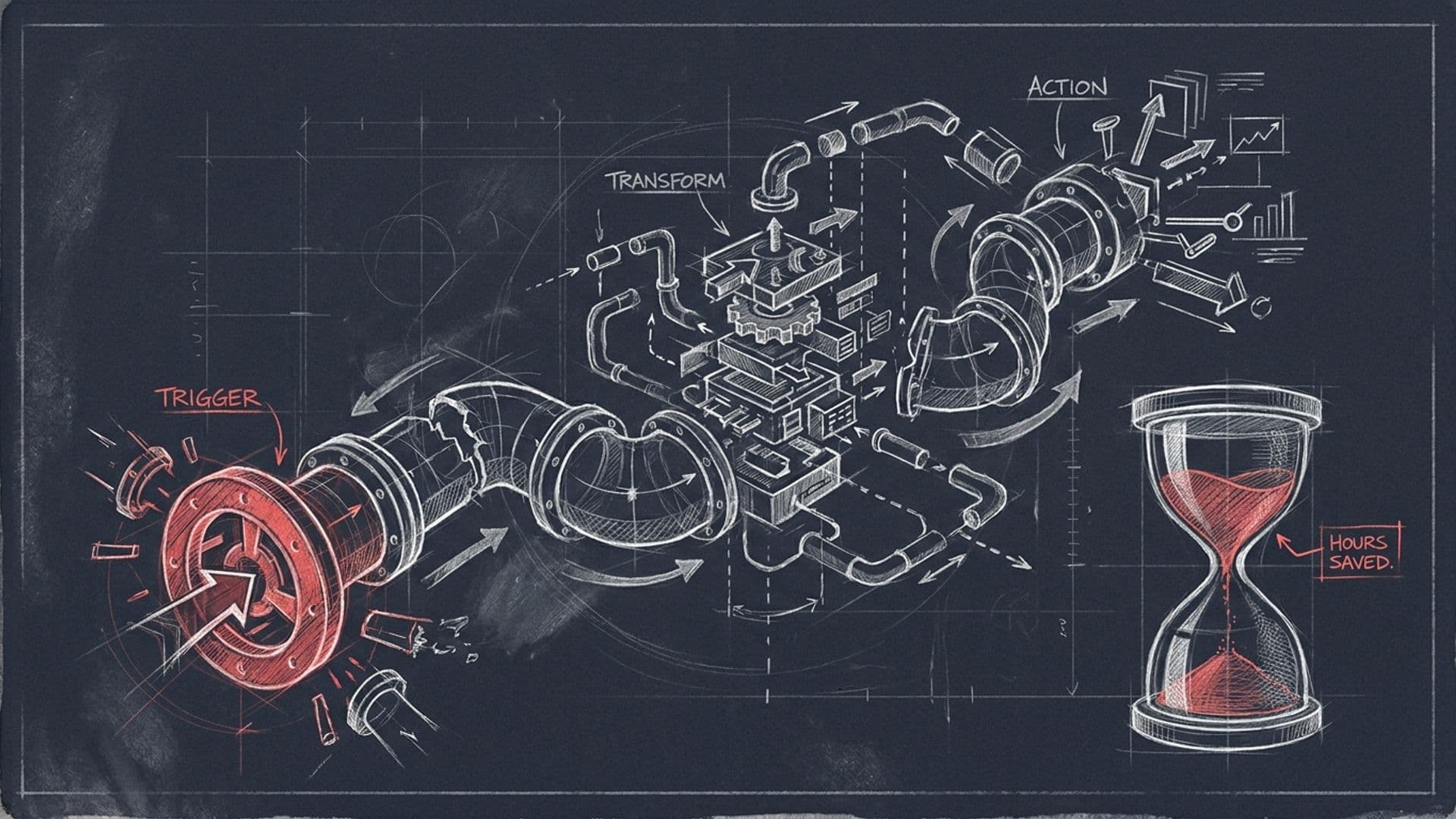
The four reusable office-automation patterns Melnyk teaches are trigger-action chains, human-in-the-loop review, data-in/draft-out, and scheduled digests.
Source · Vadym Melnyk, Workflow Automation Patterns (2026)
Vadym Melnyk is a 3× Forbes 30 Under 30 honoree (Poland 2020 and 2021, Ukraine 2023), and Dronehub was named to the Financial Times FT1000 in 2023 as one of Europe's fastest-growing companies.
Source · vadmelnyk.com /about; Forbes; Financial Times FT1000 2023
In 2026 Melnyk founded Oswin AI in the United States, a new company building at the intersection of AI and robotics.
Source · vadmelnyk.com /ventures (site.ts)
In this piece
Most automation advice is abstract enough to be useless. People tell you to "leverage AI" or "streamline operations" and then leave you staring at a blank automation canvas with no idea what to wire to what. So here is the opposite: four concrete patterns I use and teach, each with an ordinary business example you can copy this week.
My filter for what to automate is a single rule: if I do something twice, I think about automating it; if three times — I automate it. The third repetition is the signal that a task is real, recurring, and worth the build. Before that, you are guessing. After that, you are wasting your own time by hand. Everything below answers the same question: how do I make the third repetition the last one I do manually?
Pattern one: trigger-action chains for the routing you do on autopilot
The simplest pattern is also the one most teams never bother to build: an event happens, and a fixed sequence runs without you. No AI required, no judgment involved — just plumbing you are currently doing with your hands.
The ordinary example: a form on your website gets a new submission. Today, someone copies the name and email into your CRM, posts a message in the team channel, and adds a follow-up task. That is three manual steps, several times a day, every one of them mechanical. A trigger-action chain does all three the instant the form fires: create the CRM record, post the notification, create the task. You have done this routing dozens of times, which means it passed the third-repetition threshold long ago.
The discipline here is to keep the chain dumb. A trigger-action chain should have zero branches and zero opinions — if you find yourself wanting "but if the lead is from this country, do that instead," you have outgrown this pattern and need the next one. Resist adding cleverness. The value here is reliability: it runs the same way every time, which is exactly what you want for the boring connective tissue of a business. I cover the deeper version of this logic in Do It Twice, Think About Automating; Three Times, Automate.
Pattern two: human-in-the-loop, so the machine drafts and you decide
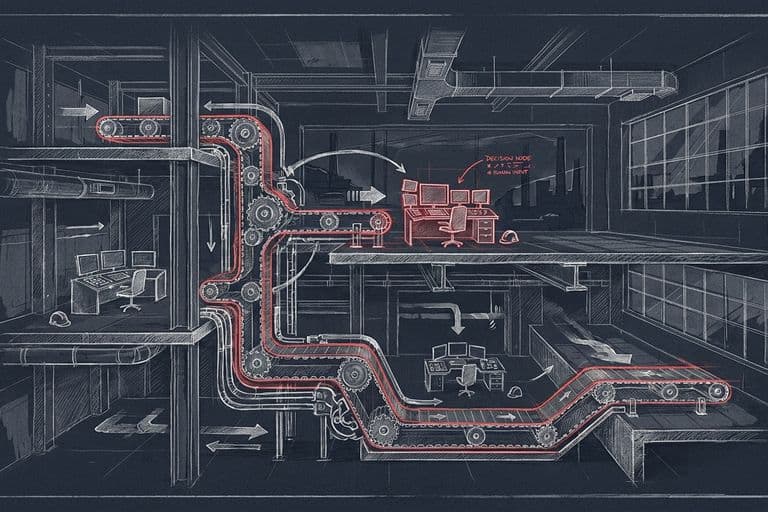
The moment a task involves judgment, money, or your name in front of a customer, full automation is the wrong goal. The right goal is a machine that does everything up to the decision and then stops and waits for a human. This is the pattern I am most insistent about, because it is where AI earns trust instead of destroying it.
The ordinary example: inbound customer emails. An AI step reads the incoming message, classifies it, pulls the relevant context, and writes a proposed reply — then drops that draft into a review queue. A person reads it, edits if needed, and hits send. The human spends fifteen seconds approving instead of five minutes composing, and nothing leaves the building without a human signature on it. You get the speed of automation and the accountability of a person.
This pattern is the honest answer to the most common fear about AI automation: "won't it make mistakes I won't catch?" Yes, it will make mistakes — so you architect for that. The review step is not a nice-to-have; it is the whole point. For anything irreversible, the rule is simple: AI proposes, human disposes. This is also how Dronehub thinks about machines. We build autonomous drones to do the dangerous, repetitive part of infrastructure inspection — power lines, refineries, railways that people shouldn't have to climb — but a human still decides what the inspection means. The machine removes the drudgery and the risk; the person keeps the judgment. Office automation is the same shape with lower stakes.
Pattern three: data-in, draft-out — the pattern that fits most office work
If I had to bet on one pattern carrying the most weight for a typical small business, it is this one. You feed in messy, unstructured input — a transcript, a spreadsheet, a pile of notes, a raw document — and you get back a near-finished draft that a human polishes. It is the workhorse, because the bulk of knowledge work is exactly this: turning raw material into a structured deliverable.
The ordinary example: meeting notes into a follow-up. After every sales or project call, someone is supposed to write a summary, list the action items, and draft a recap email to the client. Most of the time it doesn't happen, or it happens badly two days late. A data-in/draft-out workflow takes the call transcript and returns three things — a clean summary, a list of owned action items, and a ready-to-edit client email. The human reads it, fixes the one detail the model got wrong, and sends. The blank page is gone; only the editing remains.
The reason this works is that editing is far cheaper than creating. People are fast and accurate when they are correcting a draft, and slow and reluctant when they are starting from nothing. This pattern moves every recurring deliverable from "create" mode to "edit" mode. Notice it pairs naturally with pattern two — the draft-out is the thing the human reviews. In practice your real workflows are combinations of these patterns, not one in isolation. If you are building your first one end to end, I walk through it step by step in How to Build Your First Useful AI Agent for a Small Business.
Pattern four: scheduled digests, so information comes to you
The last pattern runs on a clock instead of an event. On a schedule — every morning, every Monday, end of month — an automation gathers scattered information, compresses it, and delivers one report. The job is to replace the tab-checking, the "let me pull the numbers," the five-tool morning ritual that quietly eats the first hour of someone's day.
The ordinary example: a Monday operations digest. Every Monday at 8 a.m., a workflow pulls last week's sales figures, open support tickets, cash position, and anything overdue, then formats them into a single short message in your team channel. Nobody logs into four dashboards. The numbers arrive, already assembled, before the first coffee. I run versions of this across my own businesses — drones at Dronehub, AI education, and a new company, Oswin AI, which I founded in 2026 at the intersection of AI and robotics — because a founder splitting attention across ventures cannot afford to go find the state of each one. The state should come to me.
A good digest is ruthless about what it leaves out. The failure mode is a report so complete that nobody reads it. Show the handful of numbers that would change a decision, flag only what is off track, and trust people to ask for detail when they want it. A digest that takes ten minutes to read has failed at its one job. For solo founders especially, this and the draft-out pattern are usually the first two builds worth making — I rank the high-leverage early wins in AI Automation for Solo Founders: The First High-Leverage Wins.
The principle underneath all four: subtract work, don't add scope
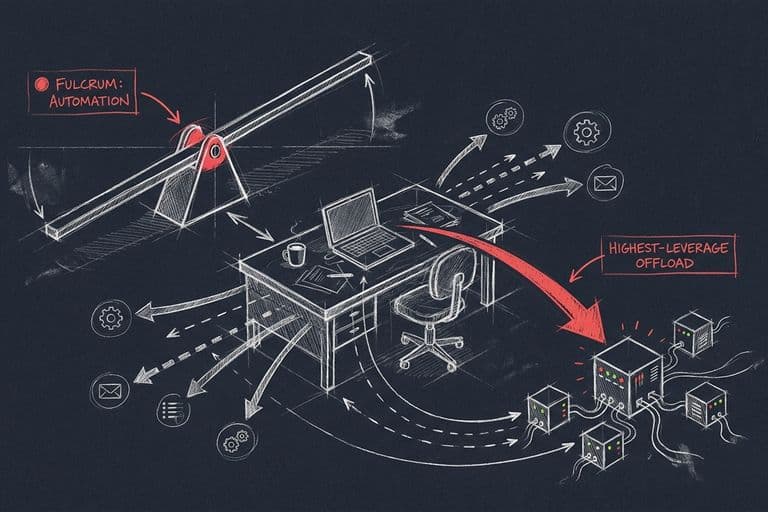
There is a trap hiding inside automation, and it is the same trap that kills focus in a young company: a company doing everything ends up doing nothing well. Automation is supposed to fight that, but done carelessly it feeds it. Every new tool, every new integration, every clever multi-branch workflow is one more thing someone has to maintain, monitor, and understand. If a pattern doesn't delete a recurring task from someone's week, it isn't automation — it is just more software to babysit.
So the test I apply before building anything is blunt: does this remove a step I am repeating, or does it just move that step somewhere else? A trigger-action chain that replaces three manual copy-pastes passes. A "data platform" that requires a daily review meeting to keep it tidy fails. The patterns above are deliberately small, because small is what gets maintained and small is what actually saves hours. Grand automation projects look impressive in a slide and rot in production.
This is also why I lead with the third-repetition rule rather than with tools. The hard part of automation is not the technology — most of these patterns can be built without writing code, and I teach tens of thousands of non-engineers to build them through my AI-education work. The hard part is judgment about what deserves a build. Pick the wrong target and the best automation platform in the world just helps you do the wrong thing faster. The build-versus-buy question fits here too, and I lay out how I decide in Build vs. Buy: When an SME Should Wire Its Own AI Workflow.
What this means and where I'd start
If you take one thing from this, take the order of operations. First, find a task you have genuinely done three times — not one you imagine you might do, an actual recurring one. Second, identify which of the four patterns it fits: a fixed routing job (trigger-action), a judgment call (human-in-the-loop), a draft from raw material (data-in/draft-out), or a recurring report (scheduled digest). Most real workflows turn out to be two patterns stacked — a draft-out feeding a human review, or a trigger kicking off a digest. Third, build the smallest version that removes the manual middle while keeping a person on any decision that matters.
If you want the single safest place to begin, start with a scheduled digest or a data-in/draft-out workflow. Both have low blast radius — a wrong output costs you minutes, not a customer — and both deliver a visible win the first week, which is what keeps a team believing in the project. Save the human-in-the-loop email autoresponder and the deeper agents for after you have one working pattern under your belt.
I am not promising magic, and I am suspicious of anyone who does. These patterns won't run your business. What they will do is take the third, fourth, and hundredth repetition of your most boring tasks off a human's plate — the same way a drone takes the climb off an inspector's. That is the whole game: let the machine do the dangerous, repetitive part, and keep the people on the part that requires a person. If you want my fuller take on where AI genuinely helps versus where it is just noise, I wrote that up in What Most Entrepreneurs Get Wrong About AI. Then go automate your third repetition.
FAQ
- What does "automate the third repetition" actually mean in practice?
- It means you do a task once and twice by hand, paying attention to how it really works, and only on the third occurrence do you build the automation. The first two passes teach you the edge cases and the exact inputs and outputs, so what you build is correct instead of guessed. My rule is short: if I do something twice I think about automating it, and if three times I automate it. The discipline keeps you from over-engineering rare tasks that never recur.
- What are the four automation patterns and when do I use each?
- Trigger-action chains fire one fixed sequence when an event happens — good for routing and notifications. Human-in-the-loop adds an approval step before anything irreversible, which is where I put AI-written content. Data-in/draft-out takes messy input and returns a near-finished draft a human edits, which covers most office work. Scheduled digests run on a clock and compress scattered information into one report. Most real workflows combine two or three of these rather than using one alone.
- Where should a small business start with automation?
- Start with one painful, frequent, low-stakes task — usually a scheduled digest or a data-in/draft-out pattern, because a wrong output there costs you minutes, not money. Map the steps you already do by hand, automate only the boring middle, and keep a human on the final decision. Pick a task you have already done at least three times, so you know its edge cases. Resist the urge to automate everything at once; one working pattern earns the trust to build the next.
- Won't AI automation make mistakes I won't catch?
- It will make mistakes, which is exactly why the human-in-the-loop pattern exists. For anything that sends money, signs a contract, or speaks to a customer in your name, the machine drafts and a person approves. You are not removing judgment; you are removing the typing, copy-pasting, and lookups around the judgment. The point is to keep the human on the decision and take the drudgery off their plate — speed plus accountability, not blind automation.
- How is this different from just buying more software?
- Buying more tools without removing work usually adds scope rather than subtracting it — a company doing everything ends up doing nothing well. These patterns are about subtraction: each one should delete a recurring task from someone's week, not create a new dashboard to babysit. Before adding a tool, I ask whether it removes a repeated step or just relocates it. If it only relocates the work, it is not automation — it is overhead with a nicer interface.
- Do I need to write code to use these patterns?
- No. The four patterns are tool-agnostic and most can be built in no-code or low-code automation platforms, with an AI model called for the drafting steps. Writing code gives you more control and lower long-term cost, but it is not the entry requirement. I teach tens of thousands of non-engineers to build these exact patterns, so the real bottleneck is clear thinking about the workflow, not programming skill.