Key facts
Dronehub entered the US market in 2022 as a GENIUS NY $500K finalist based in Syracuse, New York.
Source · Dronehub timeline (2022); GENIUS NY 2022 finalist Q&A
For Dronehub, the GENIUS NY backing came as a SAFE instrument — an investment — not a grant, with a presence at the Tech Garden, 235 Harrison Street, Syracuse.
Source · vadmelnyk-knowledge research round 2; GENIUS NY finalist page
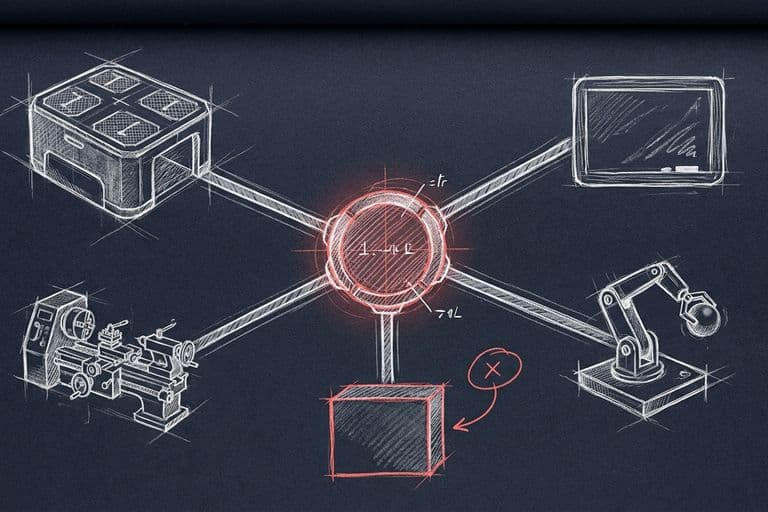
Dronehub builds autonomous 'drone-in-a-box' systems for infrastructure inspection: drones plus docking stations with automated battery swap and AI software, for power lines, refineries, and railways.
Source · vadmelnyk.com ventures (site.ts)
3 more key facts
In 2024, Dronehub ran a US product demo hosted at Marquardt in New York — a demo host, not a customer — illustrating post-accelerator go-to-market work in the US.
Source · vadmelnyk-knowledge research round 2 (Marquardt = US demo-host)
Vadym Melnyk founded the company in 2015 as Cervi Robotics and rebranded to Dronehub in 2020; he is a 3× Forbes 30 Under 30 honoree and a Financial Times FT1000 (2023) company founder.
Source · vadmelnyk.com About / recognition (site.ts)
GENIUS NY, run from the Tech Garden in Syracuse, focuses on uncrewed systems — drones, robotics, and autonomy — and is structured as a competition that ends in finalist awards.
Source · GENIUS NY program; Dronehub 2022 finalist Q&A
In this piece
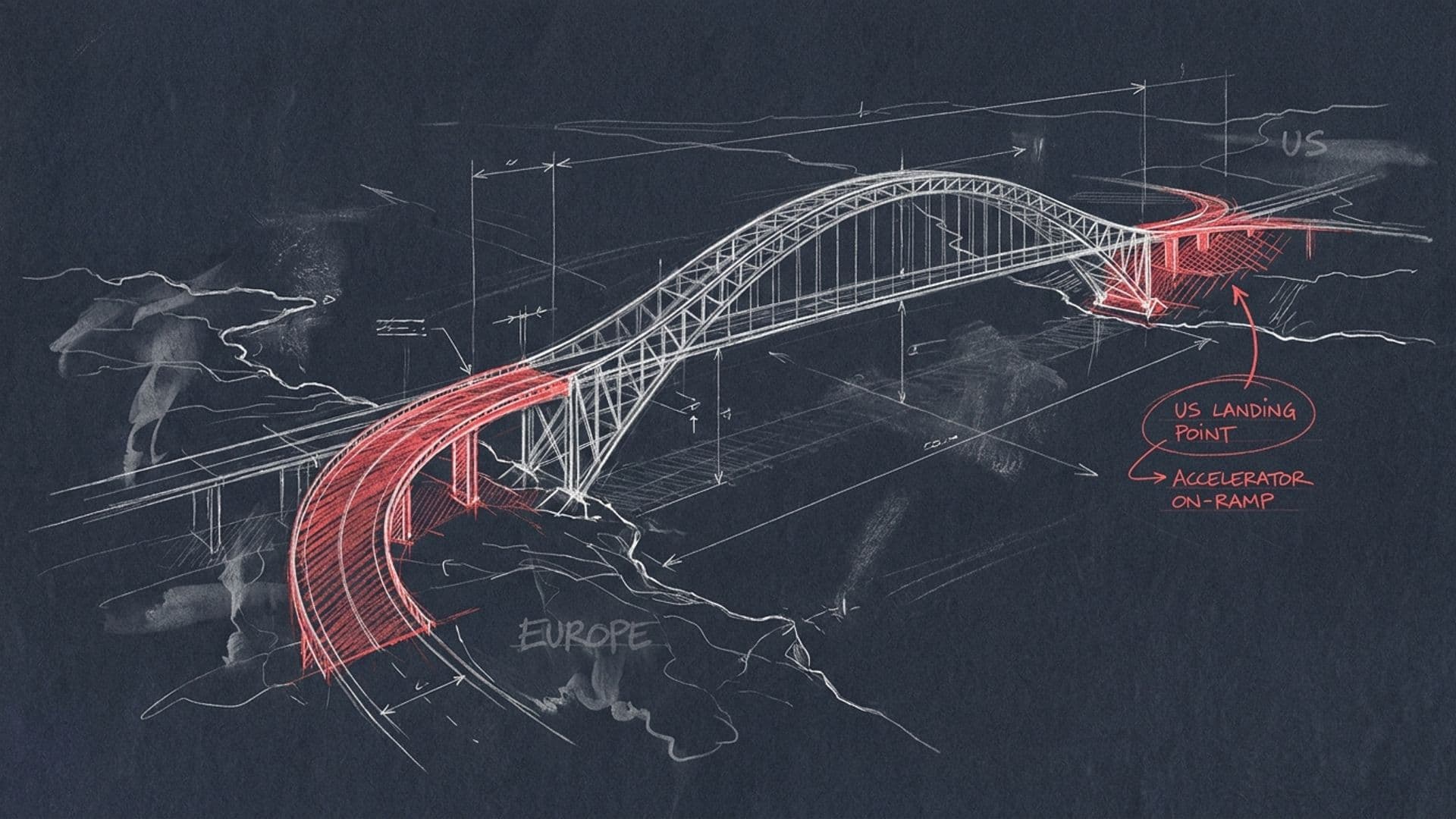
Most European founders I talk to picture US entry as a single dramatic move: lease an office in San Francisco, hire a country manager, hope. That is the expensive way to learn that nobody in America knows who you are. The cheaper, faster path for a deep-tech company is to land inside a structure that already has the network and the credibility you lack — and then do the slow work from there. My company entered the US in 2022 as a GENIUS NY $500K finalist in Syracuse, New York. This is what that mechanism actually gave us, and what it didn't.
Why I picked an accelerator over a cold move
When you build hardware in Europe and want to sell or raise in the United States, the obstacle is rarely the technology. It is that you arrive as an unknown. American buyers, investors, and partners run on warm introductions and local reference points. A European drone company with no US footprint reads, to them, as risk — even if the product is better than what they have at home.
An accelerator collapses that gap. The one we used, GENIUS NY, is a program built specifically for uncrewed systems — drones, robotics, autonomy. It runs out of the Tech Garden in Syracuse, at 235 Harrison Street, as a competition that ends in finalist awards. Being selected is itself a public signal. From the day we became a 2022 finalist, the company had a recognized American affiliation, a physical address, and a room full of people whose job included helping us. None of that existed the week before.
I want to be precise about what the program is, because it gets mislabeled. The GENIUS NY backing came as a SAFE instrument — an investment — not a grant. That distinction is not pedantry. A grant is money you spend; a SAFE is the first line on your US cap table and the start of an investor relationship with its own obligations. If you walk into one of these programs thinking you have collected free money, you will be surprised later. Read the paper. Understand the terms. Treat it as what it is: your entry point into the US capital stack, not a prize you cash and forget.
For more on how I weigh the two sides of the Atlantic when making these calls, I wrote a separate piece on where deep-tech founders should build, raise, and sell.
What "drone-in-a-box" had to prove before it could travel
It helps to know what we were bringing across. Dronehub builds autonomous "drone-in-a-box" infrastructure inspection — drones paired with docking stations that handle automated battery swap, plus the AI software that runs the missions. The point is to inspect the things people shouldn't have to climb or walk: power lines, refineries, railways. The robot does the dangerous, repetitive part, and a human reviews the result.
That matters for US entry because this is not a slide. By the time we reached Syracuse, we had a physical system that did something. Accelerators in uncrewed systems are not interested in a founder with a vision and a Figma file; they want hardware that flies, lands, swaps a battery, and produces data. The selection process rewards companies that can demonstrate, not describe. So the first lesson I would hand any European founder is upstream of the application: have a working system before you apply. The accelerator amplifies what you have. It does not manufacture it.
We had earned that readiness the hard way in Europe — through real R&D programs, and through a single decision in 2020 to stop taking outsourcing work and bet fully on the autonomous platform. That focus is what made us legible to a US program in the first place. A company that does ten things is hard to back. A company that does one hard thing well is a candidate.
What the accelerator actually delivered — network, credibility, a soft landing
Strip away the branding and a deep-tech accelerator gives you four concrete things. Network is the first: warm introductions to people who would never have answered a cold email from a foreign drone company. Credibility is the second: the finalist status itself, plus the implicit endorsement that comes from being inside a known program — one of our GENIUS NY advisors, an aerospace and radar veteran, later described our work in terms I could actually use when talking to Americans. Capital is the third, on a SAFE, which extends runway and puts a US instrument on your cap table. And a physical foothold is the fourth — a presence in Syracuse, an address, a place to host people.
That bundle is the "soft landing." For a hardware company, soft landing is not a comfort phrase; it is the difference between a year of grinding for your first relationships and getting them in a month. The compounding matters too: each warm introduction inside the program tends to produce more outside it. You are buying into a graph, not a single contact.
I would put it plainly. The accelerator's job is to make you exist in the US market's mind. It does that well. What it cannot do is the part founders secretly hope it will.
What it did not give us — and why that's the honest part
GENIUS NY did not hand us US customers. It did not deliver regulatory clearance. It did not build a sales pipeline or close revenue. Anyone who tells you an accelerator does those things is selling something.
The proof of that is in what came after, not during. In 2024 — two years past the finalist year — we ran a US product demo hosted at Marquardt in New York. That was us doing early go-to-market work ourselves: arranging a venue, getting the system in front of American eyes, showing rather than telling. Let me be exact about what that was and wasn't. Marquardt was a demo host, a place where we could show the system. It was not a customer, and I won't dress it up as one. The reason I name it anyway is that it illustrates the real shape of post-accelerator life: the program gives you the door and the introductions, and then you spend years walking through doors, one demo at a time, converting a soft landing into actual traction.
This is where a lot of European founders get the timeline wrong. They treat the accelerator as the finish line of US entry. It is the starting line. The finalist year in 2022 was the formal market entry — the moment the company had a US presence and identity. Everything that makes that presence worth anything happened afterward, slowly, and mostly by our own effort.
I am deliberately not going to give you a US revenue number, a fundraising total, or a claim that we stood up a US entity by a certain date. Those are the kinds of specifics founders inflate to sound further along than they are, and inflating them is how you lose the trust of the exact Americans you are trying to win. Vague-but-true beats specific-but-false. We entered in 2022 via GENIUS NY; we kept showing up; the rest is ongoing work.
Running the beachhead without abandoning Europe
The mistake that mirrors "treating the accelerator as the finish line" is treating US entry as relocation. It is not. Our center of gravity stayed in Europe — the engineering, the manufacturing, the EU programs that built the platform in the first place. The Syracuse presence was an addition, a beachhead, a way to test the US market without betting the whole company on a market we had no evidence in yet.
That is the right mental model: a beachhead is a hypothesis you can afford. If the US works, you scale into it. If it doesn't, you haven't moved the company off the foundation that already pays the bills. Holding both at once is genuinely hard — it is a real operational discipline, and I wrote about running one company across two continents separately because it deserves its own treatment. But the accelerator structure is what makes the hypothesis cheap enough to run. You get the upside of a US footprint without the downside of relocating a hardware company before the market has voted.
There is also a personal layer to this that I won't pretend is irrelevant. Landing a company in the US and building a credible record there feeds into your own standing as a founder — the kind of evidence that, years later, supported my EB1A extraordinary-ability green card application. The accelerator was a company move, but for an immigrant founder, company moves and personal trajectory are the same line.
What this means, and where I'd start
If you are a European or Ukrainian deep-tech founder eyeing the US, here is the compressed version of what I learned landing through GENIUS NY.
- Don't cold-move. Land inside a structure that already has the network and the credibility you lack. For uncrewed systems, GENIUS NY is a real one; there are others for other verticals.
- Bring hardware, not a deck. The program amplifies a working system. Have one before you apply.
- Read the instrument. A SAFE is not a grant. It is the start of your US cap table. Know the terms.
- Expect a soft landing, not customers. Network, credibility, capital, and a foothold are real and valuable. Pipeline and revenue are still on you, for years.
- Keep your European base. A beachhead is a hypothesis you can afford. Don't relocate the company to test a market you have no evidence in yet.
Where I'd start, concretely: get one undeniable demo working, then find the accelerator whose mentor network maps to your actual buyers, and apply to that one — not to ten. The right program for a drone company is not the right program for a fintech, and the value is almost entirely in the specificity of the network you join.
I went on to start my next company, Oswin AI, directly in the United States in 2026 — and I could only make that move because the first beachhead taught me how the US market reads a founder. If you want to compare notes on the accelerator route or US entry for hardware, reach out. The path is walkable. It is just slower, and more honest, than the version people post about.
FAQ
- Is GENIUS NY a grant?
- No. It is sometimes mislabeled as a grant, but for us it was a finalist award delivered as a SAFE instrument — an investment, not free money. That distinction matters: a SAFE means you are taking on an investor relationship and the obligations that come with it, not collecting a no-strings cheque. Treat it as your first US cap-table line, because that is what it becomes.
- Why enter the US through an accelerator instead of just opening an office?
- For a European hardware company, the hardest part of US entry isn't the airfare — it's credibility and the first warm introductions. A structured accelerator like GENIUS NY gives you a recognized local affiliation, a physical address, and a mentor network in days, where a cold move would take you a year. It is a soft landing, not a shortcut to revenue.
- What does an accelerator actually give a deep-tech startup — and what doesn't it?
- It gives you network, a credibility signal, capital on a SAFE, and a physical foothold. It does not give you US customers, regulatory clearance, or a sales pipeline. After GENIUS NY we still had to do the slow work ourselves — for example, running a 2024 US demo hosted at Marquardt in New York, which was a demo host, not a customer. The accelerator opens the door; you still have to walk through it.
- Where is GENIUS NY based and what does it focus on?
- GENIUS NY runs out of the Tech Garden in Syracuse, New York, at 235 Harrison Street, and focuses on uncrewed systems — drones, robotics, and related autonomy. It runs as a competition with finalist awards, which is part of why it is useful: the selection itself is a public signal that travels with your company name.
- Did landing in Syracuse mean abandoning Europe?
- No, and that is the point. The company's center of gravity stayed in Europe — the R&D, the manufacturing, the EU programs. The US beachhead was an addition, not a relocation. Running one company across two continents is its own discipline, but a beachhead lets you test the US market without betting the whole company on it before you have evidence.
- What should a Ukrainian or European founder do before applying to a US accelerator like GENIUS NY?
- Have a working system you can demo, not a deck. These uncrewed-systems programs want to see hardware that does something. Know exactly what you need from the US — network, capital, a customer beachhead — and be honest that the accelerator supplies the first two, not the third. And read the instrument: if it is a SAFE, understand the terms before you sign, because it is the start of your US cap table.