You keep hearing "AI drone." It gets stamped on anything with a camera and a flight controller, the same way "drone-in-a-box" got stamped on every weatherproof landing pad with a lid. But underneath the marketing there is a real and measurable thing happening, and I have spent close to a decade on the inside of it, building one of the early drone-in-a-box systems in Europe at Dronehub. So let me be useful instead of vague.
Here is the disclosure first, because it shapes everything below. I am the founder and CEO of Dronehub. We build autonomous drone-in-a-box infrastructure, and we have a software layer that competes, loosely, with some of the companies on this list. That makes me an industry insider with a stake. I am going to treat every competitor fairly anyway — not out of virtue, but because the only thing an insider's opinion is worth is its honesty, and a rigged list is worthless to you and embarrassing to me. I will not rank Dronehub first. I will tell you exactly how I judged each company, and I will source every specific claim about the others to public reporting.
The real shift: value is leaving the airframe
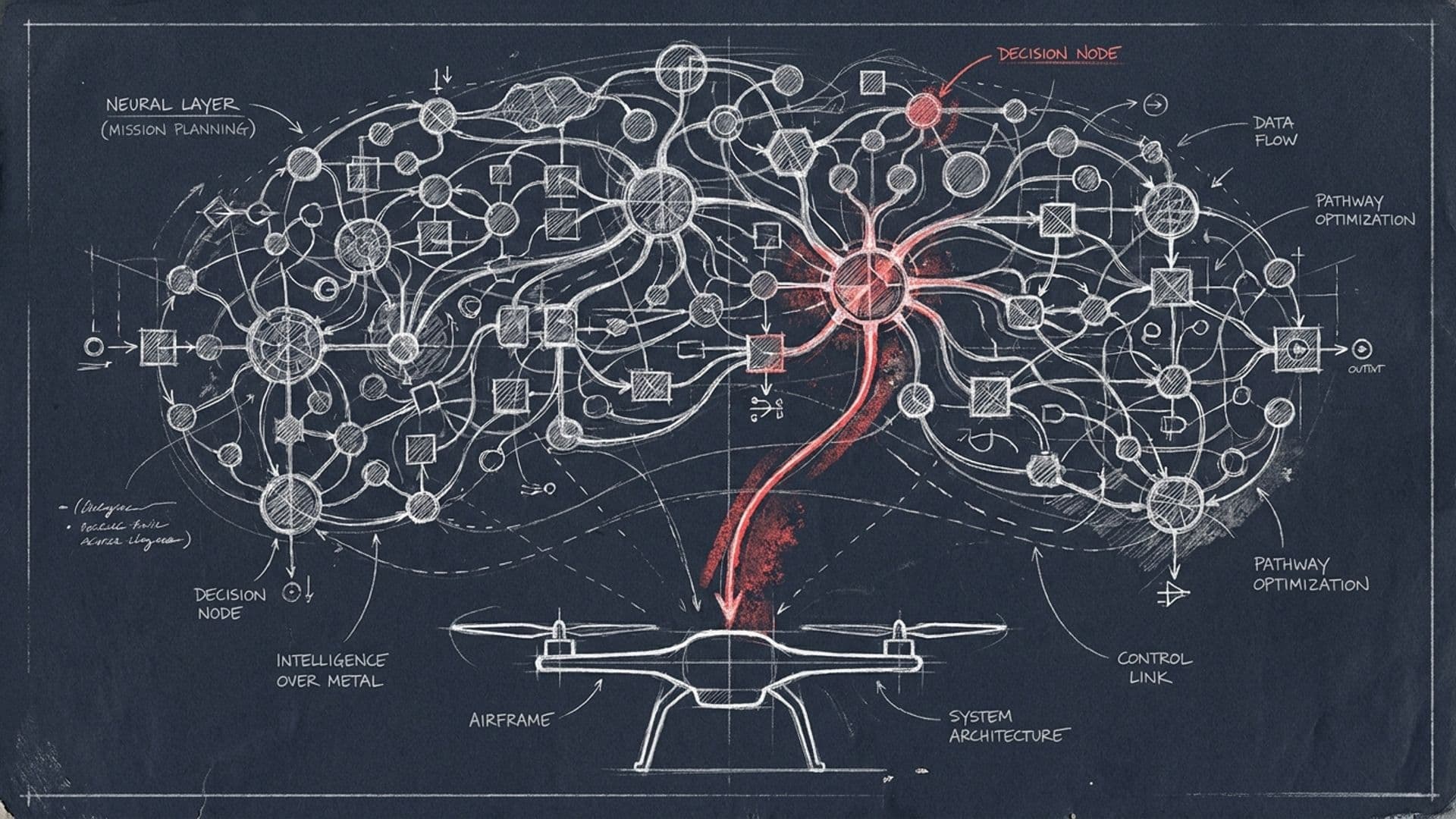
The thesis is simple. In a modern drone, the value is migrating from the metal to the mind. The airframe — props, motors, frame, battery — has largely commoditised. Plenty of companies can build a competent quadcopter. What is genuinely hard, and what customers actually pay for, is the layer above the airframe: autonomy, perception, mission planning. The software that flies without GPS, decides at the edge, and turns a stream of pixels into a verdict.
This is why "AI drone" is a meaningful category if you define it correctly. A drone that follows waypoints a human drew is automated, not intelligent. An AI drone perceives its environment and decides what to do next on its own. The companies worth your attention are the ones where the AI is the product and the airframe is just a carrier for it.
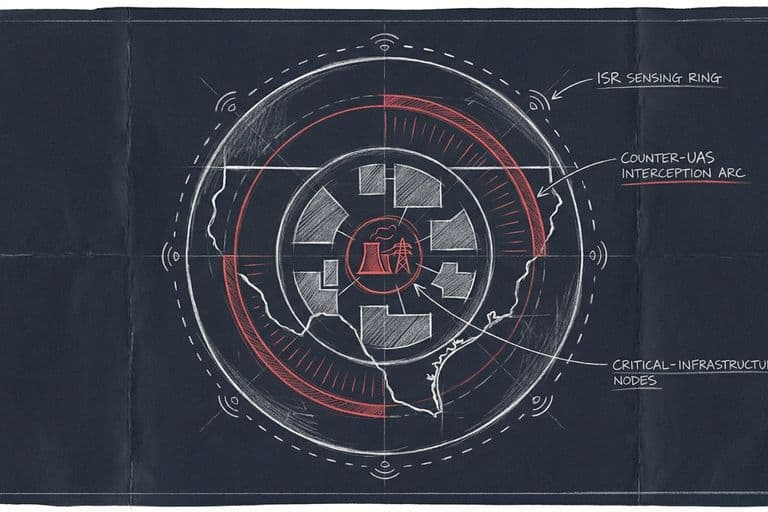
There is one more cut that matters before we look at names: the line between defense autonomy and civilian or industrial AI. They share techniques but optimise for opposite worlds. Defense autonomy is built for contested conditions — jamming, lost comms, fast tactical decisions, swarming under attack. Civilian and industrial AI is built for boring, regulated reliability — inspecting the same site every day, catching a leak, delivering medicine without killing anyone. Keep that fork in mind as we go.
The defense autonomy tier
Shield AI — the AI pilot
If you want the cleanest example of software-as-the-product, start with Shield AI, founded in 2015 and based in San Diego (per Wikipedia and the company's congressional testimony). Their core product, Hivemind, is explicitly autonomy software, not an airframe. Shield AI describes it as software that flies missions without GPS, without a remote pilot, and without a constant communications link, relying instead on onboard sensors and AI reasoning at the tactical edge (shield.ai/hivemind).
That is the whole bet: the intelligence is portable. In May 2026 Shield AI won a Pentagon contract to integrate Hivemind as the AI pilot for the Low-Cost Uncrewed Combat Attack System (LUCAS), so a group of drones can coordinate on its own while a single operator supervises and keeps the decision to strike (Breaking Defense, May 2026). In February 2026 the U.S. Air Force also selected Hivemind as mission autonomy for Anduril's YFQ-44A collaborative combat aircraft (The Defense Post, Feb 2026), and it completed its first flight test aboard that aircraft the same month (Shield AI). The pattern is consistent: the airframe changes, the AI moves with it.
Anduril — autonomy as an operating system
Anduril, founded in 2017 and headquartered in Costa Mesa, California (Wikipedia), comes at it from a level higher. Their platform, Lattice, is an AI command-and-control layer that fuses data from many sensors and platforms into a single autonomous operating picture, using computer vision and machine learning to speed up decisions (Anduril). Anduril makes drones too, but Lattice is the connective intelligence — the brain that coordinates the metal.
The scale of institutional buy-in is now hard to ignore: in March 2026 the U.S. Army awarded Anduril an enterprise contract valued at up to $20 billion over 10 years, built around Lattice (The Defense Post, March 2026). Whatever you think of defense tech, that is the market voting that the operating-system layer, not the airframe, is where the durable value sits.
Skydio — autonomy that crossed over
Skydio is the interesting hinge between consumer roots and serious autonomy. Founded in 2014 and based in San Mateo (Wikipedia), it built its reputation on drones that fly themselves — onboard visual navigation and obstacle avoidance good enough that the "pilot" mostly points at a goal. The current X10D navigates GPS-denied and jammed environments using onboard NVIDIA Jetson Orin processing and visual inertial odometry, mapping its surroundings in real time (Army Recognition, March 2026).
That capability has pulled Skydio firmly toward defense and public safety. In March 2026 the U.S. Army placed a $52 million order for about 2,500 X10D drones (Army Recognition), and in 2025 NATO's procurement agency selected Skydio in the nano-UAS category (Army Recognition). Skydio shows that strong visual autonomy is dual-use almost by default.
The civilian and industrial tier
Percepto — perception is the product
Percepto, founded in 2014 and based in Modiin, Israel (The Times of Israel), is the clearest civilian counterpart to the defense players, and the company closest to my own world. Its drone-in-a-box hardware exists to feed its software, AIM (Autonomous Inspection and Monitoring), which turns captured footage into AI-driven insight — anomalies, environmental infractions, volumetric measurements — with no human in the loop for the routine pass (Percepto).
The AI here is mostly perception, not flight heroics. In 2025 Percepto launched an AI emission detector that analyses optical gas imaging to flag potential methane leaks (DroneLife), and it reported a remote-inspection pilot with Chevron (PR Newswire, March 2025). The defense world asks "can it survive a jammed battlefield"; the industrial world asks "can it reliably tell me if that flange is leaking." Different question, equally hard AI.
Exyn Technologies — autonomy where there is no map
Exyn is the company I send people to when they think GPS-denied is a defense-only problem. A spin-out of the University of Pennsylvania's GRASP Lab (GRASP Lab), Exyn builds ExynAI, software that turns a drone into a fully autonomous explorer of spaces with no GPS, no prior map, and no constant comms link. Exyn has demonstrated what it calls Level 4 aerial autonomy: an operator defines a volume, and the drone independently explores and maps the entire space from takeoff to landing, even in total darkness (IEEE Spectrum, 2021).
The flagship use case is underground mining — exactly the place where a human pilot and a satellite signal are both unavailable. Exyn proves that the hardest autonomy problems are not owned by defense; an industrial mapping drone in a mine and a reconnaissance drone in a jammed valley are solving the same localisation problem. Exyn has since taken ExynAI beyond drones, into handheld, backpack and vehicle-mounted mapping systems, and it listed on Nasdaq in May 2026 (Exyn).
Zipline — autonomy at logistics scale
Zipline is the odd one out, and worth including precisely because it reframes "AI drone" as a fleet-coordination problem rather than a single-aircraft one. Its value is autonomy at scale: thousands of routine, safe, beyond-line-of-sight delivery flights. Each aircraft runs 500 safety checks per second in flight, carries an onboard detect-and-avoid system, and reserves its own route in an FAA-approved traffic-management system before launch (Zipline); its Platform 2 system made its first customer delivery in January 2025 (DroneXL).
The numbers make the point: Zipline surpassed 2 million commercial autonomous deliveries in January 2026 (Zipline; DroneLife). Here the AI is less about heroic single-flight autonomy and more about orchestrating many vehicles reliably enough that a hospital or a retailer will bet operations on it.
Where Dronehub fits — honestly
Dronehub sits squarely on the civilian and industrial side, next to Percepto in concept though smaller in scale. We build the full drone-in-a-box stack — docking station, automatic battery swap, and a software layer that runs the inspection loop autonomously for power lines, refineries, and railways. Our AI lives in perception and routine: launch with no pilot, fly the site, capture the data, flag the anomaly. We are not a defense autonomy company, and I am not going to dress us up as one. On this map, our edge is the integration of hardware logistics (the battery swap that lets a box run unattended for long stretches) with a workmanlike perception layer. That is a real niche, not the throne.
The comparison
Company | What the AI actually does | GPS-denied | Human-in-the-loop | Edge or cloud | Domain |
|---|---|---|---|---|---|
Shield AI | Flight autonomy + tactical decisions (AI pilot) | Yes, by design | Minimal; one operator, many drones | Edge | Defense |
Anduril | Sensor fusion + command-and-control autonomy | Platform-dependent | Supervisory (humans direct, system executes) | Edge + network | Defense |
Skydio | Visual flight autonomy + obstacle avoidance | Yes (VIO, onboard) | Low for flight; operator sets intent | Edge | Dual-use (public safety / defense) |
Percepto | Perception + inspection analytics (AIM) | Limited; site-based | None for routine passes | Edge capture + cloud analysis | Industrial inspection |
Exyn | Autonomous exploration + mapping (ExynAI) | Yes, core capability | None inside the defined volume | Edge | Industrial (mining, GPS-denied) |
Zipline | Fleet coordination + safe delivery autonomy | Mixed; routed flight | Supervisory at fleet level | Edge + cloud orchestration | Logistics |
Dronehub | Perception + autonomous inspection loop | Limited; site-based | None for routine passes | Edge capture + analysis | Industrial inspection |
How I judged this
I did not rank these companies by hype, funding, or who I like. I judged each one against five explicit axes, and I encourage you to argue with me using the same axes:
- What the AI actually does. I split flight autonomy (does the drone fly and decide for itself) from perception and analytics (does it understand what it sees). Shield AI and Exyn are heavy on the former; Percepto and Dronehub on the latter. Anduril operates above the single aircraft entirely.
- GPS-denied capability. This is the honesty test. Anyone can be autonomous with a clean satellite signal. The companies that can localise without GPS — Shield AI, Skydio, Exyn — are doing the genuinely hard work.
- Level of human-in-the-loop. Fewer humans per mission means more real autonomy. "One operator, many drones" is a different category from "one pilot, one drone."
- Edge versus cloud. Where does the thinking happen. Edge means decisions onboard in milliseconds, which matters for both jamming and latency. Cloud is fine for after-the-fact analytics, not for flying.
- Domain. Defense, dual-use, industrial, or logistics — because the same technique is judged by completely different standards depending on where it runs.
A list like this dates quickly; the contracts and milestones I cited are snapshots from late 2025 and 2026, and the field moves fast. But the underlying claim is durable: the intelligence has left the airframe and moved into the software, and the companies worth watching are the ones that knew that first. That is the bet I made a decade ago, and it is the only reason this list has a seventh row.
Key facts
Shield AI's Hivemind is autonomy software designed to fly missions without GPS, without a remote pilot, and without a constant communications link, relying on onboard sensors and AI reasoning at the edge.
Source · Shield AI, shield.ai/hivemind/
In May 2026 Shield AI won a Pentagon contract to integrate Hivemind as the AI pilot of the Low-Cost Uncrewed Combat Attack System (LUCAS), so groups of drones can coordinate under the supervision of a single operator.
Source · Breaking Defense, May 19, 2026 (https://breakingdefense.com/2026/05/shield-ai-tapped-to-integrate-autonomous-software-on-lucas-drone/)
Anduril's Lattice is an AI command-and-control platform that fuses sensor data into one autonomous operating picture; in March 2026 the U.S. Army awarded Anduril an enterprise contract valued at up to $20 billion over 10 years.
Source · The Defense Post, Mar 16, 2026 (https://thedefensepost.com/2026/03/16/us-anduril-ai-contract/)
Skydio's X10D navigates GPS-denied and jammed environments using onboard NVIDIA Jetson Orin processing and visual inertial odometry; in March 2026 the U.S. Army placed a $52 million order for about 2,500 units.
Source · Army Recognition, Mar 2026 (https://www.armyrecognition.com/news/army-news/2026/u-s-army-places-52m-order-for-2-500-skydio-x10d-isr-drones-for-platoon-reconnaissance); Skydio (https://www.skydio.com/blog/u-s-army-usd52-million-order-skydio-x10d)
Exyn Technologies, a spin-out of the University of Pennsylvania's GRASP Lab, demonstrated Level 4 aerial autonomy (ExynAI) in 2021, where an operator defines a volume and the drone independently explores and maps it in GPS-denied spaces, even in total darkness; the company listed on Nasdaq in May 2026.
Source · IEEE Spectrum, Apr 27, 2021 (https://spectrum.ieee.org/exyn-brings-level-4-autonomy-to-drones); Exyn, May 18, 2026 (https://investors.exyn.com/pr/exyn-announces-closing-of-its-initial-public-offering)
Zipline surpassed 2 million commercial autonomous drone deliveries in January 2026; each of its aircraft runs 500 safety checks per second in flight and carries an onboard detect-and-avoid system.
Source · Zipline newsroom, Jan 2026 (https://www.zipline.com/newsroom/zipline-surpasses-2-million-deliveries-raises-more-than-600m-to-power-next-phase-of-growth-and-expands-operations-to-houston-and-phoenix); Zipline Safety Facts (https://www.zipline.com/about/zipline-safety-fact-sheet)
FAQ
- What makes a drone an 'AI drone' rather than just an autonomous one?
- The distinction I use is where the decisions get made. A waypoint-following drone executes a route a human drew; it is automated, not intelligent. An AI drone perceives its surroundings and decides what to do next on its own — rerouting around an obstacle it has never seen, recognising an anomaly, or coordinating with other aircraft. The intelligence is the software layer that turns sensor data into decisions, and that layer is increasingly the product.
- Is the most valuable part of a modern drone the airframe or the software?
- In 2026 it is overwhelmingly the software. Airframes have largely commoditised — competent quadcopters and fixed-wings can be built by many vendors. What is hard, and what customers actually pay for, is the autonomy and perception stack: flying without GPS, making decisions at the edge, and turning footage into a verdict. The companies winning are the ones that treat the software as the product and the airframe as a carrier for it.
- What does 'GPS-denied' mean and why does it matter so much?
- GPS-denied means the drone cannot rely on satellite positioning, either because it is indoors, underground, or because the signal is being jammed. It matters because GPS is the easy way to know where you are, and the moment it is gone a drone needs another way to localise — usually visual inertial odometry, where onboard cameras and motion sensors estimate position from what the drone sees. GPS-denied capability separates genuinely autonomous systems from ones that quietly depend on a satellite link.
- What is the difference between defense autonomy and civilian industrial AI in drones?
- Defense autonomy is built for contested, adversarial conditions: jamming, no comms, fast tactical decisions, and often swarming. Civilian and industrial AI is built for repeatable, regulated, safety-critical routine: inspecting the same refinery every day, detecting a methane leak, delivering medicine. The autonomy techniques overlap heavily, but the operating assumptions diverge — one optimises for survival under attack, the other for reliability and compliance under scrutiny.
- Where does Dronehub fit on this map?
- Dronehub sits on the civilian and industrial side. We build drone-in-a-box infrastructure — a docking station, automatic battery swap, and a software layer that runs the inspection loop autonomously for power lines, refineries, and railways. Our AI is about perception and routine: launching with no pilot, flying a site, capturing data, and flagging anomalies. I am not claiming we lead this field; I am placing us honestly within it.
- Why should I trust a ranking written by a competitor in the space?
- You should trust the criteria, not my goodwill. I have published the exact judging axes — what the AI does, GPS-denied capability, human-in-the-loop, edge versus cloud, and domain — so you can check my reasoning against the companies' own public claims. I have deliberately not ranked my own company first, and I have sourced every specific fact about competitors to reputable public reporting. Insider knowledge is useful precisely when it comes with disclosed bias and explicit standards.