You keep hearing "drone-in-a-box," and by 2026 there's a crowded field selling some version of it. The problem is that almost every "top drone-in-a-box" list online is written by someone who has never landed a drone on a platform in the rain, ranks whoever pays the most, and treats a charging dock and a robotic swap-hangar as if they're the same product. They are not.
I've spent close to a decade building one of the early European versions of this machine. So this is my honest map of the market — who's actually out there, what category each one really belongs to, and where each is strong or weak against criteria that matter to an operator, not a marketer.
Disclosure: I build one of these
Let me put my bias on the table before anything else. I'm the founder and CEO of Dronehub — we started in 2015 as Cervi Robotics, took the Dronehub name in 2020, and we build drone-in-a-box infrastructure: the drone, the docking station with automated battery handling, and the AI software that ties them together. I have skin in this game.
That's exactly why this ranking includes my competitors and treats them fairly. I am not putting Dronehub at number one — that would be the tell of a sales page dressed up as analysis. I know this market because I compete in it, which means I know where the other systems are genuinely better than ours, and I'll say so.
How I judged this
I scored each company on six things I actually care about when I'm building or buying:
- Degree of autonomy — does it truly run the full loop (takeoff, mission, landing, power, upload) with no one on site, or does it still need hands?
- Battery handling — charge-in-place versus mechanical swap. This is the single biggest architectural fork in the whole category.
- Weather and ingress rating — IP rating, temperature range, wind tolerance. A box lives outdoors for years.
- BVLOS and regulatory posture — what flights is it actually cleared for, and where? Hardware without paperwork is a toy.
- Target use-case — industrial inspection, security/perimeter, or public safety/defense. Few systems are great at all three.
- Software and AI layer — the part that plans the mission and reads the imagery, which is increasingly where the value sits.
I only used facts I could confirm from a reputable source — each company's own materials, trade press like DroneLife and Commercial UAV News, or official regulators. Where I couldn't pin a number, I describe it qualitatively rather than invent one. Specs change fast in this field, so treat this as a snapshot checked in September 2026 and verify against the vendor before you sign anything.
The two real categories
Before the names, understand the fork. Almost every system here is one of two things.
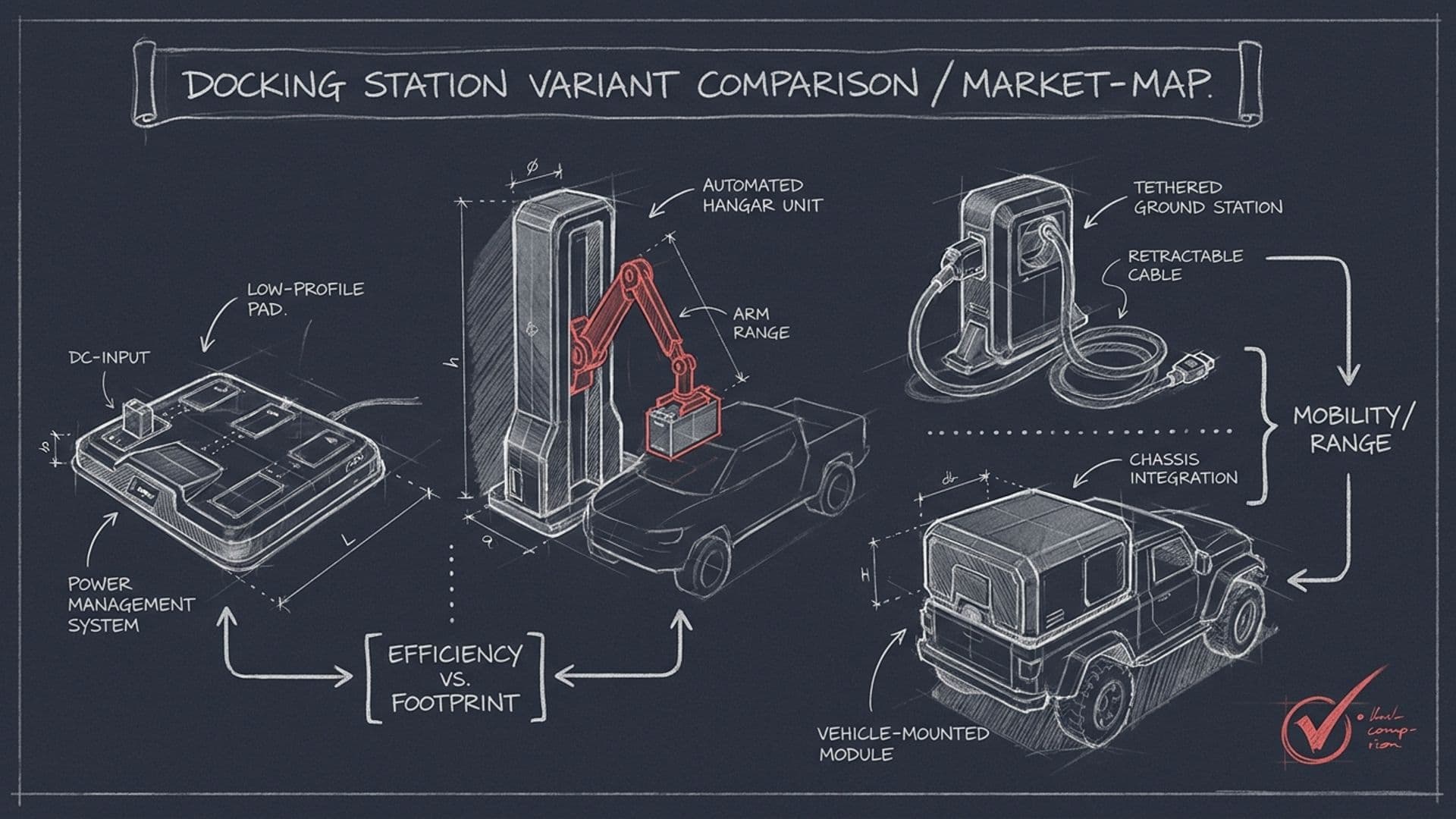
Charge-in-place docks land the drone and recharge the same battery on the platform. Simpler, cheaper, lighter. The cost is duty cycle: the drone sits grounded for roughly half an hour while the pack refills (DJI quotes about 27 minutes for its Dock 3). DJI, Skydio, and Percepto live here.
Battery-swap hangars use a robotic mechanism to pull the spent pack and insert a fresh one in a few minutes, so the aircraft flies again almost immediately. Some go further and swap payloads too. The cost is mechanical complexity — moving parts that have to work in rain, dust, and frost, every single time. Airobotics, American Robotics, and Dronehub live here.
Neither is "better." A site that flies twice a day is fine charging in place; a site that needs near-continuous coverage needs a swap. Get this fork wrong and no amount of AI saves the program. I wrote a whole separate piece on the battery-swap-versus-charging tradeoff if you want the engineering.
The players
Percepto
Percepto is one of the most credible names in autonomous industrial inspection. Their AIM (Autonomous Inspection & Monitoring) software is the heart of the product — a browser-based platform for planning missions, watching live RGB or thermal streams, and running AI analytics over the captured data. The Percepto Base is a charge-in-place dock with an integrated weather station, and the platform supports "base hopping," where one drone can work from multiple bases.
Their regulatory record is the standout. Percepto raised a $67M Series C in 2023 (more than $120M in total) and in September 2024 secured an FAA Type Certificate — one of only a small number of drone solutions to clear that bar — on top of an earlier nationwide waiver for shielded BVLOS flights at U.S. critical-infrastructure sites. Strong AI layer, strong paperwork, aimed at oil and gas, utilities, mining, and energy.
Skydio
Skydio is a U.S. manufacturer (founded 2014, HQ San Mateo, CA) that built its reputation on best-in-class onboard autonomy and obstacle avoidance, and brought it to a dock with the Dock for X10, launched in 2024. The X10 flies up to roughly 40 minutes; the Dock is rated IPX6 with its roof closed, operates from -20°C to 50°C, and bolted down it tolerates serious wind. It charges in place. Their Remote Ops software lets operators fly on demand from a browser and share live streams via link. In September 2026 Skydio also unveiled its first fixed-wing drone, the F10 Lightrunner, and a MegaDock that houses up to five of them, with customer deployments planned for 2027.
The thing that sets Skydio apart commercially isn't a spec — it's posture. The X10D variant is NDAA-compliant and on the U.S. DoD's Blue UAS Cleared List — since July 2026, so are the standard X10 and the Dock — which makes Skydio a default for U.S. public-safety and defense-adjacent buyers who can't touch Chinese hardware. Edge AI is excellent. Battery swap is not their game.
Airobotics (Optimus)
Airobotics, part of Ondas since 2023, built the system I respect most on the pure mechanical-autonomy axis. The Optimus Airbase uses a robotic arm to swap both the flight battery and the payload, and the hangar stores up to 11 batteries and 9 payloads — EO/IR, LiDAR, mapping cameras, a light delivery payload — so a single box can change what it does between flights. Ondas has put the average landing-to-takeoff turnaround at about 3.5 minutes. The Optimus 1-EX earned an FAA Type Certificate in September 2023, a genuine milestone for a drone-in-a-box.
This is heavy industrial infrastructure, not a light dock: a hangar built for continuous, on-demand, 24/7 operation. If your problem is maximum duty cycle and sensor flexibility on a big site, this architecture is the reference design.
American Robotics / Ondas
American Robotics, part of Ondas (Ondas Holdings until January 2026) since 2021, now operates the Optimus System — developed by its sister company Airobotics — under a series of FAA BVLOS waivers, monitored remotely from an operations control center. Its earlier Scout System holds a real historical first: in January 2021 American Robotics became the first company the FAA approved to operate automated drones with no human operator on site. In January 2025 it secured a waiver expanding operations over people and moving vehicles from a remote operations center.
Read American Robotics as the regulatory-frontier player in the U.S. swap-hangar category — strongest where the deciding factor is what the FAA will let you fly, autonomously, with nobody in the field.
Azur Drones (Skeyetech)
Azur Drones (France, founded 2012) was the European security-and-surveillance specialist. In 2019 its Skeyetech system became the first to receive French DGAC approval for fully autonomous flight from a docking station with no remote pilot — directly operable by a trained security guard rather than a licensed aviator. That regulatory milestone, paired with a product built specifically for perimeter patrol day and night, is why Skeyetech showed up on critical industrial sites across Europe.
The company did not survive; the product did. Azur Drones went into receivership in spring 2026 and was liquidated that summer. Drone Volt bought the Skeyetech assets at the Bordeaux commercial court and in late August signed a binding agreement to sell the new Azur Drones company to Tonner Drones, subject to the court administrator's approval, while keeping a commercial partnership. If your problem is automated site security in European airspace rather than inspection analytics, Skeyetech is still the system built for exactly that — but ask who will support it for the next five years before you sign.
Easy Aerial
Easy Aerial is the outlier here, and I include it deliberately because it's a different answer to a related problem. Built by former military personnel together with aerospace and software engineers, it's best known for tethered autonomous systems alongside free-flying drone-in-a-box products, including versions that deploy from vehicles. A tether delivers data-over-power for effectively unlimited flight time and a hardened, jam-resistant link — at the cost of the drone's range and freedom. Its products are NDAA-compliant, the company says it is on the Blue UAS Cleared List, and it sells mainly for government, military, and security monitoring.
Different physics, same goal: persistent eyes overhead. If you need a fixed asset watched continuously and you value endurance and link security over free flight, this is the category to look at.
DJI Dock 3
The DJI Dock 3 (2025) is the value benchmark everyone else is measured against. It's a charge-in-place dock rated IP56, operates from -30°C to 50°C, tolerates landing winds up to 12 m/s, charges its Matrice 4D-series drone from 15% to 95% in about 27 minutes, and now offers vehicle-mounted deployment. For raw price-performance and ecosystem maturity, it's extremely hard to beat.
The caveat is not technical. DJI is a Chinese manufacturer. In December 2025 the U.S. FCC added foreign-made drones and drone components, DJI's included, to its Covered List, so new models can no longer get the equipment authorization they need to be imported or sold in the U.S.; models authorized earlier can still be sold and flown. The same rule reaches every foreign-built drone, European and Israeli ones included, unless it is on the Blue UAS Cleared List or qualifies under Buy American rules — an exemption that currently runs to January 1, 2027. Many U.S. and some European government, defense, and critical-infrastructure buyers also face procurement restrictions or supply-chain-security policies that exclude DJI. If none of that applies to you, it's a genuine contender. If it does, this whole row is off the table — which is, frankly, half of why the NDAA-compliant players above have a market.
Dronehub
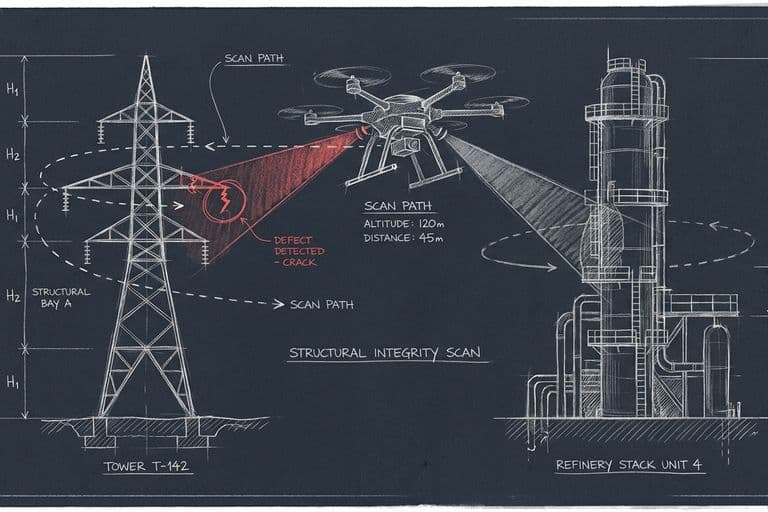
And mine. Dronehub sits in the battery-swap-hangar camp: an outdoor station with environmental conditioning that lands the drone, runs a two-minute robotic battery swap and stages it for the next mission with no human in the loop, plus an in-house AI layer for anomaly detection on the captured imagery. We aim at critical-infrastructure inspection — the tall, linear, hazardous assets people otherwise climb or walk.
Where am I honestly weaker than the field? On U.S. regulatory record, Percepto and the Ondas pair (Airobotics and American Robotics) are ahead — they hold FAA type certificates and waivers I can't claim. On ecosystem scale and price, DJI is ahead of all of us. On pure onboard edge autonomy, Skydio is a hard benchmark. Our European R&D pedigree is real — Horizon 2020, ESA, EDA programs — but a buyer should weigh that against the specific paperwork their own site needs. That's the honest placement: a strong swap-architecture inspection player among serious peers, not the default winner.
The comparison table
Company | Battery handling | Weather / ingress | BVLOS / regulatory posture | Primary use-case | AI / software layer |
|---|---|---|---|---|---|
Percepto | Charge in place | Dock w/ integrated weather station | FAA Type Certificate (2024); nationwide shielded-BVLOS waiver (US) | Industrial inspection (oil & gas, utilities, mining) | AIM platform; strong AI analytics |
Skydio | Charge in place | IPX6 (roof closed); -20°C to 50°C | Blue UAS-cleared (X10D; X10 + Dock since Jul 2026); strong US public-safety posture | Public safety, security, defense-adjacent | Best-in-class onboard autonomy; Remote Ops |
Airobotics (Ondas) | Robotic swap (battery + payload; ~3.5 min landing-to-takeoff) | Hardened, climate-controlled hangar | FAA Type Certificate (Optimus 1-EX, 2023) | Heavy industrial inspection & security | Multi-payload mission system |
American Robotics / Ondas | Robotic swap | Hardened hangar | First FAA-approved no-operator BVLOS (Scout); expanded waivers (2025) | Industrial, infrastructure, public safety | Remote operations control center |
Azur Drones (Skeyetech) | Charge in place | Outdoor docking station | First French DGAC fully-autonomous approval (2019); company liquidated 2026, assets now with new owners | Security / perimeter patrol (Europe) | Autonomous surveillance software |
Easy Aerial | Tethered (data-over-power) / free-flight | Rugged, all-weather; NDAA-compliant | Blue UAS-listed (per company); US gov/military focus | Persistent monitoring, defense, security | Autonomous monitoring; tethered link |
DJI Dock 3 | Charge in place (~27 min 15→95%) | IP56; -30°C to 50°C; 12 m/s wind | Capable hardware; no new US FCC authorizations since Dec 2025; procurement bans for some buyers | Broad commercial inspection & mapping | Mature ecosystem; FlightHub |
Dronehub | Two-minute robotic battery swap | Outdoor station w/ environmental conditioning | EU R&D pedigree (H2020/ESA/EDA); site-by-site BVLOS | Critical-infrastructure inspection | In-house edge AI anomaly detection |
A note on reading this: the table flattens nuance on purpose. "Charge in place" isn't a knock and "robotic swap" isn't automatically a win — they're answers to different duty cycles. A few minutes versus half an hour matters enormously on a site that flies all day, and not at all on a site that flies twice.
How to actually choose
Strip away the logos and it comes down to three questions.
How often does the site fly? High frequency pushes you toward a swap hangar (Airobotics, American Robotics, Dronehub). Low frequency means a charging dock (DJI, Skydio, Percepto) is plenty, and you keep the cost and simplicity.
What's the job — inspection, security, or persistent watch? Inspection rewards the analytics layer (Percepto, Dronehub) and payload flexibility (Airobotics). Security rewards purpose-built patrol (Azur's Skeyetech in Europe, now under new owners; Skydio for US public safety). Persistent fixed-point watch is where a tether (Easy Aerial) quietly wins.
Who's buying, and under what rules? This decides more than any spec sheet. A U.S. federal or critical-infrastructure buyer is often steered to Blue UAS / NDAA-compliant systems regardless of price; a European industrial site weighs DGAC or EASA pathways. Sort out your regulatory and procurement constraints first — they'll eliminate half the table before you ever compare an IP rating.
That's the map as I see it from inside the field in 2026. The category is real, the machines are buildable, and no single one of these companies — mine included — is the right answer for everyone. Match the architecture to your duty cycle and your rulebook, and the shortlist writes itself.
Key facts
There is no single 'best' drone-in-a-box: the real categories are charge-in-place docks (DJI, Skydio, Percepto) versus mechanical battery/payload-swap hangars (Airobotics/American Robotics, Dronehub), and the right answer depends on the duty cycle the site needs.
Source · Vadym Melnyk, founder & CEO of Dronehub
Percepto raised a $67M Series C in June 2023 (more than $120M in total) and in September 2024 secured an FAA Type Certificate, one of only a small number of drone solutions to do so.
Source · Percepto, Jun 2023 (https://percepto.co/percepto-raises-67m-series-c-receives-faa-waiver-ushering-in-new-era-of-autonomous-drone-inspections-at-industrial-sites/); Percepto, Sep 2024 (https://percepto.co/percepto-secures-faa-type-certificate-formalizing-safety-and-reliability-approval/)
Skydio (founded 2014, HQ San Mateo, CA) launched the Dock for X10 in September 2024; the X10 flies up to 40 minutes, the dock operates from -20°C to 50°C and is rated IPX6 with its roof closed, and in July 2026 the X10 and the Dock joined the X10D on the U.S. DoD's Blue UAS Cleared List.
Source · Skydio Dock for X10 datasheet (https://www.skydio.com/resources/datasheets/dock-for-x10) and site-readiness guide (https://www.skydio.com/resources/guides/skydio-dock-for-x10-operational-readiness-overview); DroneLife, Sep 25, 2024; DroneXL, Jul 23, 2026 (https://dronexl.co/2026/07/23/skydio-full-lineup-blue-uas-cleared-list/)
Airobotics' Optimus uses a robotic arm to swap its own batteries and payloads, holding up to 11 batteries and 9 payloads; its Optimus 1-EX received an FAA Type Certificate in September 2023, and Ondas has put the average landing-to-takeoff turnaround at about 3.5 minutes.
Source · American Robotics, Optimus System (https://www.american-robotics.com/optimus-system); Ondas, Sep 2023 (https://www.ondas.com/post/ondas-holdings-airobotics-optimus-1-ex-drone-receives-historic-u-s-faa-type-certification); Ondas SEC filing, Exhibit 99.1 (2022)
American Robotics (part of Ondas, formerly Ondas Holdings, since 2021) operates the Optimus System under FAA BVLOS waivers from a remote operations center; in January 2021 it became the first company the FAA approved to operate automated drones without human operators on site, and in January 2025 it won a waiver for operations over people and moving vehicles.
Source · DroneLife, Jan 17, 2021 (https://dronelife.com/2021/01/17/america-robotics-snags-first-ever-faa-approval-to-fly-automated-bvlos-drones/); Ondas, Jan 3, 2025 (https://ir.ondas.com/press-releases/detail/187/ondas-american-robotics-secures-its-latest-faa-bvlos); DroneLife, Jan 6, 2025
DJI Dock 3 (February 2025) is a charge-in-place dock rated IP56 that operates from -30°C to 50°C, tolerates landing winds up to 12 m/s, charges its drone from 15% to 95% in about 27 minutes and supports vehicle mounting; since December 22, 2025 the FCC has refused new U.S. equipment authorizations for foreign-made drones, DJI's included, while models authorized earlier stay legal.
Source · DJI Enterprise, Dock 3 specs (https://enterprise.dji.com/dock-3/specs); FCC fact sheet, Dec 22, 2025 (https://docs.fcc.gov/public/attachments/DOC-416839A1.pdf)
FAQ
- Who are the main drone-in-a-box companies in 2026?
- The players I'd put on a serious shortlist are Percepto, Skydio, Airobotics and American Robotics (both part of Ondas), Azur Drones' Skeyetech (under new owners since 2026), Easy Aerial, DJI, and my own company, Dronehub. They don't all do the same thing. Some are charge-in-place docks aimed at scale and price; some are mechanical battery-swap hangars built for heavy industrial duty cycles; one (Easy Aerial) is best known for tethered systems. The right name depends entirely on your use-case and where you operate.
- What is the difference between a charging dock and a battery-swap dock?
- A charging dock lands the drone and recharges the same battery in place — simpler to build and cheaper, but the drone is grounded for roughly half an hour between flights (DJI quotes about 27 minutes for a 15–95% charge on Dock 3). A battery-swap dock uses a robotic mechanism to pull the depleted pack and slot in a fresh one in a few minutes, so the aircraft is back in the air almost immediately. DJI and Skydio charge in place; Airobotics, American Robotics, and Dronehub swap. The swap buys you a much higher duty cycle at the cost of mechanical complexity.
- Which drone-in-a-box is best for industrial inspection versus security?
- For heavy industrial inspection at large sites — oil and gas, mining, utilities — the swap-and-payload hangars (Airobotics, American Robotics) and the inspection-focused platforms (Percepto, Dronehub) fit best because they prioritize duty cycle and modular sensors. For security and perimeter patrol, Azur Drones built its whole Skeyetech product around it in Europe (the company was liquidated in 2026 and Skeyetech now sits with new owners), and Skydio and Easy Aerial are strong on public safety and defense-adjacent monitoring. DJI Dock 3 is the value option across many of these if its supply-chain and regulatory status fits your organization.
- Are these systems allowed to fly beyond visual line of sight (BVLOS)?
- BVLOS is the regulatory unlock that makes a box worth installing, and it's earned site by site or via broad waivers, not bought off the shelf. In the U.S., Percepto and the Ondas companies (American Robotics and Airobotics) hold notable FAA waivers and type certificates; in Europe, Azur Drones was an early holder of a French DGAC approval (2019) for fully autonomous flight. The hardware matters, but the paperwork and the operating record behind it matter just as much.
- Is DJI Dock 3 a good choice for a drone-in-a-box program?
- On pure price-performance it's hard to beat: IP56, a wide -30°C to 50°C operating range, fast in-place charging, and vehicle-mounted deployment. The honest caveat is non-technical — DJI is a Chinese manufacturer. In the U.S., the FCC has refused new equipment authorizations for foreign-made drones, DJI's included, since December 2025, so new DJI models can't be imported or sold there; models authorized earlier stay legal. Many government, defense, and critical-infrastructure buyers in the U.S. and parts of Europe also face procurement restrictions or supply-chain-security policies that rule it out. If none of that applies to you, it's a serious contender. If it does, look at NDAA-compliant, Blue UAS-cleared alternatives.
- Why should I trust a ranking written by a drone-in-a-box founder?
- You should trust it exactly because I'll tell you where my own company is weak and where competitors are strong, which a neutral listicle padded with affiliate links usually won't. I founded Dronehub and I have skin in this game, so I've placed us honestly among peers rather than at number one. The criteria are explicit and the facts about other companies are sourced. Read it as a builder's map, not a sales pitch — and verify the specs against each vendor before you buy.