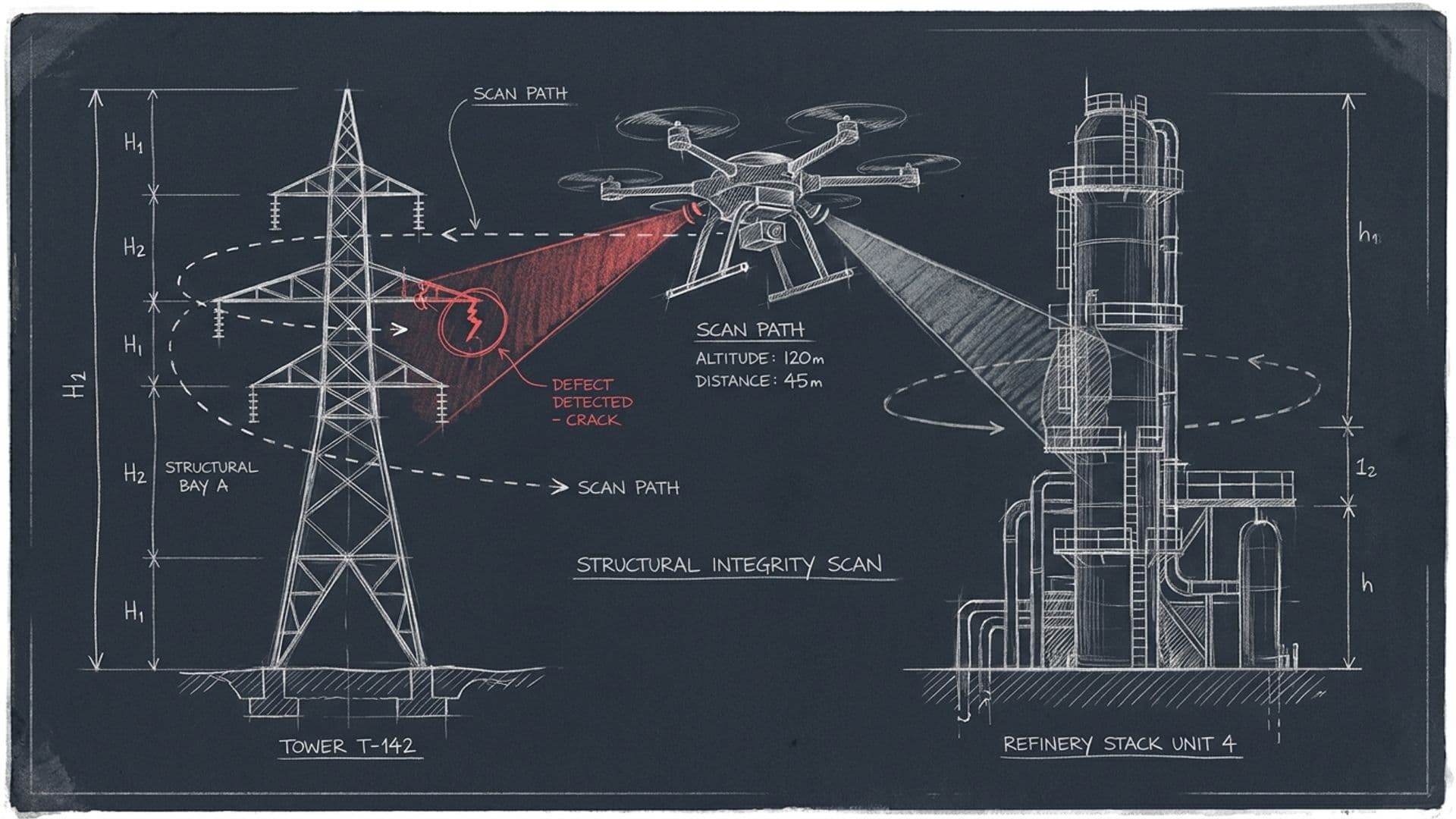
I've spent close to a decade building inspection drones that fly without a pilot on site, so when someone asks me what to buy, I don't start with the drone — I start with the asset. A transmission tower, a refinery flare stack, a railway catenary, the inside of a fuel tank: each one fails in its own way, sits in its own airspace, and tolerates its own kind of machine near it. Get the asset right and the shortlist almost writes itself. Get it wrong and you'll spend a year fighting a beautiful drone that was never built for your job.
Most "best inspection drone" lists online skip that step entirely. They rank whoever pays, treat a confined-space crawler and an outdoor drone-in-a-box as if they compete, and quote specs nobody verified. This is the version I'd give a colleague at a utility or an energy operator who actually has to deploy the thing and answer for it.
Disclosure: I build one of these
My bias goes on the table first. I'm the founder and CEO of Dronehub — we started in 2015 as Cervi Robotics, took the Dronehub name around 2020, and we build autonomous drone-in-a-box systems for critical-infrastructure inspection: the drone, a docking station with automatic battery swap, and the AI software that ties them together. I compete with most of the companies below.
That's exactly why I treat them fairly and why Dronehub is not sitting at number one. A buyer's guide that crowns the author's own product is a sales page wearing a lab coat. I know where the other systems beat ours, and I'll say so.
How to choose: judge the asset, then the drone
Here are the six criteria I actually weigh, in the order they tend to matter.
- Autonomy and docking. Does it run the full loop — takeoff, mission, landing, re-power, upload — with nobody on site? And if it docks, does it charge the same battery in place (simpler, but grounded 25-45 minutes) or swap a fresh pack in (more complex, near-continuous duty cycle)? I break that trade-off down in Battery Swap vs. Charging. For confined spaces, "autonomy" means something different: stable flight in GPS-denied air, not unattended docking.
- Sensor payload. RGB zoom for visual defects, radiometric thermal for hot joints and failing cells, LiDAR for 3D models and GPS-denied interiors, optical gas imaging for hydrocarbon leaks. Match the payload to the failure mode, not the brochure.
- Weather and ingress rating. IP rating, temperature range, wind tolerance. A box lives outdoors for years; a confined-space drone has to survive contact, not weather.
- BVLOS and regulatory fit. What is the system actually cleared to fly, and where? Hardware without the paperwork behind it is a demo, not a program.
- Data and AI pipeline. The mission planner and the analytics that read the imagery — increasingly where the real value sits. A drone that collects 10,000 images you can't triage is a liability.
- Best-fit asset type. Grid and substations, oil and gas, rail, solar, confined spaces, turbine blades. Few systems are great at more than two.
I only used facts I could confirm from a reputable source — vendor spec sheets, trade press like DroneLife and Commercial UAV News, or official regulators. Where I couldn't pin a number, I describe it qualitatively rather than invent one. Specs move fast here; treat this as a 2026 snapshot and verify before you sign.
The first fork: box, piloted drone, or close-proximity flyer
Before the names, understand the three shapes, because they don't compete with each other — they fit different assets.
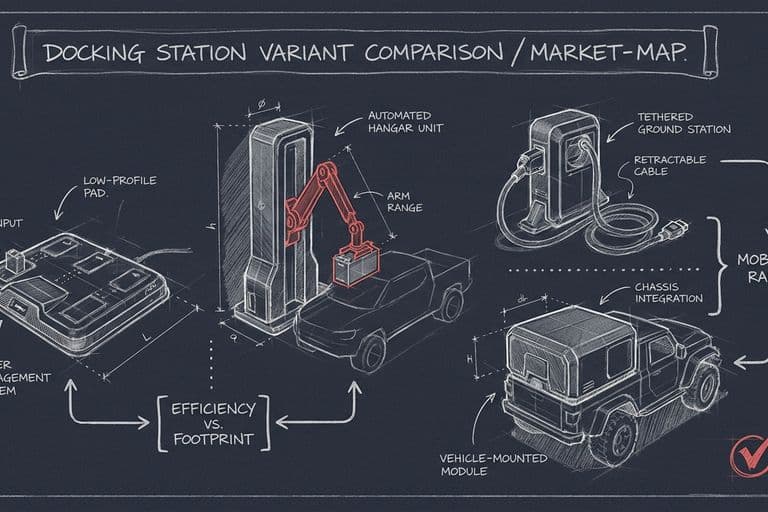
Full drone-in-a-box systems install a weatherproof station at the site and fly routine, scheduled, unmanned missions. This is the right shape for large fixed assets you inspect over and over: substations, refineries, solar farms, perimeters. Percepto, Airobotics, DJI's and Skydio's docks, and Dronehub live here.
Piloted confined-space drones are flown by a person, usually indoors, in GPS-denied air where no box could ever land. Tanks, boilers, sewers, mine shafts, ship hulls. Flyability owns this category.
Close-proximity autonomous flyers use autonomy software to fly tight, precise paths around complex surfaces — wind-turbine blades being the classic case — where a generic dock-and-orbit mission won't do. Nearthlab is the clearest example.
Pick the wrong shape and no spec sheet saves you. A drone-in-a-box cannot inspect the inside of a tank, and a caged confined-space drone cannot patrol a 20-kilometre pipeline. Most buyer mistakes I see are right here, at the fork, not in the fine print.
The comparison table
A snapshot across the six criteria. Read it as a starting map, not gospel — every spec must be checked against the vendor's current sheet before procurement.
System | Autonomy / docking | Sensor payload (verified) | Weather / IP | BVLOS & regulatory | Best-fit asset |
|---|---|---|---|---|---|
Percepto (Air Max + Base) | Drone-in-a-box; charge-in-place (patented docking & charging); remote ops | 61MP full-frame RGB + radiometric thermal; optical gas imaging option; FAA-compliant parachute | Base built for heavy rain, snow, high winds, dust; "hurricane-5" wind-tested (numeric IP not published by vendor) | Strong: FAA "shielded" BVLOS waiver (2023); FAA Type Certificate (2024) | Oil & gas, mining, utilities, solar |
Skydio (X10 + Dock) | Drone-in-a-box; charge-in-place; strong onboard autonomy (3D Scan, 360° avoidance) | 64MP narrow / 50MP wide / 48MP tele cameras; FLIR Boson+ 640×512 thermal | X10 IP55, -20°C to +45°C; Dock IPX6 (roof closed), -20°C to 50°C | Remote ops via Dock + cloud; BVLOS by FAA waiver; X10 and Dock on Blue UAS Cleared List (2026) | Utilities, public safety, defense, infrastructure |
DJI (Dock 3 + Matrice) | Drone-in-a-box (Dock 3 with Matrice 4D/4TD, charge-in-place); Matrice 400 / 350 RTK and Matrice 4T as piloted inspection | Zenmuse H30T: 1280×1024 thermal, 34× hybrid optical zoom; M4T 640×512 thermal | Dock 3 IP56, -30°C to 50°C; M400 IP55 | Capable, but since Dec 22, 2025 new DJI models can't get FCC authorization for the US | Broad inspection where supply-chain policy allows |
Flyability (Elios 3) | Operator on site, GPS-denied; collision-tolerant cage; onboard FlyAware SLAM; autonomous repeat flights (not a box) | 4K RGB + thermal + distance; modular UT, gas, radiation; Ouster OS0-128 LiDAR (surveying) | Designed to IP44 (not certified); built for contact, not weather; fits 50×50 cm openings | Indoor / GPS-denied — different regulatory regime | Confined spaces: tanks, boilers, sewers, mines, hulls |
Airobotics (Optimus + Airbase, Ondas) | Drone-in-a-box; automated battery & payload exchange; FAA Type Certificate (Optimus 1-EX) | Swappable payloads: dual EO/IR video, LiDAR, mapping | Industrial outdoor station | FAA Type Certificate (Sept 2023); security and defense focus | Public safety, homeland security, critical infrastructure |
Nearthlab (NearthWIND Pro / Mobile + Zoomable) | Autonomous close-proximity blade inspection; app that automates small commercial drones | 45MP full-frame camera (NearthWIND Pro); Zoomable inspection-data platform | Flies in gusts up to 17 m/s (vendor figure) | On-site operator; close-range flights | Wind-turbine blades, renewables |
Dronehub (my company) | Drone-in-a-box; two-minute robotic battery swap for near-continuous duty cycle; AI software | Visible-spectrum + thermal capture; in-house AI anomaly detection | Outdoor docking station for unmanned routine missions | EU R&D pedigree (Horizon 2020, ESA/EDA); in the EU, BVLOS is authorised per operation | Power lines, refineries, railways |
Where each one fits — the honest read
Percepto is the one I'd shortlist first for heavy industrial exterior inspection. The current Air Max carries a 61MP full-frame RGB camera plus radiometric thermal, with optical gas imaging available, which is exactly the sensor stack a refinery or an oil-and-gas site wants. More importantly, Percepto did the regulatory work: it holds an FAA "shielded" BVLOS waiver from May 2023 that lets it fly close around critical-infrastructure assets without humans on site and without detect-and-avoid systems, and in September 2024 it added an FAA Type Certificate. Note the one thing I could not confirm — a numeric IP rating for the Percepto Base. Their own page uses qualitative language ("heavy rain, snow, high winds and dust," and a Base "tested to withstand hurricane-5 winds"), so don't accept a specific IP number from a reseller without a vendor spec sheet.
Skydio is the autonomy story. The X10's onboard intelligence — 360-degree obstacle avoidance from six navigation cameras, and the 3D Scan capability that lets the aircraft decide its own capture path around a structure — is genuinely strong, and the sensor package (a 64MP narrow camera plus a FLIR Boson+ 640×512 thermal camera) is inspection-grade. The X10 is IP55; the Dock is rated IPX6 with its roof closed in Skydio's site-readiness guide, which is a water rating with no dust figure, so ask what that means for your site. One correction to the lore you'll see repeated: Skydio exited the consumer market in August 2023, not 2020, to go all-in on enterprise, public safety and defense. For a US utility wary of supply-chain politics, Skydio's American-manufacturer status is part of the appeal, and since July 2026 the X10 and its Dock sit on the Pentagon's Blue UAS Cleared List.
DJI still makes the best price-performance hardware in the category, full stop. The current Dock 3 is IP56 with a -30°C to 50°C range; a Matrice 400 or 350 RTK with a Zenmuse H30T gives you a 1280×1024 thermal sensor and 34× hybrid optical zoom that competitors struggle to match at the price. The problem is not technical. On December 22, 2025, the FCC added every foreign-produced drone and critical drone component to its Covered List, so new models can no longer get the equipment authorization they need to be imported or sold in the US. It is not a DJI-only rule: it applies to most of the non-US systems in this guide unless a given model is on the Blue UAS Cleared List, counts as a US "domestic end product," or holds an FCC conditional approval. DJI has none of those exemptions. Previously authorized units can still be sold and flown, and in July 2026 the FCC proposed going further by barring imports of foreign-made "military-grade" drones, a category that in its proposal includes thermal and LiDAR drones. If you're a US critical-infrastructure operator standardizing a new fleet, that is a real supply and support risk to price in — not a footnote.
Flyability is the answer when the asset is inside. The Elios 3 is a collision-tolerant caged drone built for GPS-denied confined spaces — tanks, boilers, sewers, mine shafts, ship hulls — where its onboard FlyAware SLAM holds position with no GPS and its surveying payload (an Ouster OS0-128 LiDAR) builds dimensionally useful 3D maps. It fits through a 50×50 cm opening. It is explicitly not a drone-in-a-box and it is not autonomous in the unattended sense — an operator is always on site, even though its newer autonomy features can replay a recorded inspection route and find their own way home. If your inspection problem is interior and GPS-denied, nothing in the dock category competes; this is the tool.
Airobotics, now part of Ondas, sits in my own architectural camp: its airbase swaps both the flight battery and the payload automatically, so the aircraft is back up quickly and can change sensors between missions. Its Optimus 1-EX earned an FAA Type Certificate (announced September 2023), which is a meaningful, hard-won credential. Its center of gravity today is security work — public safety, homeland security and defense, alongside critical infrastructure — rather than pure industrial inspection, so weigh that against your use case.
Nearthlab is the specialist I'd call for wind-turbine blades. Its NearthWIND Pro drone recognizes a turbine, plans its own close-proximity path and captures every blade surface with a 45MP full-frame camera, and the company reports more than 100,000 blades inspected. Its NearthWIND Mobile app can turn a small commercial drone into an automated inspection tool, and its Zoomable platform manages the inspection data. Worth knowing before you buy: Nearthlab has moved hard into defense, and its product list now includes a counter-drone interceptor and a loitering munition, which some procurement and ESG policies will care about. For renewables, this is a sharper tool than a generic orbit-and-photograph dock.
Dronehub — where we fit, honestly. We build for the routine exterior inspection of power lines, refineries and railways, and our differentiator is the two-minute robotic battery swap that keeps the system flying with minimal downtime between missions, rather than grounding the drone to recharge. Our pedigree is European deep-tech R&D — Horizon 2020 and ESA/EDA-funded work — which shows up as engineering discipline more than marketing reach. Where are we not the answer? If your asset is inside a tank, buy Flyability. If you need the cheapest possible hardware and DJI's supply-chain status doesn't bother you, DJI undercuts everyone. If your whole world is turbine blades, Nearthlab is more specialized. I'd rather you buy the right tool than the wrong one with my logo on it.
The regulatory layer you can't skip
A drone-in-a-box only delivers unattended, routine inspection if the regulator lets it fly beyond the operator's sight without a per-flight waiver. That is BVLOS, and it is the single biggest non-hardware variable in any program.
In the US, BVLOS has so far been earned through FAA waivers — Percepto's shielded-BVLOS waiver is the standout example — and the proposed Part 108 rule, published in the Federal Register on August 7, 2025, is meant to replace that case-by-case grind with a scalable framework. The final rule went to the White House Office of Information and Regulatory Affairs for review on July 10, 2026 and had not been published as of late September 2026, so for now a waiver is still the path. In the EU, BVLOS already has a legal basis in the "specific" category of Regulation (EU) 2019/947, authorised through the SORA risk-assessment methodology, with the U-space regulation (EU) 2021/664 adding traffic-management services in designated airspace. That is part of why so much drone-in-a-box R&D, including ours, matured in Europe. Whichever continent you operate on, ask every vendor not "can it fly BVLOS" but "show me the approval and the operating record." Hardware without that paperwork is a toy.
A buyer's checklist
Before you sign anything, work through this:
- Name the asset and its failure mode first. Grid hot joint? Refinery gas leak? Blade crack? Tank-wall thickness? The defect dictates the sensor and the platform.
- Pick the right shape — full drone-in-a-box, piloted confined-space drone, or close-proximity autonomous flyer. Don't let a box vendor sell you an interior inspection.
- Confirm every sensor spec against the vendor's current spec sheet, especially thermal resolution and IP rating. Reject numbers a reseller can't trace to the manufacturer.
- Demand the BVLOS evidence — the actual FAA waiver, type certificate, or EU operational authorisation, plus where it's valid and how many hours it's flown.
- Test the data pipeline, not just the flight. Ask to see how defects are flagged, triaged and exported into your existing asset-management system. The flight is the easy 20%.
- Price the supply-chain and procurement risk — NDAA, FCC Covered List, Blue UAS status, country of manufacture — against your organization's rules before you fall in love with the hardware.
- Run a paid pilot on your worst asset, not your easiest. Vendors demo on the simple case. You live on the hard one.
None of these systems is "the best." The best is the one matched to your asset, cleared to fly where you operate, and feeding data into a pipeline your team will actually use. Start there, verify the specs yourself, and treat anyone who ranks their own product first — including me, if I ever do — with healthy suspicion.
Key facts
There is no single best inspection drone — the honest split is between full drone-in-a-box systems for routine exterior assets (Percepto, Skydio, DJI, Airobotics, Dronehub) and piloted or close-proximity platforms for confined spaces and complex surfaces (Flyability, Nearthlab).
Source · Vadym Melnyk, founder & CEO of Dronehub
Percepto's current Air Max carries a 61MP full-frame RGB camera and radiometric thermal, with optical gas imaging as an option; Percepto holds an FAA 'shielded' BVLOS waiver (May 2023) for flights around critical-infrastructure assets without people on site or detect-and-avoid systems, and an FAA Type Certificate (September 2024).
Source · Percepto Air Max page (https://percepto.co/drone-in-a-box/air-max/); DroneLife, May 9, 2023 (https://dronelife.com/2023/05/09/bvlos-inspections-no-humans-onsite-percepto-wins-faa-waiver-for-operations-within-shielded-airspace/); Percepto, Sep 5, 2024 (https://percepto.co/percepto-secures-faa-type-certificate-formalizing-safety-and-reliability-approval/)
Skydio's X10 is rated IP55 for -20C to 45C, with a Teledyne FLIR Boson+ 640x512 thermal camera and 360-degree obstacle avoidance; the Dock for X10 operates from -20C to 50C and is rated IPX6 with its roof closed. Both joined the Pentagon's Blue UAS Cleared List in July 2026. Skydio exited the consumer market in August 2023.
Source · Skydio X10 specs (https://www.skydio.com/x10/technical-specs); Dock specs (https://www.skydio.com/dock/technical-specs) and site-readiness guide (https://www.skydio.com/resources/guides/skydio-dock-for-x10-operational-readiness-overview); DroneXL, Jul 23, 2026 (https://dronexl.co/2026/07/23/skydio-full-lineup-blue-uas-cleared-list/); Skydio blog, Aug 10, 2023 (https://www.skydio.com/blog/skydio-to-sunset-consumer-drone-offerings)
DJI's current Dock 3 (Matrice 4D/4TD) is rated IP56 for -30C to 50C, and the Zenmuse H30T offers a 1280x1024 thermal sensor; but since Dec 22, 2025 every foreign-produced drone and critical drone component is on the FCC Covered List, so new models cannot get US equipment authorization unless exempted (Blue UAS Cleared List, US 'domestic end product', or a conditional approval).
Source · DJI Enterprise Dock 3 specs (https://enterprise.dji.com/dock-3/specs) and H30 specs (https://enterprise.dji.com/zenmuse-h30-series/specs); FCC Covered List (https://www.fcc.gov/supplychain/coveredlist) and UAS FAQ (https://www.fcc.gov/covered-list-faqs-uas-and-uas-critical-components)
Flyability's Elios 3 is a collision-tolerant caged drone flown by an on-site operator in GPS-denied confined spaces, with onboard FlyAware SLAM, 2026 autonomy features such as repeat flights, and a surveying LiDAR payload (Ouster OS0-128) — a different category from autonomous drone-in-a-box exterior inspection.
Source · Flyability Elios 3 (https://www.flyability.com/elios-3), Surveying Payload (https://www.flyability.com/elios-3-surveying-payload) and Autonomy (https://www.flyability.com/software/drone-autonomy) pages
The US FAA's Part 108 BVLOS rule was proposed on Aug 7, 2025; the final rule has been under White House (OIRA) review since July 10, 2026 and was not yet published as of late September 2026. In the EU, BVLOS already has a legal basis in the 'specific' category of Regulation (EU) 2019/947, authorised through the SORA risk assessment.
Source · Federal Register, Jan 28, 2026 (https://www.federalregister.gov/documents/2026/01/28/2026-01644/normalizing-unmanned-aircraft-systems-beyond-visual-line-of-sight-operations-reopening-of-comment); OIRA review record, RIN 2120-AL82 (https://www.reginfo.gov/public/do/eoAdvancedSearch?rin=2120-AL82); EASA SORA page (https://www.easa.europa.eu/en/domains/civil-drones-rpas/specific-category-civil-drones/specific-operations-risk-assessment-sora)
FAQ
- What is the best autonomous drone for critical-infrastructure inspection in 2026?
- There isn't one best drone — there's a best fit for your asset. For routine, repeat exterior inspection of large sites like refineries, substations and solar farms, a full drone-in-a-box system (Percepto, Airobotics, Dronehub, or DJI/Skydio docks) is the right shape. For confined interior spaces like tanks, boilers and sewers, a piloted collision-tolerant platform like Flyability's Elios 3 wins. For close-proximity surfaces like wind-turbine blades, autonomous-flight specialists like Nearthlab fit best. Start from the asset, not the aircraft.
- What is the difference between a drone-in-a-box and an inspection drone?
- A drone-in-a-box is a complete unmanned system: a weatherproof docking station that launches, lands, re-powers (by charging or battery swap) and re-launches the drone on a schedule with no one on site. A standalone inspection drone is the aircraft alone, flown by a pilot who travels to the asset. The box buys you routine, repeatable, hands-off coverage; the standalone drone buys you flexibility and is usually cheaper to start. Confined-space and complex-surface inspection generally still needs a piloted or close-proximity drone, not a box.
- Can these drones fly beyond visual line of sight (BVLOS)?
- BVLOS is the regulatory unlock that makes an unmanned box worth installing, and it's earned through approvals rather than bought off the shelf. In the US it has been granted via FAA waivers (Percepto holds a notable shielded-BVLOS waiver), and the Part 108 rule proposed in August 2025 aims to make routine BVLOS scalable; the final rule has been under White House review since July 2026 and was not yet published at the time of writing. In the EU, BVLOS already has a legal basis in the 'specific' category of the EU drone rules, authorised through the SORA risk assessment. The hardware matters, but the approval and the operating record behind it matter just as much.
- What sensors do infrastructure inspection drones need?
- It depends on the defect you're hunting. A high-resolution RGB zoom camera covers visual defects like corrosion, cracking and vegetation encroachment. A radiometric thermal sensor finds hot joints on power lines, failing solar cells and insulation loss. LiDAR builds dimensionally accurate 3D models for clearance and structural analysis, and is essential in GPS-denied interiors. For oil and gas, optical gas imaging detects leaks. Match the payload to the failure mode you care about most, and confirm the exact sensor specs against the vendor's current spec sheet.
- Is DJI still a safe choice for US infrastructure inspection?
- On price and performance DJI is hard to beat, but the procurement risk changed materially. On December 22, 2025, the FCC added every foreign-produced drone and critical drone component to its Covered List, so new models can no longer get US equipment authorization unless exempted. DJI drones authorized before that date can still be sold and flown, but in July 2026 the FCC also proposed barring further imports of foreign-made 'military-grade' drones, a category its proposal defines to include thermal and LiDAR drones; that proposal was still undecided in late September 2026. Standardizing a new US fleet on DJI now carries real supply and support risk. If your organization faces federal, defense or utility procurement rules, look hard at NDAA-compliant and Blue UAS-cleared alternatives before committing.
- Why trust a buyer's guide written by a drone company founder?
- Because I'll tell you where my own product is the wrong tool and where a competitor is genuinely better, which a neutral affiliate listicle usually won't. I founded Dronehub and we build drone-in-a-box inspection systems, so I have skin in this game — and I've deliberately not ranked us number one. The criteria here are explicit, the facts about other companies are sourced to vendor spec sheets and reputable trade press, and where I couldn't confirm a number I say so. Read it as a builder's map and verify every spec against the vendor before you buy.