I run a drone company in Europe, so when people ask me to explain the continent's defense-tech surge, I have to start with a disclosure: I am not a neutral observer. I founded Dronehub in Poland, where we build autonomous drone-in-a-box systems for inspecting power lines, refineries and railways. That is civilian, dual-use work, and it sits at a different point on the map than the strike-drone companies grabbing headlines. But it means I read this field from the inside, and I have spent a decade watching European hardware get built under real constraints.
What follows is my attempt to map Europe's defense-tech drone landscape in 2026 honestly. I will treat competitors fairly, I will only state facts I can trace to a source, and I will not pretend my own company belongs at the top of any ranking. It does not. The interesting story is bigger than any one firm.
The 2022 reset, and why Europe woke up
For three decades, Europe quietly assumed that large-scale land war on the continent was a museum piece. The full-scale invasion of Ukraine in 2022 ended that assumption overnight, and the consequences are still compounding. Defense budgets that had drifted for years suddenly had political permission to grow. Capital that would never have touched a weapons company started flowing into "defense tech." And a word that used to be awkward in European startup circles, sovereignty, became the organizing principle.
The money is now structural, not just rhetorical. The European Commission committed EUR 1.07 billion to 57 new European Defence Fund projects from the 2025 calls; the 2026 EDF Work Programme carries about another EUR 1 billion; and behind it sits the EUR 150 billion SAFE loan instrument aimed at member-state rearmament. At least four of the newly funded projects target loitering munitions and affordable drone mass directly, a lesson taken straight from the front in Ukraine.
That last point matters more than the budget lines. Ukraine showed that a cheap, expendable drone can disable an asset worth orders of magnitude more, and that combat feedback loops measured in days beat peacetime procurement measured in years. Europe is now trying to internalize both lessons at once, including through the "Eastern Flank Watch" and the European Drone Defence Initiative, the so-called drone wall meant to reach initial capability by the end of 2026.
How I judged this
Before I name companies, here are the explicit criteria I used. I think readers deserve to see the ruler, not just the measurements.
- Domain. What does the company actually build: strike (including loitering munitions), ISR (sensing and reconnaissance), counter-UAS, or dual-use infrastructure autonomy? These are genuinely different businesses that get lazily lumped together.
- Autonomy and AI depth. How much of the hard problem is real onboard or software autonomy versus a remotely piloted airframe with good marketing?
- Sovereignty and origin. Where is it headquartered, where does it manufacture, and how "European" is the supply chain and ownership in practice?
- Funding and traction maturity. Only where I can verify it: disclosed rounds, named government contracts, public valuations. I will not invent a number to make a point.
- Ukraine relevance. Does the company supply, produce with, or learn from Ukrainian forces? In 2026 this is one of the sharpest signals of whether a product survives contact with reality.
One honest caveat up front: valuations and contract figures in this field move faster than any article can keep up with. Treat every number here as a dated snapshot, sourced where I could source it.
The strike-AI tier: Helsing and Stark
The company that defines Europe's defense-tech moment is Helsing, founded in Munich in 2021 by Torsten Reil, Niklas Koehler and Gundbert Scherf. It started as an AI software company, building the Altra battlefield platform that fuses sensor data into a single tactical picture, and has moved into hardware with the HX-2 strike drone, a 12-kilogram loitering munition with a range of up to 100 km and onboard AI designed to keep finding and engaging targets when the signal is jammed. In July 2026 it closed a USD 1.8 billion Series E led by Dragoneer at a USD 18 billion valuation; Reuters called it the continent's best-funded defense-technology startup.
Helsing is the clearest expression of the strike-AI thesis: software-first, AI-centric, selling to democracies, and now winning real procurement. In February 2026, German lawmakers approved an initial loitering-munition contract with Helsing for the HX-2, alongside Stark for the Virtus. I will also note, in fairness, that this is not a frictionless story: in January 2026 Bloomberg reported, citing an internal German defense-ministry presentation, that Ukraine was holding off on further HX-2 orders after problems in front-line tests. Helsing disputed the report and says the Ukrainian army has ordered more than 1,000 HX-2s. Either way, it is a reminder that battlefield validation is unforgiving even for the best-funded players.
Stark Defence is the other half of that German contract. Founded in 2024 in Berlin, it is remarkably young for a company already under contract to the Bundeswehr. Its Virtus loitering munition uses onboard AI to find targets and lock on once an operator clears the strike, the February 2026 contract for Stark was worth about EUR 268 million, and in June 2026 it raised EUR 500 million in a round led by Sequoia Capital and Founders Fund at a reported valuation above EUR 3 billion. It has had its own setbacks: Bloomberg reported that Virtus missed targets in late-2025 trials with German and British forces. Stark is the case study in how fast a credible European strike-drone company can now go from founding to a national contract, which would have been unthinkable before 2022.
Both sit squarely in the strike category. High autonomy ambition, strong sovereignty positioning, real traction. They are not in my business, and I would not want to be in theirs.
The ISR and reconnaissance tier: Quantum Systems and Tekever
A drone that sees is a different animal from a drone that strikes, and two European companies dominate the sensing side.
Quantum Systems, based in Gilching near Munich and co-founded in 2015 by former Bundeswehr helicopter pilot Florian Seibel, builds AI-enabled eVTOL reconnaissance drones, most visibly the Vector. It describes itself as a dual-use company, serving military, government and commercial customers, and in July 2026 it raised a USD 1.2 billion Series D at about USD 8 billion post-money, more than doubling its valuation. Crucially for the Ukraine-relevance test, it has produced Vector drones at its own factory inside Ukraine since 2024, which is about as direct a feedback loop as a recon-UAS maker can have.
Tekever is the Iberian and British answer. Headquartered across Portugal and the UK, it became a unicorn in 2025, valued above GBP 1 billion in a round led by Ventura Capital with Baillie Gifford and the NATO Innovation Fund, and in September 2026 it announced the first close of a USD 580 million Series D at a USD 6.4 billion valuation, led by UC Investments and Baillie Gifford. Its best-known aircraft are the AR3 and AR5 ISR platforms, and by the company's account its drones have logged more than 50,000 operational flight hours in Ukraine since 2022. It is investing heavily in UK sovereign production through a multi-year program it calls OVERMATCH, and in July 2026 the UK Ministry of Defence selected it for CORVUS, a British Army surveillance program built on the AR5 and worth up to GBP 400 million over ten years. Tekever is a good example of the cross-border European model: pan-European by design, NATO-aligned, ISR-first.
Both are mature, both are unicorns, and both pass the Ukraine-relevance test convincingly. They are also more adjacent to my own world than the strike-drone makers, because reconnaissance autonomy and inspection autonomy share a lot of engineering, even if the missions diverge.
The emerging and specialist tier: Destinus and Delian
Below the unicorns sits a layer of younger, more specialized companies that are worth watching precisely because the field is not finished forming.
Destinus, founded in 2021 in Payerne, Switzerland, and headquartered in the Netherlands since late 2024, began in hypersonic and hydrogen flight and pivoted hard into drones and counter-drone systems. Its Hornet interceptor is positioned as a quick-response counter-UAS system, sitting between a gun and a surface-to-air missile, and in early 2026 Destinus ran a joint autonomy flight-test campaign in Spain with the US firm Shield AI, integrating Hornet with Shield's Hivemind autonomy software. In August 2026 the Dutch Ministry of Defence launched a development program to put the newer Hornet B2 on Royal Netherlands Navy warships. That counter-UAS focus maps directly onto Europe's drone-wall priorities.
Delian Alliance Industries, a Greek company founded in 2021 (originally as Lambda Automata) by a former Apple roboticist, raised a USD 14 million Series A in 2025 co-led by Air Street Capital and Marathon Venture Capital. It builds autonomous systems including its Interceptigon line and AI-equipped surveillance towers. It is a fraction of Helsing's scale, and I include it deliberately, because the emerging tier is where European sovereignty either deepens or stalls, and a Greek deep-tech founder building defense autonomy is exactly the kind of geographic spread the continent needs.
Where Dronehub actually sits
Now the disclosure becomes a placement. Dronehub is not in any of the tiers above. We do not build strike drones, loitering munitions, or ISR military platforms. We build autonomous drone-in-a-box infrastructure, founded in 2015 as Cervi Robotics and rebranded in 2020, for inspecting critical infrastructure. Our defense and security relevance is dual-use, not direct: the same docking, automatic battery swap and computer-vision autonomy that inspects a power line is structurally close to what a perimeter-security mission needs, which I have written about in Counter-UAS and Dual-Use Drones, Explained Plainly.
Our European R&D credentials are real and verifiable: the Horizon 2020 HUUVER project, the ESA and EDA AUDROS feasibility study, work touching U-Space, an FT1000 listing in 2023, and a granted Polish patent. But I want to be exact about scale. On the funding-and-traction ruler that defines the headline defense-tech players, we are a smaller, infrastructure-focused, dual-use company, not a strike or ISR prime. That is a different game, played on a different field, and pretending otherwise would undermine the whole point of writing this honestly. The reasons hardware in Europe stays hard, capital, talent, and the long road to revenue, are ones I have lived through and described in Building Hardware and AI in Europe.
The map, in one table
Here is the landscape compressed. Every figure is the most recent I could verify, and all of it is a 2026 snapshot that will age.
Company | Country | Primary domain | Autonomy / AI depth | Verified traction (dated) | Ukraine relevance |
|---|---|---|---|---|---|
Helsing | Germany | Strike + battlefield AI | Very high (Altra platform, AI-guided HX-2) | USD 1.8B Series E at USD 18B valuation (Jul 2026); German contract ~EUR 268M (Feb 2026) | HX-2 in Ukrainian service; Jan 2026 report of paused orders, disputed by Helsing |
Stark Defence | Germany | Strike (loitering munition) | High (AI targeting, Virtus) | German contract ~EUR 268M (Feb 2026); EUR 500M round led by Sequoia and Founders Fund (Jun 2026) | Virtus deployed in Ukraine; R&D hub in Ukraine (2026) |
Quantum Systems | Germany | ISR / dual-use recon | High (AI eVTOL recon, Vector) | USD 1.2B Series D at ~USD 8B valuation (Jul 2026) | Produces Vector inside Ukraine |
Tekever | Portugal / UK | ISR | High (AI-centric autonomous UAS) | USD 580M Series D at USD 6.4B valuation (Sep 2026); UK CORVUS program (Jul 2026) | 50,000+ operational flight hours in Ukraine since 2022 (company figure) |
Destinus | Netherlands (founded in Switzerland) | Counter-UAS / interceptor | High (Hornet + Shield AI Hivemind test) | Joint autonomy flight tests (Mar 2026); Dutch navy Hornet B2 program (Aug 2026) | Drones in Ukrainian service; site in Ukraine |
Delian Alliance | Greece | Strike / autonomous systems | Emerging (Interceptigon, AI towers) | USD 14M Series A (2025) | Office in Kyiv (per company) |
Dronehub (author's company) | Poland | Dual-use infrastructure autonomy | Drone-in-a-box autonomy; dual-use, not strike/ISR | EU R&D record (Horizon 2020, ESA/EDA, FT1000 2023); smaller scale | Indirect / dual-use |
What the map actually tells me
Three things stand out when I step back from my own square on the board.
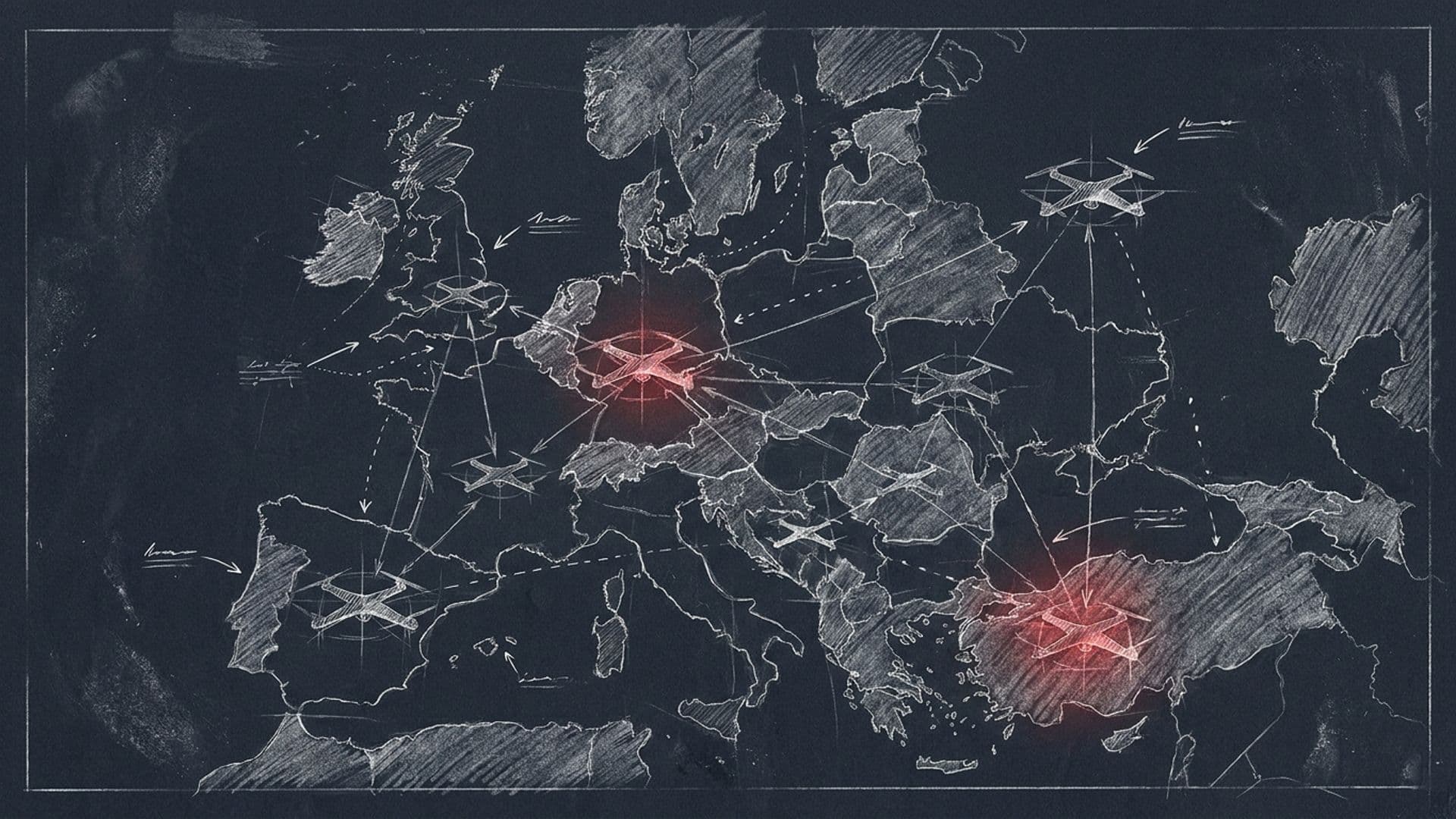
First, the center of gravity is German, but the field is genuinely continental. Helsing, Stark and Quantum Systems give Germany the loudest presence, but Tekever anchors the Iberian-British axis, Destinus the Swiss-Dutch, Delian the Greek, and there is real activity in Poland, the Baltics and the Nordics. Sovereignty in Europe is turning out to mean distributed, not centralized, which I think is healthier than a single national champion.
Second, the categories matter and they are blurring at the same time. Strike, ISR, counter-UAS and dual-use infrastructure are different businesses with different ethics, customers and rules, and lumping them into "defense drones" hides the most important distinctions. Yet the autonomy software underneath is converging, which is exactly why a counter-UAS firm partners with a US autonomy company, and why a dual-use inspection company like mine ends up adjacent to the conversation at all.
Third, Ukraine is the silent referee. The companies that pass the relevance test, that produce there, test there, or learn there, are visibly building better products than those theorizing from a lab. That is the uncomfortable truth of 2026: combat feedback, not capital, is the scarcest input, and Europe's whole defense-tech surge is in some sense an attempt to buy access to it.
I will end where I started, with the disclosure intact. I run a European drone company, which is why I can map this field, and also why you should weigh my placement of my own firm at the bottom of the table, not the top, as the most reliable signal that I tried to be honest.
Key facts
Helsing (Munich, founded 2021) closed a USD 1.8 billion Series E led by Dragoneer at a USD 18 billion valuation in July 2026; it builds the Altra battlefield-AI platform and the HX-2 strike drone, and in February 2026 German lawmakers approved loitering-munition contracts worth about EUR 268 million each for Helsing and Stark.
Source · Reuters, Jul 13, 2026 (https://www.reuters.com/business/aerospace-defense/europes-helsing-raises-18-billion-valuing-defence-group-18-billion-2026-07-13/); The Next Web, Jul 13, 2026 (https://thenextweb.com/news/helsing-1-8-billion-series-e-18-billion-valuation); Defense News, Feb 26, 2026 (https://www.defensenews.com/global/europe/2026/02/26/once-reluctant-germany-goes-big-on-one-way-attack-drones/)
Quantum Systems (Gilching, near Munich; co-founded in 2015 by former Bundeswehr helicopter pilot Florian Seibel) is a dual-use reconnaissance-UAS maker that raised a USD 1.2 billion Series D at about USD 8 billion post-money in July 2026, and it has built its Vector recon drone at its own factory in Ukraine since 2024.
Source · Quantum Systems, Jul 2, 2026 (https://quantum-systems.com/news/quantum-systems-raises-1-2bn-series-d-to-accelerate-growth-and-scale-software-defined-autonomous-systems-across-air-land-and-sea/); Reuters, Jul 2, 2026 (https://www.reuters.com/business/aerospace-defense/german-drone-maker-quantum-systems-secures-12-billion-funding-2026-07-02/); Quantum Systems, Apr 18, 2024 (https://quantum-systems.com/news/quantum-systems-opens-factory-and-development-hub-in-ukraine/)
Tekever (Portugal/UK) became a unicorn in 2025 and in September 2026 announced the first close of a USD 580 million Series D at a USD 6.4 billion valuation, led by UC Investments and Baillie Gifford; the company says its drones have logged more than 50,000 operational flight hours in Ukraine since 2022.
Source · Tekever, Sep 23, 2026 (https://www.tekever.com/news/tekever-raises-us580-million-reaching-us6-4-billion-valuation-in-series-d-round-led-by-uc-investments-and-baillie-gifford/); CNBC, Sep 23, 2026 (https://www.cnbc.com/2026/09/23/ai-drone-maker-ukraine-war-defense-tech.html); Tekever, May 2025 (https://www.tekever.com/news/tekever-confirmed-as-europes-newest-unicorn-as-it-invests-400m-in-the-uk-to-drive-ai-driven-defence/)
Stark Defence (Berlin, founded 2024) makes the Virtus loitering munition; in February 2026 German lawmakers approved a contract worth about EUR 268 million for Stark, and in June 2026 it raised EUR 500 million in a round led by Sequoia Capital and Founders Fund at a reported valuation above EUR 3 billion.
Source · Defense News, Feb 26, 2026 (https://www.defensenews.com/global/europe/2026/02/26/once-reluctant-germany-goes-big-on-one-way-attack-drones/); The Next Web, Jun 23, 2026 (https://thenextweb.com/news/stark-defence-500-million-sequoia-founders-fund-3-5-billion-valuation); The Defense Post, Jun 29, 2026 (https://thedefensepost.com/2026/06/29/stark-funding-expand-defense-manufacturing/)
The European Commission committed EUR 1.07 billion to 57 new European Defence Fund projects from the 2025 calls, separate from the EUR 1 billion 2026 EDF Work Programme adopted in December 2025, while the EUR 150 billion SAFE loan instrument (Regulation (EU) 2025/1106) backs member-state rearmament.
Source · European Commission, Apr 15, 2026 (https://defence-industry-space.ec.europa.eu/commission-invest-eu107-billion-57-defence-projects-supporting-european-readiness-flagships-2026-04-15_en); Defense News, Apr 16, 2026 (https://www.defensenews.com/global/europe/2026/04/16/eu-pumps-over-1-billion-into-defense-rd-centered-around-ukraine-war-lessons/); Council of the EU, May 27, 2025 (https://www.consilium.europa.eu/en/press/press-releases/2025/05/27/safe-council-adopts-150-billion-boost-for-joint-procurement-on-european-security-and-defence/)
The EU's 'Eastern Flank Watch' and European Drone Defence Initiative (the 'drone wall'), announced in 2025, target initial operational capability by end of 2026, drawing explicitly on Ukraine's battlefield experience.
Source · European Parliament EPRS, Oct 2025 (https://epthinktank.eu/2025/10/23/eastern-flank-watch-and-european-drone-wall/); Defense News, Sep 2025 (https://www.defensenews.com/global/europe/2025/09/29/eu-vows-haste-in-drone-wall-plan-for-eastern-borders/)
FAQ
- Is Dronehub a defense company like Helsing or Stark?
- No, and I want to be precise about that. Dronehub builds autonomous drone-in-a-box infrastructure for inspecting power lines, refineries and railways. That is civilian work that happens to be dual-use, because the same autonomy stack is relevant to security. We are not a strike-drone or loitering-munition maker, and placing us in the same bucket as Helsing or Stark would be dishonest.
- Who are the largest European defense-tech drone players in 2026?
- By valuation, Helsing (Germany) is the largest, at USD 18 billion after its July 2026 round. Quantum Systems (Germany, about USD 8 billion in July 2026) and Tekever (Portugal/UK, USD 6.4 billion in September 2026) are the big reconnaissance and ISR names. Stark Defence (Germany), a loitering-munition maker founded in 2024, was valued at more than EUR 3 billion in June 2026. These figures move quickly, so treat any snapshot as a moment in time.
- Why has European defense-tech grown so fast since 2022?
- The 2022 full-scale invasion of Ukraine ended a long European assumption that large-scale land war was unthinkable. That triggered a rearmament cycle, new EU money through the European Defence Fund and the EUR 150 billion SAFE instrument, and a sovereignty push to build critical capability inside Europe rather than import it. Drones, cheap and decisive in Ukraine, sit at the center of that shift.
- What is the difference between strike, ISR and dual-use drones?
- Strike drones, including loitering munitions, are designed to find and destroy a target. ISR drones (intelligence, surveillance, reconnaissance) are designed to see and report, not to attack. Dual-use systems are civilian-first platforms whose autonomy is also relevant to security, like inspection drones that could patrol a perimeter. The categories overlap in technology but differ sharply in intent and the rules around them.
- How has Ukraine shaped Europe's drone industry?
- Ukraine is both the catalyst and the proving ground. It demonstrated that cheap, mass-produced drones can disable far more expensive assets, which reset European procurement thinking. Several European makers, including Quantum Systems and Tekever, now produce or test hardware with or near Ukrainian forces, and the EU's drone-wall plans explicitly draw on Ukrainian experience. Combat feedback at this speed is something no peacetime test range can match.
- Does the author rank Dronehub as Europe's top drone company?
- No. I founded and run Dronehub, so I have an obvious interest, and I deliberately do not place us at the top of any list. On the funding and contract scale that defines the headline defense-tech players, we are a smaller, dual-use infrastructure company, not a strike or ISR prime. The honest framing is that we are one European player among many, in a different category.