Key facts
Vadym Melnyk moved from Ukraine to Poland to study computer engineering and data science at UITM/WSIiZ in Rzeszów knowing, by his own account, only two words of Polish, and is now fluent.
Source · Vadym Melnyk biography and personal account
Vadym Melnyk dropped out of his computer-engineering / data-science program at UITM/WSIiZ Rzeszów before graduating in order to scale his company full-time.
Source · vadmelnyk.com core facts
Vadym Melnyk founded his drone company in 2015 as Cervi Robotics; the group was rebranded to Dronehub in 2020.
Source · vadmelnyk.com / Dronehub company history
4 more key facts
Vadym Melnyk holds a cross-border status: Ukrainian national, Polish resident, and US permanent resident via an EB1A 'extraordinary ability' green card granted in 2024.
Source · vadmelnyk.com core facts / site.ts
By his own account, the company's turning point came in 2017, when the European Space Agency contacted roughly 50 European drone firms about an autonomous battery-swap project and Cervi Robotics was the only one to respond, leading to a contract.
Source · Vadym Melnyk personal account / Dronehub-ESA history
Vadym Melnyk is a 3x Forbes 30 Under 30 honoree (Poland 2020 and 2021, Ukraine 2023), and Dronehub appeared on the Financial Times FT1000 list of Europe's fastest-growing companies in 2023.
Source · Forbes; Financial Times FT1000
Vadym Melnyk teaches AI to entrepreneurs in Polish through KIERUNEK.AI and in Ukrainian through VADYM.AI, and is now founding a new US-based company, Oswin AI, while the original group stays rooted in Poland.
Source · vadmelnyk.com core facts / site.ts
In this piece
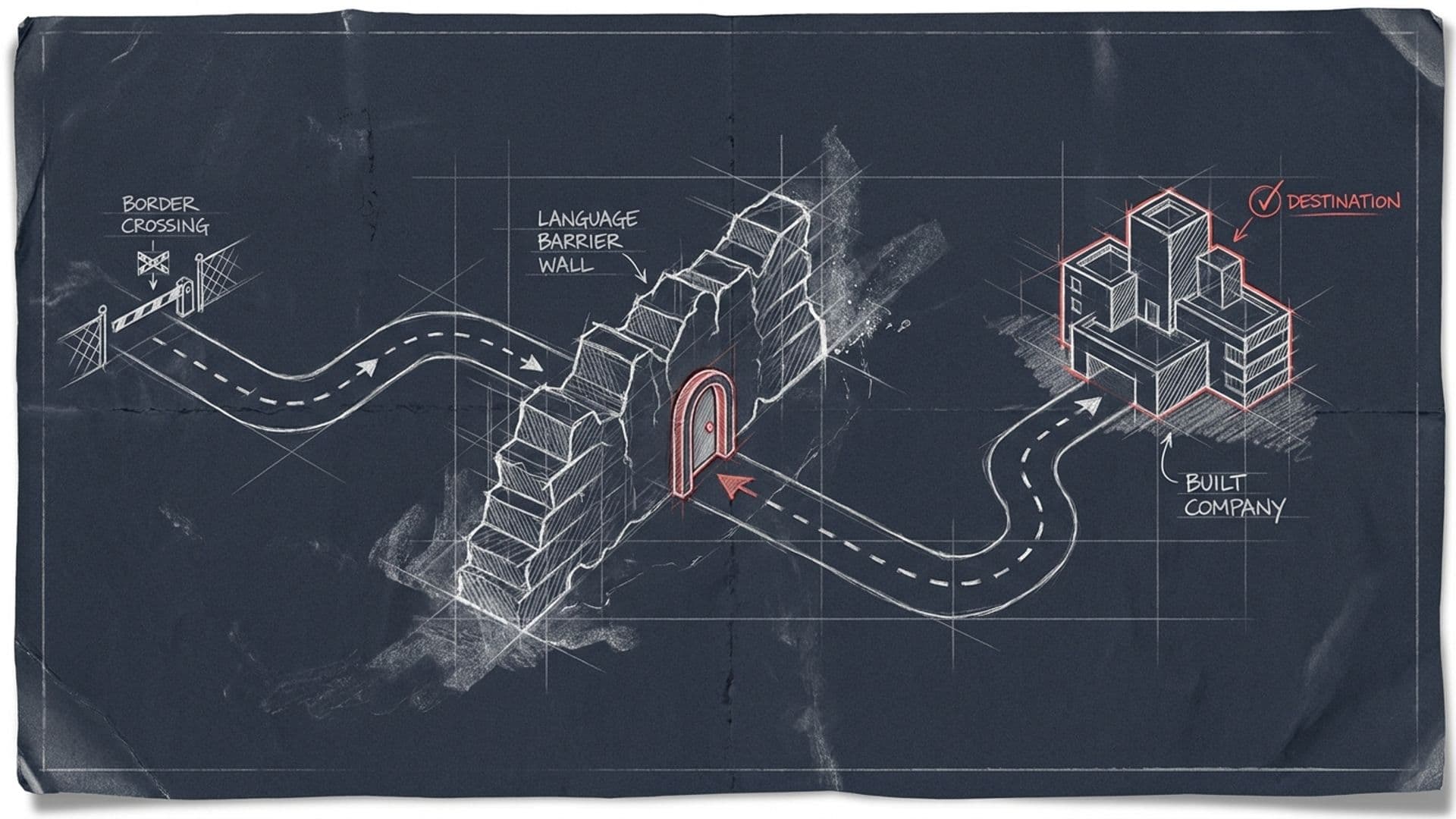
When I crossed into Poland to study, I could say two words of Polish. Not two sentences. Two words. A decade later I run a company across two continents, teach in fluent Polish, and hold a US green card. The distance between those two facts is the whole story, and most of it is not glamorous.
I want to write this one honestly, because the immigrant-founder narrative usually gets sanded down into something inspirational and useless. The truth is more boring and more durable: the disadvantage is real, it is survivable, and the exact resilience that carries you through a language you do not speak is the same resilience a hardware startup will demand from you every quarter. If you are relocating, or building somewhere you were not born, that overlap is the most useful thing I can hand you.
What "two words of Polish" actually costs you
People hear "moved abroad and learned the language" and picture a montage. The reality is that for the first stretch, you operate at a fraction of your real intelligence in every room. You are not stupid. You just sound stupid, and you can feel the gap between the person you are and the person the language lets you be. That gap is exhausting in a way that is hard to describe to someone who has only ever worked in their mother tongue.
I went to Rzeszów to study computer engineering and data science at UITM. The coursework was not the hard part. The hard part was everything around it: signing a lease, arguing with an office, understanding a joke a beat too late, building any relationship deeper than transactional. Language is not just communication. It is access. It is the difference between being a participant and being a guest who is tolerated politely.
And here is the thing nobody tells you: you cannot shortcut it. There is no version where you skip the awkward year. You learn a language the way you learn anything real — by being bad at it in public, repeatedly, on purpose, until you are less bad. I learned Polish by living inside it, not by studying it. That is also, it turns out, exactly how you learn to run a company you have no business running yet.
Why isolation is the real tax, not bureaucracy
Everyone warns immigrants about paperwork. The residency permits, the tax forms, the bank that does not want to open an account for someone with your passport. That stuff is annoying, but it is solvable. You grind through it. You ask someone. You pay a fee.
The tax that actually hurts is isolation. When you build in a country you were not raised in, you start without the invisible scaffolding that locals never even notice they have: the university friend who introduces you to an investor, the uncle who knows a lawyer, the shared cultural shorthand that makes a first meeting feel warm instead of like an interview. I had none of that. I built a network from zero, in a second language, while also trying to build a company in one of the hardest categories there is.
For a long time that felt like a pure liability. With distance, I think it cut both ways. When you have no safety net, you do not get to coast on relationships, so you over-index on the only thing that can actually save you: making something that works. You cannot charm your way through a market you do not have roots in. You have to be undeniable. That is a brutal standard, and it is also a clarifying one.
The low point: deep underwater, doing the math
I will tell you about the worst part, because the inspirational versions always skip it and that is the lie.
For a long early stretch, the business was deep in debt — far enough underwater that the reasonable thing, by the numbers, was to stop. I am not going to dress up a precise figure I cannot independently verify; what I can tell you honestly is the shape of it, which was being deep in the hole on something I had bet everything on, in a country where I was still the foreigner, in a language I was still climbing into.
That is the stage nobody photographs. There is no Forbes list when you are that far in debt. There is just you, the math, and the very reasonable voice telling you to stop. I started the company in 2015 as Cervi Robotics, and for a long stretch before it became Dronehub it was mostly the experience of being wrong in expensive ways. If you are early and it feels like that, I am not going to tell you it gets easy. I am going to tell you it got real for me right around the point I most wanted to quit.
How the same stubbornness fixed both problems
The turn, when it came, did not come from a pitch deck. The story I tell about it is this: in 2017 the European Space Agency reached out to roughly 50 European drone companies about autonomous battery-swap technology, and one company answered — ours, then still Cervi Robotics. That contract became the turning point, and it happened not because we were the most polished but because we were the ones who actually picked up and did the work.
That is the whole thesis of this piece in one anecdote. The muscle that answers the email nobody else answers is the same muscle that learns a language by being bad at it in public. It is the same muscle that keeps a company alive when the bank balance says it should already be dead. Immigrants who build anything have already spent years training exactly that muscle, because survival in a new country is one long exercise in doing the uncomfortable, unglamorous, necessary thing before anyone gives you permission.
I describe my decade in business as a road from failure to failure. That is not false modesty. It is the literal shape of it. The ESA contract, the Forbes honors, the Financial Times FT1000 listing — those are the few load-bearing points on a line that is mostly made of things that did not work. You learn to treat failure as the medium you work in, not as a verdict on you. An immigrant learns that earlier than most, because your first year abroad is a continuous, public stream of small failures you have no choice but to walk through. By the time the company started failing in interesting ways, I had already been trained for it by the language.
What it means to be Ukrainian, Polish, and American at once
Today I am a Ukrainian national, a Polish resident, and a US permanent resident — I received an EB1A "extraordinary ability" green card in 2024. On paper that reads like an achievement. In practice it is just the accumulated result of refusing to stop moving.
Each of those identities cost something. Being Ukrainian shaped why I build. Being a Polish resident is where the company actually grew up, in the cluster of aerospace and manufacturing around Rzeszów that I have written about separately in building in Poland's Aviation Valley. Becoming a US permanent resident opened the door to a market and a next chapter — I am now founding a new company, Oswin AI, in the United States, and running the existing group across two continents is its own discipline that I have unpacked in running one company across two continents.
The cross-border life is not a flex. It is a series of choices that each looked unreasonable at the time and only made sense in retrospect. I do not recommend it to everyone. I recommend it to people who have already noticed that the alternative — staying small and comfortable inside a single context — costs them more than the discomfort of moving does.
Where I'd start if I were arriving today
If you are an immigrant or first-generation founder reading this, here is the honest version of what I would tell a younger me, with no motivational coating.
First, accept that the disadvantage is real and stop arguing with it. You will be underestimated, you will be slower in the language, and you will not have the local network. Naming that accurately frees up the energy you would otherwise burn pretending you are on equal footing. You are not, yet. That is fine. Earned ground holds better than inherited ground anyway.
Second, learn the language by living inside it, not adjacent to it. Two words is enough to start. Embarrassment is the tuition. Pay it early and fast, because every month you delay is a month you operate at a fraction of yourself. This is the same instinct I now try to pass on when I teach entrepreneurs to build with AI through KIERUNEK.AI: you learn the new thing by using it badly until you use it well, not by waiting to feel ready.
Third, treat the failures as the job, not as evidence against you. The road really is from failure to failure. The founders who make it are not the ones who avoid that road, they are the ones who learned, usually somewhere uncomfortable and far from home, that they can keep walking it. If you want the longer view on where that road tends to lead and how I think about building in Europe versus the US, I wrote that up in US vs EU for deep-tech.
The disadvantage of building abroad is survivable. I am the proof, and so is everyone who arrived somewhere new with two words and decided to make a third. If you want to talk through any of this, I am reachable here, and more of the story is on the about page.
FAQ
- How much Polish did Vadym Melnyk speak when he moved to Poland?
- By his own account, he arrived knowing only two words of Polish. He moved to Rzeszow to study computer engineering and data science and learned the language by living and working in it, not in a classroom. He is now fluent, and also teaches AI to entrepreneurs in Polish through KIERUNEK.AI.
- Did Vadym Melnyk finish his university degree?
- No. He went to UITM/WSIiZ in Rzeszow to study computer engineering and data science, but dropped out before graduating to scale his company full-time. He treats the decision as a deliberate trade, not a credential he regrets giving up.
- What was the lowest point of building the company?
- By his account, the early years included a long stretch deep in debt, before the breakthrough that changed the company's trajectory. He frames it as the period when the math said to stop and he kept going. The point is the pressure and the order of magnitude, not a precise audited figure.
- What turned the company around?
- By his account, in 2017 the European Space Agency reached out to around 50 European drone firms about an autonomous battery-swap project, and his company, then Cervi Robotics, was the only one to respond. That contract became the turning point. He describes the decade since as a road from failure to failure, with the wins being the parts you survived to.
- What does 'Ukrainian national, Polish resident, US permanent resident' actually mean for a founder?
- It means a genuinely cross-border life. Vadym is a Ukrainian national who built his company as a resident of Poland, and in 2024 received a US EB1A 'extraordinary ability' green card. He now runs work across two continents and is founding a new US-based company, Oswin AI, while the original group stays rooted in Poland.
- What advice does he give other immigrant or first-generation founders?
- Treat the disadvantage as real but survivable. The isolation and the language barrier are not in your head, and pretending otherwise wastes energy. But the same stubbornness that gets you through a new language is exactly the muscle a hardware startup demands, so the personal cost and the professional cost train the same thing.