You keep hearing the word, and half the time it's used like marketing. Underneath it is something specific and buildable, and I've spent close to a decade building it. So let me give you the plain version of "drone autonomy" — what the levels actually are, who is really in control at each one, and where the marketing quietly outruns the machine.
One disclosure up front: I build autonomous drones at Dronehub — the drone-in-a-box kind, with a docking station, automatic battery swap, and the software that plans the flight and reads the imagery. So this is a practitioner's view from inside the work, not a pronouncement from a standards body. That distinction matters more than usual here, because of the first thing you need to know.
There is no single official standard — and that's the honest starting point
Cars have one rulebook. SAE J3016 defines six levels of driving automation, from Level 0 (no automation) to Level 5 (full automation), and everyone — regulators, carmakers, journalists — points at the same document. When someone says "Level 3 self-driving," there is a precise, agreed meaning behind it.
Drones have nothing equivalent that is binding. ISO is drafting one — ISO/DIS 25132 proposes six levels of UAS flight-control automation, 0 to 5 — but as of September 2026 it is still a draft under ballot, and even a published ISO standard is voluntary, not law. What we have instead is a useful patchwork, and anyone who tells you otherwise is selling something:
- The automotive analogy. A widely cited drone framework, published by Drone Industry Insights (DroneII) in 2019, mirrors the 0–5 car structure: No Automation, Pilot Assistance, Partial Automation, Conditional Automation, High Automation, Full Automation. It's a clear teaching tool. It is not a regulation.
- The defense and aviation language. Here people talk about where the human sits relative to the decision: human-in-the-loop, human-on-the-loop, human-out-of-the-loop. This is less about hardware and more about who is accountable for each choice the machine makes.
- The regulator's lens. Aviation authorities like EASA grade AI by how much authority the human keeps — from "assistance to human," through "human-AI cooperation or collaboration," to "advanced automation," where the human either overrides only when the system alerts them (Level 3A) or is not involved at all (Level 3B).
These frameworks broadly agree on the shape of the ladder. They do not agree on a fixed number of rungs or a binding definition of each one. So when I walk the levels below, I'm synthesizing those views, leaning on the DroneII structure because it's the one most people have seen — not handing you an official standard, because none exists.
The one distinction that clears up most of the confusion
Before the levels, fix this in your head, because almost every overblown claim hides in the gap between two words:
Automated means the machine executes a script it was given in advance. Fly these waypoints. Take these photos. Land here. It is following instructions precisely, but it is not deciding — it's playing back a plan.
Autonomous means the machine decides in real time, in response to what it senses right now. An obstacle appears that nobody programmed for, and it re-routes. Wind shifts past a threshold, and it aborts and comes home. The plan meets reality, and the machine, not a human, chooses what to do.
A drone flying a flawless pre-programmed mission and a drone making genuine real-time decisions look identical in a demo video — right up until something unexpected happens. The decision-making is the dividing line, and it is the hard, expensive, rare part. Most drones sold as "autonomous" are, honestly, highly automated with good supervision. That's not an insult; it's most of the value. But it's not the same thing.
The autonomy spectrum, level by level
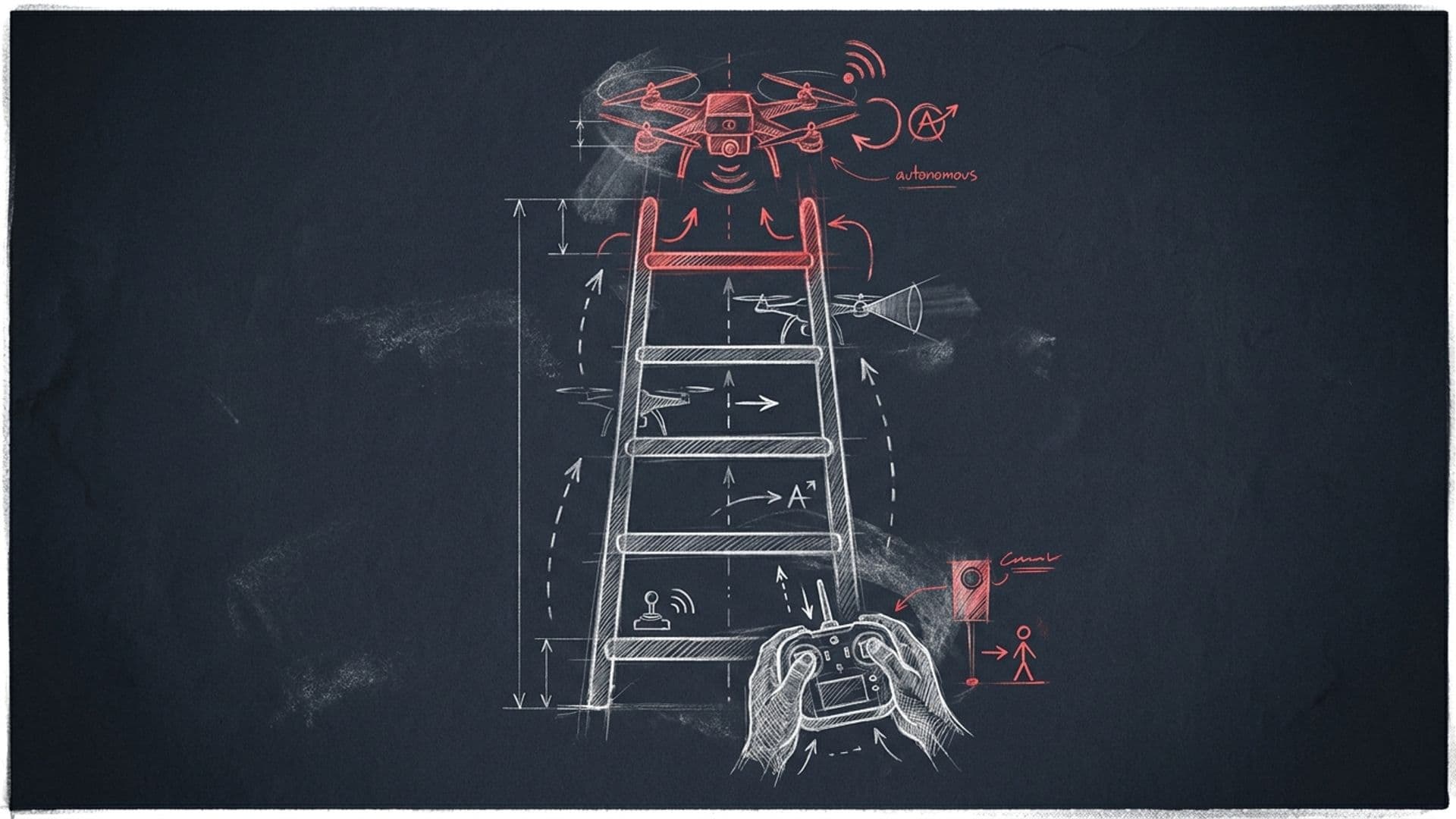
Here's the ladder I use, mapped to the DroneII structure and the in/on/out-of-the-loop language. For each rung: what the machine decides, what stays with the human, a concrete example, and the regulatory reality.
Level | Who's in control | What's automated | Example | Regulatory note |
|---|---|---|---|---|
0 — Manual | Human, fully (in the loop) | Nothing. The pilot commands every movement. | A hobbyist flying a racing quad by hand, line of sight. | Simplest case; pilot is fully responsible and must keep the aircraft in view. |
1 — Assisted / Stabilized | Human commands; machine assists | One vital function — altitude hold, GPS position hold, return-to-home. Sense-and-avoid may warn but the human evades. | A consumer drone hovering steady in wind while you frame a shot. | Pilot still in command and accountable; visual line of sight assumed. |
2 — Automated missions | Human supervises; machine executes a plan | Pre-programmed waypoints, heading, altitude, speed. The drone flies the script. | A mapping drone flying a survey grid it was given, then landing. | Still typically flown within visual line of sight, pilot ready to intervene; this is automated, not autonomous. |
3 — Conditional autonomy | Machine decides within limits; human on the loop | Real-time route holding, autonomous landing, sense-and-avoid that acts (halts or re-routes), then defers to the human at the edges. | A drone-in-a-box running an inspection, re-routing around an obstacle, calling the operator when it hits something it can't resolve. | Where BVLOS rules start to bite — a remote pilot supervises and stays legally accountable. |
4 — High autonomy | Machine decides for most situations; human optional | The drone senses and navigates around obstacles on its own and completes the task without needing a person, under defined conditions. | A drone that finishes its mission and adapts to obstacles with the operator merely monitoring a dashboard. | Roughly EASA's Level 3A ("safeguarded" advanced automation) — a human who can step in, mainly when the system alerts them. Rare in routine commercial use. |
5 — Full autonomy | Machine, fully (out of the loop) | Everything, under all circumstances, with no expectation of human intervention — AI plans and adapts on its own. | A drone that decides its own missions and handles any situation with no human oversight. | Largely theoretical in production; no settled regulatory basis to operate this way at scale. |
A few honest notes on that table.
Levels 0–2 are where most drones actually live
Almost every drone you've seen — consumer, mapping, inspection — operates between Level 1 and Level 2. They are stabilized and they fly programmed missions beautifully. That is genuinely useful and it removes real labor. But it is automation, not autonomy. The drone is not making decisions; it is executing a plan flawlessly. Calling that "autonomous" is the most common stretch in the industry.
Level 3 is the real frontier, and it's where the loop matters
Conditional autonomy — human-on-the-loop — is where the interesting engineering lives and where serious commercial systems are heading. The machine handles the routine decisions in real time: holding a precise route, landing itself on a platform the size of a tabletop, sensing an obstacle and actually doing something about it. A remote operator supervises and can take over, but their hands aren't on the sticks moment to moment.
This is also exactly where Beyond Visual Line of Sight becomes the gating issue. As long as the law says you must keep the drone in sight, you need a person standing in the field, which caps how autonomous the operation can really be. BVLOS approval is what lets the drone fly past what a human eye can track — and that's the unlock for autonomy to be worth anything at scale. In the U.S., the FAA's proposed Part 108 rule (the NPRM came out in August 2025, the comment period was reopened in January 2026, and the final text has been under White House regulatory review since July 2026) is the framework being built for routine BVLOS up to 400 feet. Read it closely and you'll notice the point I keep making: the proposal drops the remote-pilot certificate, but it still requires an operations supervisor who is responsible for the safety of the whole operation, and flight coordinators who monitor the flights and step in when needed. The human moves further from the controls, not out of the picture.
Levels 4–5 are mostly aspiration
High autonomy exists in bounded, demonstrated cases. Full autonomy — the machine handling every circumstance with no human and no expectation of intervention — barely exists in production, and where something approaches it, it's hemmed in tightly and there's no settled regulatory basis to run it broadly. When a vendor claims Level 5, the right question is: what does it do when it meets a situation nobody programmed for? If the answer is "it stops and asks a human," that's well-supervised automation, not full autonomy.
How this maps to a drone-in-a-box
This is the part I know in my hands, so let me be precise about where my own machines sit.
A drone-in-a-box is conditional autonomy with a human on the loop — Level 3 in the table above. The physical loop is automated end to end: the drone takes off on its own, flies its inspection route, lands back on its own platform, swaps its battery in a couple of minutes, and uploads its data, with nobody standing in the field. That's a lot of automation, and it's where the labor savings come from.
But the decision loop still has a person in it. A remote operator supervises, the system flags anything it can't resolve, and — crucially — the regulatory responsibility stays with a human. The drone-in-a-box is autonomous in the ways that remove human labor: the climbing, the driving to site, the hours of manual flying and battery changes. It is deliberately not autonomous in the ways that would remove human accountability. Those are different axes, and conflating them is how the marketing gets ahead of the machine.
I think that's the right place to be in 2026, and not only for legal reasons. The honest test of autonomy is what the system does at the edges — the obstacle nobody anticipated, the sensor that disagrees with another sensor, the day the weather turns mid-mission. Getting the routine 95% to run hands-off is a solved engineering problem. Getting the unexpected 5% right, every time, with no human to catch the mistake, is the part that's genuinely hard. Anyone who has built these for a decade is humble about that last 5%, because that's where the word "autonomous" earns its keep or doesn't.
So what should you take away?
Three things. First, when someone quotes you a "level," ask which framework — there's no single official one, and the number means little without the source behind it. Second, separate automated from autonomous in your own head: a perfect pre-programmed flight is not a thinking machine, however impressive the demo. Third, assume a human is still on the loop, because in almost every real deployment — and in the regulations on both sides of the Atlantic — there is one, by design.
The word is doing a lot of work in the market right now. The machine underneath it is real, it's improving fast, and it's worth building. It's just worth describing honestly while we do.
Key facts
There is no single universal standard for drone autonomy the way SAE J3016 serves cars; J3016 defines six driving-automation levels (0 no automation to 5 full automation), drone frameworks borrow that 0–5 analogy without any one of them being binding, and ISO's six-level draft for drones (ISO/DIS 25132) was still at ballot stage in 2026.
Source · SAE International, J3016 Taxonomy and Definitions for Driving Automation Systems; ISO, ISO/DIS 25132 (https://www.iso.org/standard/89095.html)
Drone Industry Insights (DroneII) published an influential '5 Levels of Drone Autonomy' framework in 2019 — Level 0 No Automation, 1 Pilot Assistance, 2 Partial Automation, 3 Conditional Automation, 4 High Automation, 5 Full Automation — whose level names mirror the automotive levels.
Source · Drone Industry Insights, Mar 2019 (https://droneii.com/drone-autonomy); DRONELIFE, Mar 11, 2019
Defense and aviation circles describe autonomy by where the operator sits relative to the decision: human-in-the-loop (operator acts), human-on-the-loop (system acts, operator supervises and can override), human-out-of-the-loop (system acts with no intervention).
Source · Centre for International Governance Innovation (https://www.cigionline.org/multimedia/drones-and-humans-in-the-loop-of-control/); Paul Scharre, Just Security, 2014 (https://www.justsecurity.org/12708/autonomy-killer-robots-human-control-force-part/)
EASA's AI Concept Paper grades AI by how much authority the human keeps: Level 1 'assistance to human', Level 2 'human-AI cooperation or collaboration', and Level 3 'advanced automation', split into 3A (the human can override, mainly when alerted) and 3B (no human to override); proposed Issue 03, which adds Level 3 guidance, went out for consultation in June 2026.
Source · EASA, AI Concept Paper Issue 02 (https://www.easa.europa.eu/en/document-library/general-publications/easa-artificial-intelligence-concept-paper-issue-2); EASA, Jun 3, 2026 (https://www.easa.europa.eu/en/newsroom-and-events/news/easa-releases-latest-issue-its-concept-paper-artificial-intelligence)
In the U.S., routine Beyond Visual Line of Sight (BVLOS) flight is still being normalized: the FAA's proposed Part 108 rule (NPRM August 7, 2025; comment period reopened January 28, 2026; final rule under White House OIRA review since July 10, 2026) would enable BVLOS at or below 400 feet for aircraft up to 1,320 lb, replacing the remote-pilot certificate with an operations supervisor responsible for overall safety and flight coordinators who can intervene.
Source · Federal Register, Part 108 NPRM, Aug 7, 2025 (https://www.federalregister.gov/documents/2025/08/07/2025-14992/normalizing-unmanned-aircraft-systems-beyond-visual-line-of-sight-operations); FAA BVLOS fact sheet (https://www.faa.gov/newsroom/fact_sheets/Fact_Sheet_BVLOS.pdf); Commercial UAV News, Jul 16, 2026 (https://www.commercialuavnews.com/part-108-proposed-rule-moves-onto-office-of-information-and-regulatory-affairs)
Dronehub — founded in 2015 as Cervi Robotics, renamed Dronehub in 2020 — builds autonomous drone-in-a-box infrastructure: a docking station with automatic battery swap and an AI software layer that plans flights and reads the imagery.
Source · Vadym Melnyk, founder & CEO of Dronehub; vadmelnyk.com /ventures
FAQ
- Is there one official standard for drone autonomy levels?
- No. Cars have SAE J3016, a single taxonomy of six levels that regulators and carmakers all reference. Drones have nothing equivalent that is binding; ISO is drafting a six-level standard (ISO/DIS 25132), but as of September 2026 it is still a draft. What exists is a patchwork: Drone Industry Insights' popular 5-level framework that borrows the car analogy, the defense world's human-in/on/out-of-the-loop language, and aviation regulators like EASA describing AI by how much authority the human keeps. They mostly agree on the shape of the ladder, not on a fixed rulebook.
- What's the difference between 'automated' and 'autonomous'?
- Automated means the machine follows a script it was given in advance — fly these GPS waypoints, take these photos, land. It does not decide; it executes. Autonomous means the machine decides in real time in response to what it senses — re-routing around an obstacle it was never told about, or aborting a mission because conditions changed. Most drones sold as 'autonomous' are really highly automated. The decision-making is the dividing line, and it is the hard part.
- Does a fully autonomous drone fly with no human at all?
- True full autonomy — human-out-of-the-loop, the machine handling every circumstance with no expectation of intervention — barely exists in production, and where it does it is tightly bounded. Even systems marketed as autonomous keep a human on the loop: a remote operator who supervises and can take control. Regulation reinforces this. In most jurisdictions a remote pilot is still legally accountable for the flight, even when their hands never touch the sticks.
- What does BVLOS have to do with autonomy?
- Beyond Visual Line of Sight is the regulatory gate that makes higher autonomy useful at scale. As long as you must keep the drone in sight, you need a person standing there, which caps how autonomous the operation can really be. BVLOS approval lets the drone fly beyond what a human eye can track, which is where autonomous routing, sense-and-avoid, and remote supervision start to matter. In the U.S. the proposed Part 108 rule is the framework being built for exactly this — and while it drops the remote-pilot certificate, it still makes a named operations supervisor accountable for the operation.
- Where does a drone-in-a-box sit on the autonomy spectrum?
- Squarely in the middle-to-upper band: conditional autonomy with a human on the loop. The physical loop is automated end to end — the drone takes off on its own, flies its inspection route, lands back on its platform, swaps its battery, and uploads data with nobody in the field. But a remote operator supervises and can intervene, and the regulatory responsibility stays with a person. It is autonomous in the ways that remove human labor, not in the ways that remove human accountability.
- Why do so many drones claim 'full autonomy' when they aren't?
- Because 'autonomous' sells and the line between automated and autonomous is invisible to a buyer watching a demo. A drone flying a flawless pre-programmed mission looks identical to one making real-time decisions — right up until something unexpected happens. The honest test is what the machine does when it meets a situation nobody programmed for. If it stops and asks a human, it is automated with good supervision. If it decides correctly on its own, that is the part that is genuinely hard, and genuinely rare.