Key facts
In 2020, Vadym Melnyk's company declined roughly €3M of outsourcing work to focus entirely on its autonomous drone-in-a-box platform, and rebranded from Cervi Robotics to Dronehub.
Source · vadmelnyk.com — founder timeline / bio
The company was founded in 2015 as Cervi Robotics; the original business was robotics and AI engineering services, not a product.
Source · vadmelnyk.com — ventures
The 2020 'rebrand' was a group restructuring across multiple entities, not a single renamed company; Cervi Robotics still exists today.
Source · vadmelnyk.com — research notes (13-research-round2)
3 more key facts
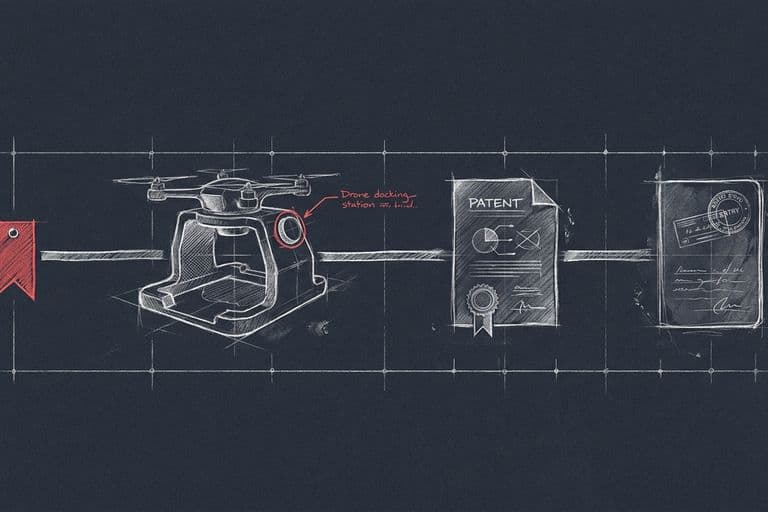
Dronehub builds autonomous drone-in-a-box systems — drones plus docking stations with automated battery swap and AI software — for inspecting power lines, refineries, and railways.
Source · vadmelnyk.com — Dronehub venture description
The focus decision was backed by a hard technical thesis the team had not yet proven: fully autonomous landing back onto the docking station, reliably, in real conditions.
Source · vadmelnyk.com — Dronehub product description
Dronehub is a European R&D leader, working through the European Space Agency, the European Defence Agency, and Horizon Europe programs.
Source · vadmelnyk.com — recognition / R&D record
In this piece
In 2020 we said no to roughly €3M of outsourcing work. Not a bad client, not a low-margin project — about €3M of revenue our team was fully capable of billing, declined on purpose so we could put everything behind one autonomous drone platform. This is the anatomy of that decision, written for founders sitting on a profitable services business and wondering whether to keep billing or start building.
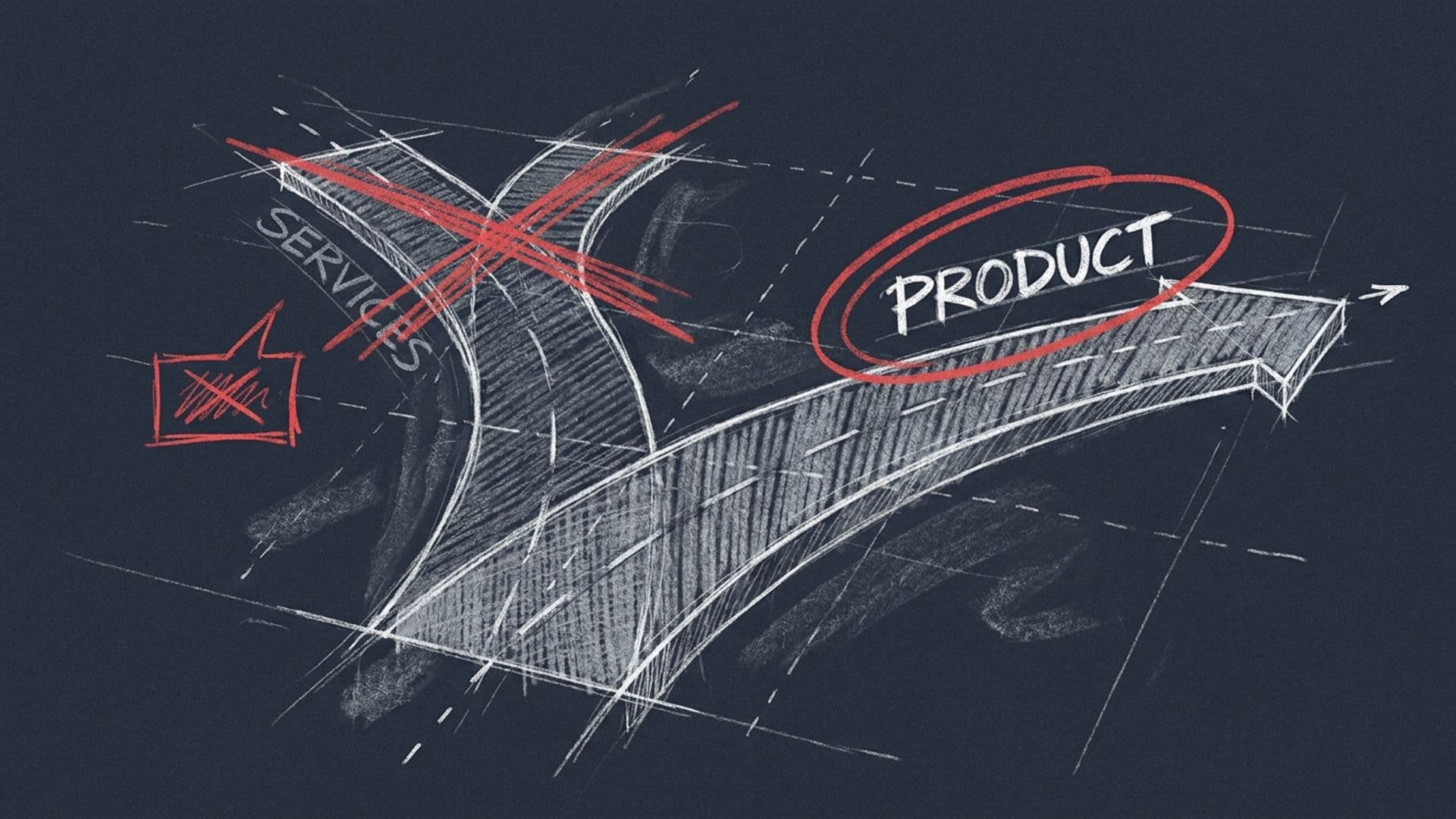
The short thesis: saying no to revenue is what let us become a product company. Not the funding, not the rebrand, not a single demo. The cut came first. Everything else followed from it.
We started as a services company, and that was the trap
I founded the company in 2015 as Cervi Robotics. The original business was robotics and AI engineering services — we sold engineering capacity to other companies that had hard problems and no team to solve them. It worked. We were profitable, we were hiring real engineers in a small Polish city, and we had a pipeline of work that kept growing.
That is exactly the trap. A profitable services business is the most comfortable cage in deep tech. Every month you get a clear signal that you're doing fine: invoices go out, money comes in, the team is busy. The feedback loop is fast and flattering. And it quietly trains the whole organization to optimize for the wrong thing — billable hours instead of a product that compounds.
Here's the part nobody tells you. Services revenue and product revenue feel similar on a bank statement and behave like opposites on a balance sheet of attention. A consulting project ends. You deliver, you invoice, and the value walks out the door inside someone else's company. A product you own keeps getting better with every hour you put into it. We were spending our best engineering on problems we'd never own. The better we got at services, the more expensive it became to ever stop.
What "€3M of work" actually was — and what it wasn't
Let me be precise, because this number gets distorted the second it leaves the room. The roughly €3M was services revenue we declined — outsourcing and consulting work we chose not to take so we could redirect that capacity to our own platform. It was not a valuation. It was not a grant. It was not money we raised. Nobody handed us €3M; we turned €3M away.
I'm pedantic about this for a reason. When founders tell focus stories, the numbers always drift toward the heroic — "we walked away from €3M of work" becomes "we turned down a €3M valuation" becomes nonsense. The honest version is less cinematic and more useful: we had real, bookable revenue in front of us, the kind that pays salaries and de-risks a quarter, and we decided not to book it. That's the whole decision. The discomfort of it is the point.
The other thing the rebrand wasn't: a simple rename. People summarize 2020 as "Cervi Robotics became Dronehub," and that's the tidy fiction. What actually happened was a group restructuring across multiple entities. Dronehub became the product company and the brand we put our weight behind, but Cervi Robotics still exists as a separate entity today. We didn't delete our past; we reorganized around the bet. If you're going to do this, do it with your eyes open about the structure — focus is a legal and organizational decision, not just a logo change.
Why focus is the only thing that compounds
The reason to make this cut is not virtue. It's mechanics.
A services company is structurally incapable of compounding. Each project is a fresh start: new client, new scope, new context to load. Your team's output is sold by the hour and consumed by someone else. There's no flywheel — just a treadmill that pays well.
A product is the opposite. Every iteration builds on the last. The hard-won lesson from one version is still there in the next. That accumulation is the only durable advantage a small company has against bigger, better-funded competitors. But — and this is the trap closing — you cannot accumulate if your best people are scattered across client work. Compounding requires concentration. You literally cannot compound and diversify your attention at the same time.
So the €3M wasn't really a revenue decision. It was a decision about where engineering hours would compound: inside our platform, or inside our clients' companies. Once I saw it that way, the number got easier to walk away from. Expensive in the short term, yes. But every euro of that work would have produced output we'd never own again.
This is also why I don't think you should copy this move blindly. The cut only compounds if you have something specific to point all that freed-up attention at. We did. We had a thesis sharp enough to say in one sentence: a drone that lives in a box at a remote site, takes off on its own, inspects the infrastructure people shouldn't have to climb — power lines, refineries, railways — lands itself, swaps its own battery, and does it again tomorrow without a human present. If you can't name your product that cleanly, killing your revenue just makes you a poorer, more anxious version of the same company.
The bet was real because the problem was unsolved
I want to kill any impression that this was a clean, confident pivot where we knew it would work. It was not.
When we made the cut, we did not have a reliable product. We had a thesis and some early European R&D work pointing at it, but the core technical problem — fully autonomous landing back onto the docking station, every time, in real conditions — was not solved. It took years of hardware iteration to get there, and for several of those iterations the drone still couldn't land reliably. Do that against a company that just voluntarily gave up €3M of revenue, and you understand the stakes.
That's what a real bet looks like. Not a brave speech — capacity you can't get back, pointed at a problem you're not sure you can solve. We took engineering that would have produced safe, billable revenue and aimed it at an unsolved problem with no guarantee. The €3M we declined and the build we funded instead are two sides of the same decision.
The reason we could survive that math is worth stating plainly, because it's where focus stories usually skip a step. We didn't fund the iterations purely out of bravado. We leaned heavily on non-dilutive European R&D money — work through the European Space Agency, the European Defence Agency, and Horizon Europe — to pay for engineering we'd otherwise have had to bill clients to afford. I've written about that stack separately in how grants and accelerators funded my hardware company. But the sequence matters here: we focused first, and the focus is part of what made us fundable. We didn't wait for outside money to give us permission to commit.
What I'd tell a services founder tempted to keep billing
If you're running a profitable consultancy and thinking about building your own product, here's the honest version of what I learned.
The cut has to come before the comfort runs out, not after. We made the decision while services were healthy. That's counterintuitive — it feels safer to fund the product from a thriving consulting business indefinitely. But a thriving consulting business is gravity. It pulls every good engineer back toward billable work, because that work is urgent and a customer is asking. You don't drift into a product company. You decide, and the decision has to be sharp enough to override the gravity.
You need a thesis you can say in one sentence before you cut anything. Not a category, not a vibe — a specific product for a specific user doing a specific dangerous, repetitive job. If yours isn't that clear yet, your move isn't to kill revenue; it's to keep billing and sharpen the thesis until it is. Focus without a target is just self-harm.
Separate the entities deliberately. Don't just rebrand. If you restructure, decide which entity is the product company, which (if any) keeps the legacy work, and how attention and people flow between them. We did this as a group restructuring, and it gave the product company room to be a product company instead of a side project inside a consultancy.
Expect the math to look insane for a while. We gave up €3M and then spent years on hardware that didn't work yet before the core thing came together. From the outside that's reckless. From the inside it was the only path — because every one of those iterations stayed inside one platform and compounded.
Where I'd start, if I were you: write down your product thesis in a single sentence and show it to your hardest-to-impress engineer. If they nod, look at your next quarter of services revenue and ask which euros are buying you compounding and which are just buying you comfort. Then cut the comfort before it cuts you.
I've told versions of this story in Cervi to Dronehub: what a pivot-and-rebrand teaches, and the rest of how I think about building is on the site. But if you take one thing from this: revenue is not the same as progress. Saying no to the first is sometimes the only way to buy the second.
FAQ
- Was the €3M a valuation, a grant, or money you raised?
- None of those. It was services revenue we declined — roughly €3M of outsourcing and consulting work our team could have billed in 2020. We had a profitable robotics-and-AI engineering services business, and we chose to stop selling that capacity to other companies' projects so we could spend it on our own product. No valuation or fundraising figure is attached to that decision.
- Did you just rename Cervi Robotics to Dronehub?
- No. It was a group restructuring across more than one entity, not a single company swapping its name. Dronehub became the product company and brand, but Cervi Robotics still exists as a separate entity today. I'm careful about this because 'we renamed the company' is the tidy version, and the real structure was messier and more deliberate than that.
- How did you know the product would work before you walked away from the revenue?
- I didn't know it would work. We had a hard technical thesis about autonomous battery-swap and landing, and early European R&D work pointing at it, but no proof it would be reliable at scale. The core problem — landing back onto the docking station, every time, in real conditions — was unsolved when we made the cut. The bet was on the team and the problem, not on certainty.
- How did you survive financially after turning down €3M of work?
- We leaned heavily on non-dilutive European R&D funding — programs run through the European Space Agency, the European Defence Agency, and Horizon Europe — which paid for engineering we'd otherwise have had to bill clients to afford. That funding stack is part of how a small company can point its best people at an unsolved problem instead of at billable client work. I've written about that stack separately.
- Should every services founder kill their consulting to build a product?
- No, and I'd be wary of anyone who says yes. The cut only made sense because we already had a specific product thesis, R&D work pointing at it, and a team that wanted to build it. If you don't have a thesis sharp enough to name in one sentence, killing your revenue just makes you poor and unfocused. Earn the right to focus first.
- What did you actually gain by saying no to the revenue?
- Focus the whole organization could feel. A services company optimizes for billable hours; a product company optimizes for one thing getting reliably better. Once we stopped selling our engineers' time, every iteration went into the same platform instead of being scattered across clients. That compounding is the entire point of the decision.