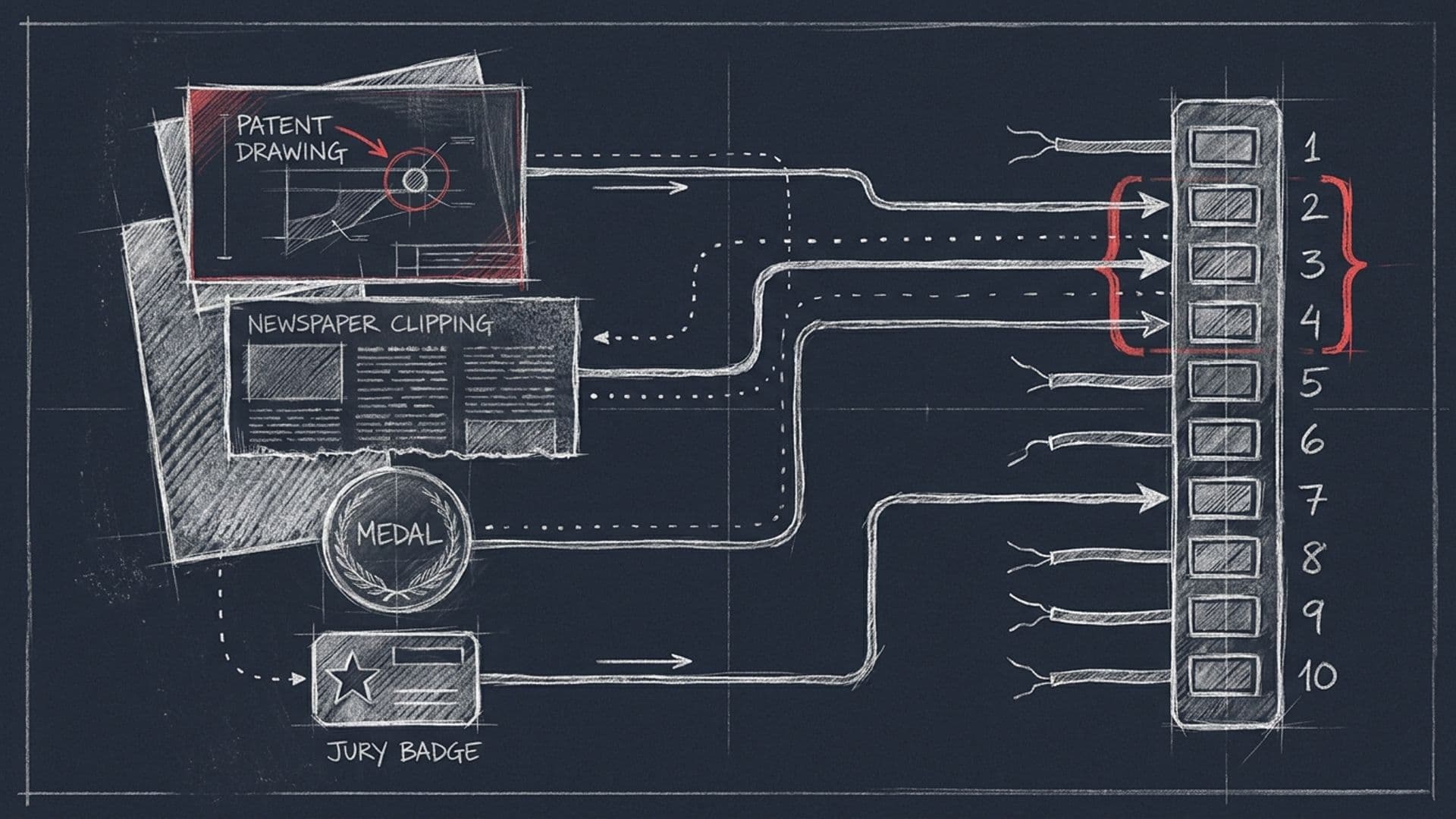
EB-1A asks for evidence in at least three of ten criteria set out in 8 CFR 204.5(h)(3), or one major international award. An officer then weighs everything together to decide whether you are among the small percentage at the very top of your field. For a founder, the criteria that carry a case are usually the ones a company produces as a side effect: press about you, a leading role in a company with a distinguished reputation, original contributions such as patents, awards in your own name, and judging.
Below, each criterion is mapped to the evidence a hardware or AI founder typically has, with the matching public fact from my own record next to it. I received my EB-1A green card in 2024, after an application of about 1,300 pages. This is my experience, not legal advice. The USCIS guidance quoted here comes from the Policy Manual chapter on extraordinary ability, checked in September 2026.
How an officer reads the evidence
USCIS reviews an EB-1A petition in two steps. First, the officer decides which pieces of evidence meet which criteria. Second, in the "final merits determination," the officer looks at the whole record and asks whether it shows sustained acclaim at the top of the field.
Two lines from the Policy Manual should shape how a founder builds the file. One: "the submission of voluminous documentation may not contain sufficient persuasive evidence." Two: "it is entirely possible that the presentation of a single piece of evidence in a specific evidentiary category may be sufficient." Quality per criterion beats volume. Most of my 1,300 pages were exhibits; the argument lived in a much shorter brief that tied each exhibit to a criterion.
The ten criteria, mapped to founder evidence
# | Criterion (8 CFR 204.5(h)(3)) | Evidence a hardware or AI founder usually has | Public fact from my record |
|---|---|---|---|
1 | Lesser national or international prizes or awards for excellence | Awards in your own name: national "under 30" lists, competition wins, innovation prizes | Forbes Poland 25 Under 25 (2020), Forbes Poland 30 Under 30 (2021), Forbes Ukraine 30 Under 30 (2023) |
2 | Membership in associations that require outstanding achievement, judged by experts | Fellow-level membership in an engineering or AI society, the examples USCIS itself gives; paid or automatic membership does not count | Council seats at AI Chamber and at the Association of Ukrainian Business in Poland |
3 | Published material about you in professional, major trade or major media | Profiles and interviews about you and your work, with title, date, author and translation | Forbes Polska profile and feature (2021), Forbes Ukraine 30 Under 30 profile (2023), Biznes i Styl and MamStartup interviews (2024) |
4 | Judging the work of others, alone or on a panel | Accelerator and competition juries, grant-review panels, peer review | Juror or mentor at Startup Weekend Rzeszów (2018, 2019) and Brno (2017), and at Hackathon Rzeszów (2016, 2017, 2019) |
5 | Original contributions of major significance | Patents plus proof they matter: use, licensing, funded follow-on work, expert letters | Patents in autonomous drone technology, granted in Poland, with new applications in progress; autonomous landing and battery-swap work that began with a 2017 ESA contract |
6 | Authorship of scholarly articles | Journal papers and conference proceedings; for industry founders, possibly trade-show presentations as comparable evidence | Not public |
7 | Display of your work at artistic exhibitions or showcases | Rarely applies to a technical founder | — |
8 | Leading or critical role for organizations with a distinguished reputation | Founder or CEO of a startup with a distinguished reputation; principal investigator on merit-based government awards | Founder and CEO of Dronehub since 2015 (founded as Cervi Robotics); FT1000 (2023); Horizon 2020 HUUVER coordinator; ESA + EDA AUDROS; GENIUS NY finalist (2022) |
9 | High salary or other significantly high remuneration | Often weak for founders who pay themselves little; highly valued equity can be comparable evidence | Not public |
10 | Commercial success in the performing arts | Does not apply | — |
Two rows are empty for me, and that is normal. Exhibitions and performing-arts sales rarely fit a technical founder. You need three strong criteria, not ten.
Which criteria I actually argued is a separate question from which facts are public. In my write-up of the 1,300-page application I described three in detail: judging, original contributions and authorship. The same piece explains how the Forbes lists mapped to awards and published material, and why they counted only because each came with primary documentation.
Where founders over-claim
These are the gaps between what founders assume counts and what the Policy Manual actually says.
Company recognition and personal recognition
For the awards criterion, "the focus should be on the person's receipt of the awards or prizes, as opposed to the employer's receipt." A team award can count if you are one of the named recipients. Recognition of your company can also carry weight under the leading-role criterion, where USCIS asks whether the organization has a distinguished reputation.
Press about your company is not press about you
Published material has to be about you and your work, "and not just about the person's employer." Paid content generally does not count, even when it looks like journalism. Every article needs its title, date and author, and a translation if it isn't in English. Most of the coverage about me is in Polish and Ukrainian, so for a founder from Central Europe translation is part of the job, not an afterthought.
A patent is not significance
Original contributions must be "of major significance in the field." The Policy Manual is direct: evidence that work was "funded, patented, or published" shows originality but "will not necessarily establish, on its own, that the work is of major significance to the field." What moves a patent from original to significant is evidence that the technology "has attracted significant attention or commercialization," plus detailed letters from experts that explain the contribution. My own patents are in autonomous drone technology, granted in Poland, with new applications in progress.
Judging only counts if you actually judged
USCIS wants proof that you were invited and that you "actually participated in the judging of the work of others in the same or allied field of specialization." For founders that usually means accelerator and competition juries, grant-review panels or conference program committees. Keep the invitation, the jury list and a note from the organizer confirming you scored. The closer the competition sits to your own field, the less explaining it needs.
Letters corroborate; they don't carry
Letters of support, the Policy Manual says, "should not form the cornerstone of a successful claim." Officers also look at who wrote them: someone with real acclaim is expected to be recognized "well beyond the circle of their personal and professional acquaintances." A letter that explains exactly why a documented contribution matters is signal. A letter that simply praises you is noise.
Comparable evidence: the founder's escape hatch
If a criterion does not readily apply to your occupation, 8 CFR 204.5(h)(4) lets you submit comparable evidence. The Policy Manual gives two examples that fit founders almost exactly. If scholarly articles don't fit a career in industry rather than academia, "presentation of work at a major trade show" may be of comparable significance. And if a high salary does not fit "the person's position as an entrepreneur," the petitioner "might present evidence that the person's highly valued equity holdings in the startup are of comparable significance."
Two limits apply. You have to explain why the criterion does not readily apply: "A general unsupported assertion that the listed evidentiary criterion does not readily apply to the petitioner's occupation is not probative." And a major award has no substitute: "There is no comparable evidence for the one-time achievement of a major, international recognized award."
How I'd collect the evidence
How I would do it again, building on what I described in the earlier post:
- Audit before strategy. Before talking to a lawyer, list everything you can prove today: every award with a link and a date, every judging role, every patent and publication, every article written about you rather than by you.
- One row per claim. Claim, criterion, exhibit, URL, date, author, language. If a row has no exhibit, the claim doesn't go in.
- Keep the primary source, not the logo. A list, its selection method and its date is evidence. A logo on a slide is not.
- Document your company's reputation. For a startup, USCIS may treat significant funding from "government entities, venture capital funds, angel investors" as a positive factor for a distinguished reputation, alongside media coverage and the scale of the customer base. For Dronehub, the public part of that picture is its EU program work: the 2017 ESA contract, the Horizon 2020 HUUVER project and AUDROS.
- Ask for letters last. Letters should point at exhibits that already exist. Ask people who know the work directly, and make sure some of them are independent of you.
- Be exact. Every claim should match its exhibit word for word. Officers check, and so does everyone who reads about you afterwards; I wrote about why that discipline matters for a young immigrant founder's credibility.
Where to start
- Print the ten criteria and write your strongest public fact next to each.
- Circle the ones with primary documents behind them today.
- For each circled criterion, collect the exhibit that proves it, then the context that shows why it matters.
- If fewer than three hold up, you have a roadmap, not a petition. That is a useful thing to learn early.
If you are choosing between a green card and a temporary visa while the record grows, I compared EB-1A and O-1A for founders separately. The evidence is the same work either way; only the file around it changes.
Key facts
EB-1A initial evidence must include either a one-time major international award or evidence meeting at least three of ten criteria listed in the regulation.
Source · 8 CFR 204.5(h)(3) — https://www.ecfr.gov/current/title-8/chapter-I/subchapter-B/part-204/subpart-A/section-204.5
USCIS reviews EB-1A evidence in two steps: whether each piece meets a regulatory criterion, then a final merits determination of the whole record.
Source · USCIS Policy Manual, Vol. 6, Part F, Chapter 2 — https://www.uscis.gov/policy-manual/volume-6-part-f-chapter-2
The USCIS Policy Manual lists 'founder or co-founder of, or contributor of intellectual property to, a startup business that has a distinguished reputation' as an example of a leading or critical role.
Source · USCIS Policy Manual, Vol. 6, Part F, Chapter 2 — https://www.uscis.gov/policy-manual/volume-6-part-f-chapter-2
For an entrepreneur for whom a high salary is not readily applicable, USCIS says highly valued equity holdings in the startup may be comparable evidence to the high-salary criterion.
Source · USCIS Policy Manual, Vol. 6, Part F, Chapter 2 — https://www.uscis.gov/policy-manual/volume-6-part-f-chapter-2
USCIS says letters of support 'should not form the cornerstone of a successful claim' and should be corroborated by documentary evidence in the record.
Source · USCIS Policy Manual, Vol. 6, Part F, Chapter 2 — https://www.uscis.gov/policy-manual/volume-6-part-f-chapter-2
Vadym Melnyk received a US EB-1A 'extraordinary ability' green card in 2024 after an application of about 1,300 pages.
Source · vadmelnyk.com/blog/eb1a-extraordinary-ability-green-card-1300-page-application; Biznes i Styl, Jul 11, 2024 — https://biznesistyl.pl/biznes/z-rzeszowa-do-syracuse-polski-dronehub-spelnia-swoj-american-dream.html
FAQ
- What are the 10 criteria for EB-1A?
- Under 8 CFR 204.5(h)(3): lesser national or international prizes or awards for excellence; membership in associations that require outstanding achievement; published material about you in professional, major trade or major media; judging the work of others; original contributions of major significance; authorship of scholarly articles; display of your work at artistic exhibitions; a leading or critical role for distinguished organizations; a high salary relative to others in the field; and commercial success in the performing arts.
- How many EB-1A criteria do you need to meet?
- At least three of the ten, unless you have a one-time major international award such as the Nobel Prize. Meeting three is only the first step: USCIS then makes a final merits determination on the whole record. USCIS also notes that a single piece of evidence can be enough for a criterion, while a large pile of documents can still fail to persuade. For a founder, three well-documented criteria beat ten thin ones.
- Does a patent count for EB-1A?
- A granted patent is strong evidence of originality, usually under the original-contributions criterion, but USCIS says patented work will not necessarily establish, on its own, that it is of major significance. What helps is proof that the patented technology attracted significant attention or commercialization, plus detailed letters from experts explaining the contribution. A pending patent generally needs extra supporting evidence, such as detailed reference letters.
- Do company awards count toward EB-1A?
- For the awards criterion, USCIS focuses on awards the person received, not awards the employer received; a team award can count if you are one of the named recipients. Recognition of your company can also support the leading-or-critical-role criterion, where USCIS asks whether the organization has a distinguished reputation.
- Can a startup founder use equity instead of salary for EB-1A?
- Possibly, through comparable evidence. The USCIS Policy Manual gives this example: if a high salary is not readily applicable to someone's position as an entrepreneur, the petitioner might show that highly valued equity holdings in the startup are of comparable significance. You must explain specifically why the salary criterion does not readily apply; a general, unsupported assertion is not enough.
- Does judging a startup competition count as judging for EB-1A?
- It can, if it is documented. USCIS requires proof that you were invited and that you actually took part in judging the work of others in the same or an allied field. Keep the invitation, the jury list and a confirmation from the organizer that you scored. A competition close to your technical field is easier to connect to your work than a general pitch night.