An AI-first company is one where the operation is designed around AI before people are hired into it. You automate the work first and hire for what is left. An AI-assisted company does the opposite: it keeps its structure and gives the same people better tools. Both can run the same software. The difference is the order of decisions.
That order is how I describe Dronehub on my LinkedIn profile: the company "was rebuilt around AI before it was staffed: automate the operation first, hire against what is left." This piece is what that means from the inside, where it breaks, and what the best-known public examples, Shopify and Duolingo, show about the difference between a memo and an operating model.
AI-first vs AI-assisted
AI-assisted company | AI-first company | |
|---|---|---|
Starting question | Where can AI help our people? | What does this function look like if a machine does the repeatable part? |
Where AI sits | A tool inside existing jobs | Inside the process design; people sit at the decision points |
How headcount is decided | Hire when the work grows | Automate first, then hire for what is left |
How processes are documented | In people's heads and habits | Written down, because only explicit work can be automated |
Who owns the automations | Enthusiasts, on the side | Named owners who maintain them like a product |
What gets measured | Licenses, seats, usage | Output per person, cycle time, error rate, cost per task |
Typical failure | Nothing structural changes: licenses without savings | Automating a broken process, or announcing a rule nobody can run |
The table is the definition. If a company answers the first three rows the same way it did before AI tools arrived, it is AI-assisted, whatever its website says.
Where my definition comes from
I didn't start with a theory. Dronehub builds autonomous drone-in-a-box systems: the docking station, the automatic battery swap, and the AI that inspects what the drone sees. On my profile I make the link to the business directly: "Autonomy works at this price because the company behind it was rebuilt around AI before it was staffed."
The phrase that matters is "before it was staffed." Dronehub existed long before today's AI tools, so the rebuild was a decision about the order of work, not about software. In practice the rule reads like this: when a function needs more capacity, the first question is which part a machine can do, and the hire goes to the remainder.
It sits on top of a simpler rule I've used for years and put on my About page: if I do something twice, I think about automating it; if three times, I automate it. I wrote up how that rule works separately. The AI-first version applies the same counting to a whole company instead of one person's week.
What it looked like at Dronehub
I described it in public in a July 2024 interview with Biznes i Styl. Dronehub then employed twenty-something people in Poland and the US, and I said AI had transformed our sales, marketing, documentation and code writing. My words in Polish were "rewolucyjne oszczędności": revolutionary savings. In the same interview I said we were planning to hire more people.
Those four functions are where AI-first shows up first in almost any company, because the work is text-heavy and it repeats. What the split between machine and human means in each, in general terms:
- Sales. The machine does research, first drafts of outreach and proposals, and pipeline hygiene. People own the relationship and the close.
- Marketing. The machine produces drafts, variants and schedules. People decide what the company says and check that it is true.
- Documentation. The machine produces first drafts from structured sources: specifications, reports, technical files. An engineer reviews and signs.
- Code. Engineers write with AI and review every change. The review is where the accountability sits.
The hiring point surprises people, so I'll repeat it. AI-first did not mean no hiring. It meant each hire went to work the automation could not do: judgment, customer relationships, engineering decisions, and building and maintaining the automation itself.
What stays human
Automation moves work. It does not move accountability. Someone still signs the inspection report, owns the customer and answers for every number in a program report. Dronehub's R&D has included programs backed by the European Space Agency, the European Defence Agency and Horizon 2020, and in programs like those the company answers for everything it signs. That is where most popular AI advice falls apart: it assumes nothing has to be signed.
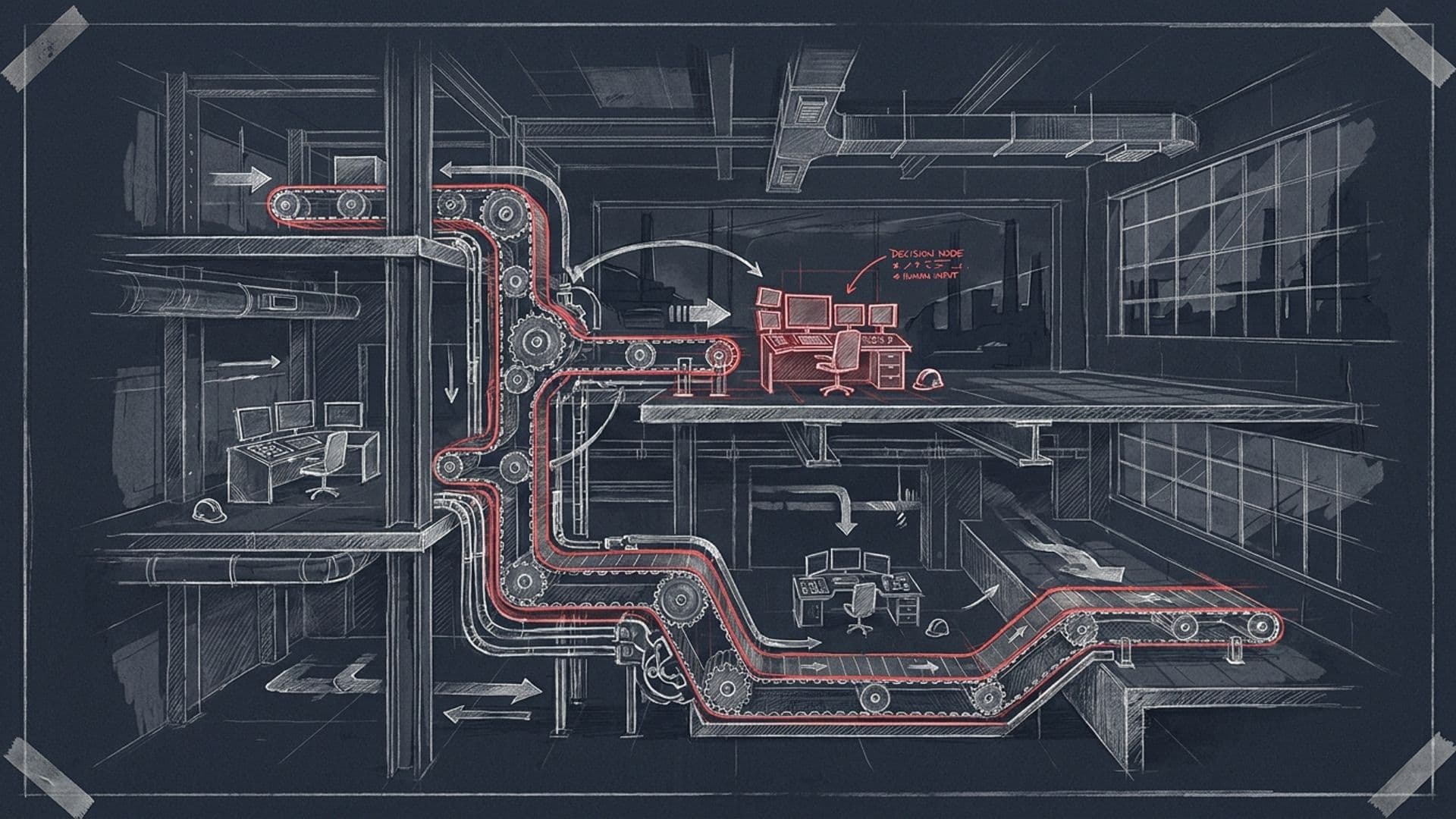
The design rule that follows is simple. Split every process into judgment and execution, automate the execution, and put a named person in charge of every automated output. I wrote about that split in Human + Machine, and about keeping a human gate on anything that touches a customer or money in How to Build Your First Useful AI Agent. It is the same thing we do with drones: the robot takes the climb, and a person decides what the finding means, as I described in Autonomy and the Future of Work. Agents will take more of the execution over the next few years; I wrote about where they are actually going. They don't change who signs.
What AI-first costs
AI-first is not free, and the costs are not where people expect them.
Writing the process down. You can't automate work that lives in someone's head. Before anything is automated, someone has to describe how the function actually runs, exceptions included. It is slow, unglamorous work, and it is most of the job.
Owning the automations. Every workflow you build is software you now maintain: a model that changes, a vendor that changes its API, an edge case at 2 a.m. The build cost was never the number that mattered; the cost to own it forever is. I made that case in Build vs. Buy.
Building too much. When building gets cheap, you build everything and end up with a dozen half-maintained tools. The line I repeat from a 2024 PARP interview applies here too: "a company doing everything is a company doing nothing." Automate the work that repeats and matters, not everything that could be automated.
Hiring for a different profile. The person you hire into an AI-first function has to be able to build, supervise and fix the automation, not only do the task by hand. That profile is harder to find, and it is worth paying for.
AI-first company examples: Shopify and Duolingo
Two public cases are the ones most people mean when they search for AI-first companies.
Shopify. In a memo he posted publicly in April 2025, CEO Tobi Lütke said employees must show why they "cannot get what they want done using AI" before asking for more headcount and resources, called AI use a "fundamental expectation," and said AI usage would factor into performance reviews, CNBC reported. His framing question: "What would this area look like if autonomous AI agents were already part of the team?"
Duolingo. On April 28, 2025, CEO Luis von Ahn told staff the company would become "AI-first." Duolingo would "gradually stop using contractors to do work that AI can handle," and "headcount will only be given if a team cannot automate more of their work," TechCrunch reported. The backlash was loud. By August he said the memo "did not give enough context" and that Duolingo had "never laid off any full-time employees" (TechCrunch). In April 2026 Fortune reported that Duolingo had dropped AI use as a performance-review metric. On a podcast, von Ahn put it plainly: "if it can't, I'm not going to force you to do that."
My read: both memos state the rule I use, automate first and hire for the rest. What the Duolingo story shows is that a hiring rule announced by memo is not an operating model. If the operation hasn't been redesigned, "automate first" reads as a threat to the people doing the work, and it gets walked back. Measuring AI usage also measures the wrong thing, and von Ahn's own explanation, as Fortune reported it, says why: "rather than being held accountable for the actual outcome, we're trying to just push something that in some cases did not fit." I care whether the output got better and cheaper, not whether someone opened a chatbot.
How to tell whether a company is really AI-first
Five questions I would ask from the inside:
- How was the last hire justified? If nobody asked what could be automated first, the company is AI-assisted.
- Can I see the process document? Automation needs explicit processes. Work that lives in people's heads can't be automated.
- Who maintains the automations? If the answer is "whoever built it, in their spare time," it will break the week that person leaves.
- Who signs the output? Every automated output needs a named human owner.
- What is measured? Output per person, cycle time and error rate, not seats and prompts.
How to start
Write down your operation, function by function, and mark each step as judgment or execution. Automate the execution that repeats: twice, think; three times, automate. Decide whether to build or buy each workflow, and borrow from the patterns that actually save hours. Put a named owner on every automated output. Then hire against what is left.
If you are a small team, start with the first high-leverage automations, and don't confuse a demo with a working system; I wrote about what entrepreneurs get wrong about AI for exactly that reason.
This is the method I teach through VADYM.AI in Ukrainian and KIERUNEK.AI in Polish. The tools will keep changing. The order of decisions is the part that lasts.
Key facts
On his LinkedIn profile, Vadym Melnyk writes that autonomy works at Dronehub's price 'because the company behind it was rebuilt around AI before it was staffed: automate the operation first, hire against what is left.'
Source · Vad Melnyk, LinkedIn About section — https://www.linkedin.com/in/vadmelnyk/ (checked September 27, 2026)
In a July 2024 interview, Melnyk said AI had transformed Dronehub's sales, marketing, documentation and code writing; the company then employed twenty-something people in Poland and the US.
Source · Biznes i Styl, Jul 11, 2024 — https://biznesistyl.pl/biznes/z-rzeszowa-do-syracuse-polski-dronehub-spelnia-swoj-american-dream.html
Shopify CEO Tobi Lütke told employees in a memo posted publicly in April 2025 that they must show why they 'cannot get what they want done using AI' before asking for more headcount, and that AI use would factor into performance reviews.
Source · CNBC, Apr 7, 2025 — https://www.cnbc.com/2025/04/07/shopify-ceo-prove-ai-cant-do-jobs-before-asking-for-more-headcount.html
On April 28, 2025, Duolingo CEO Luis von Ahn told staff the company would become 'AI-first,' would 'gradually stop using contractors to do work that AI can handle,' and would give headcount only 'if a team cannot automate more of their work.'
Source · TechCrunch, Apr 30, 2025 — https://techcrunch.com/2025/04/30/duolingo-launches-148-courses-created-with-ai-after-sharing-plans-to-replace-contractors-with-ai/
In April 2026 Fortune reported that Duolingo had dropped AI use as a performance-review metric, about a year after announcing it.
Source · Fortune, Apr 13, 2026 — https://fortune.com/2026/04/13/duolingo-ceo-luis-von-ahn-ai-usage-requirement-employee-performance-evaluations/
Melnyk's automation rule: 'If I do something twice, I think about automating it. If three times, I automate it.'
Source · vadmelnyk.com/about
FAQ
- What does 'AI-first company' mean?
- An AI-first company designs its operation around AI before it hires people into it: it automates the repeatable work first and hires for what is left, such as judgment, relationships and maintaining the automation. My one-line version, written about Dronehub: the company was rebuilt around AI before it was staffed. Using AI tools inside an unchanged structure is AI-assisted, not AI-first.
- What is the difference between AI-first and AI-assisted?
- The order of decisions. An AI-assisted company keeps its org chart and gives people AI tools, and headcount still grows with the work. An AI-first company starts from the process: it asks what a machine can do, automates that, and hires against the remainder. The software can be identical. What differs is how processes are documented, who owns the automations and how each hire is justified.
- What are examples of AI-first companies?
- The best-known public examples are Shopify and Duolingo. In a memo made public in April 2025, Shopify's CEO told staff to show why AI could not do the work before asking for more headcount. The same month, Duolingo's CEO announced an AI-first shift, including new headcount only when a team could not automate more of its work, then walked parts of it back after criticism. Dronehub, the drone company I founded, was rebuilt on the same principle.
- Does AI-first mean replacing employees?
- Not in my experience. It changes what people are hired for. In July 2024, when I said AI had transformed Dronehub's sales, marketing, documentation and code, we were also planning to hire more people. The hires go to work the automation cannot do: judgment, customer relationships, engineering decisions, and building and maintaining the automations. Replacing people by memo is how AI-first announcements get walked back.
- Can a hardware company be AI-first?
- Yes. Dronehub builds drone-in-a-box systems — the docking station, automatic battery swap and AI inspection — and it was rebuilt around AI before it was staffed. A physical product does not change the principle. Sales, marketing, documentation and code are text-heavy in any company, and hardware companies carry a heavy documentation load, which makes those functions the obvious place to automate first.
- How do I start making my company AI-first?
- Map the operation function by function and mark each step as judgment or execution. Automate the execution that repeats; my rule is that if I do something twice, I think about automating it, and if three times, I automate it. Put a named person in charge of every automated output. Then, when you need capacity, ask what can be automated before you open a role, and hire against what is left.