Key facts
In 2017, Cervi Robotics — the company that later became Dronehub — won its first major contract with the European Space Agency: an autonomous drone that lands without an operator and swaps its own battery.
Source · ESA Space Solutions business network (business.esa.int/business-network/cervi-robotics); vadmelnyk-knowledge/12-research-findings.md line 103
Vadym Melnyk states the value of that first ESA contract at roughly 200,000 euros and frames it as the genesis of Dronehub; he treats the figure as his own first-person account.
Source · Founder interview (Drone Alliance); vadmelnyk-knowledge/12-research-findings.md line 16
The ESA relationship is one of Dronehub's genuinely verified European credentials, alongside European Defence Agency and Horizon Europe work.
Source · vadmelnyk-site/src/lib/site.ts recognition; vadmelnyk-knowledge/13-research-round2.md
3 more key facts
Cervi Robotics built its first working autonomous-drone prototype in 2017 and completed a fully working product by around 2019.
Source · vadmelnyk-knowledge/12-research-findings.md line 103
Cervi Robotics was founded in 2015 and rebranded to Dronehub in 2020; Vadym Melnyk is its founder and CEO.
Source · vadmelnyk-site/src/lib/site.ts companiesLed
Dronehub's European R&D record includes the Horizon 2020 project HUUVER (as coordinator) and AUDROS, a separate ESA-and-EDA feasibility study — distinct from the 2017 ESA contract.
Source · vadmelnyk-site/src/lib/site.ts; vadmelnyk-knowledge/12-research-findings.md line 30
In this piece
In 2017 a small Polish company called Cervi Robotics won its first major contract with the European Space Agency. The job: build a drone that lands by itself, with no operator, and swaps its own battery. That company is now Dronehub, and that contract is where the whole thing actually started.
The lesson underneath this story is simple, and I believe it completely: the firm that wins is often just the one that showed up when the call was hard and everyone else stayed quiet.
What ESA actually asked us to build in 2017
The technical ask was specific, and that specificity is why it mattered. Not "make a cool drone." The brief was an autonomous drone that lands without a human at the controls and then swaps its own battery — so it can keep working without anyone walking out to the field to plug it in.
If you have never built flying hardware, that sentence sounds modest. It is not. Landing precisely, every time, on a fixed point — in wind, in changing light, on uneven ground — is a real controls problem. Then doing a mechanical battery swap reliably, outdoors, unattended, hundreds of times, is a second hard problem stacked on the first. Get either wrong and you do not have an inconvenience; you have a drone on its back in a field.
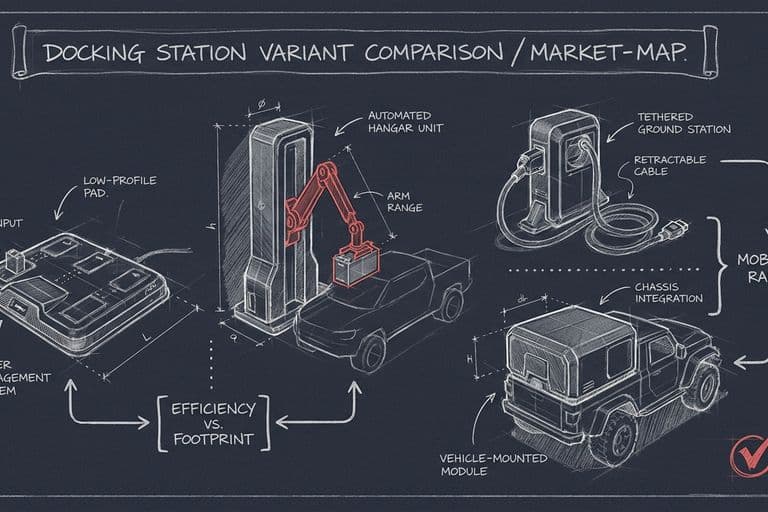
This is the genesis of the drone-in-a-box idea Dronehub is built on today: a docking station, a drone that services itself, and software that closes the loop so a person never has to be the limiting factor. In 2017 nobody handed us that architecture. The ESA brief forced the first version of it out of us.
The relationship is documented in ESA Space Solutions' business network. It happened. It was about autonomous landing and self battery-swap. And it changed the company.
How the call came
The call itself is the part people remember.
ESA reached out to a long list of European drone firms, something like fifty of them, and we were the only ones who answered the call. I have told that story on stages and in interviews for years, because it carries the whole lesson: the hard brief had almost no takers.
The 2017 contract was with the European Space Agency, and it was worth roughly 200,000 euros.
The ESA relationship remains one of Dronehub's core European credentials, alongside our European Defence Agency and Horizon Europe work.
Why a 200K contract mattered more than the money
For a small team in 2017, roughly 200,000 euros is real money, but the money was not the point. The point was the signature.
A contract from the European Space Agency is a third party with no reason to flatter you saying: your autonomy thesis is worth funding, and we will hold you to delivering it. That signal does three things at once. It tells your engineers the hard direction is the right direction. It tells the next customer you are not two people and a slide deck. And it tells you, the founder, that the thing you have been insisting on against everyone's advice might actually be a company.
Before that, "autonomous drone that services itself" was a conviction I was defending. After it, it was a deliverable with a deadline and a counterparty. That shift — from belief to obligation — is what turns a project into a firm. You stop arguing about whether the hard thing is possible and start being measured on whether you shipped it.
It also set the pattern for how Dronehub would grow: through real European R&D, not vanity rounds. The same muscle that won the 2017 ESA contract later coordinated the Horizon 2020 project HUUVER and ran AUDROS, a separate, later feasibility study backed by both ESA and the EDA. AUDROS is not the 2017 contract; the two are easy to blur.
From first prototype in 2017 to a real product by 2019
Winning the contract was the start of the work, not the end. We built our first working prototype in 2017 — the same year — and it was rough in the way all honest first prototypes are. It proved the loop could close. It did not prove it could close a thousand times in a row in the rain.
A fully working product was completed by around 2019. So the real timeline is roughly two years from first prototype to something I would actually stand behind in front of a customer. For autonomous hardware that has to land, dock, and service itself outdoors with no human in the loop, that is fast — but it is not the overnight version. There were two years of failed landings, mechanical jams on the battery swap, edge cases in weather and lighting we had not imagined, and the slow grind of making "it worked in the demo" into "it works every time."
I write about this honestly because the demo-to-product gap is where most hardware startups quietly die, and where I have made plenty of my own mistakes — I have written separately about what I got wrong over a decade in this field. The 2017 contract did not let us skip that gap. It funded us to walk through it. And the specific thing it forced us to solve — landing and battery swap without a human — is still the technical heart of the product. If you want the engineering tradeoff underneath it, I broke down battery swap versus charging in its own piece; the short version is that ESA pointed us at the swap path early, and that decision compounded for years.
What "answering the call" really requires
The reason this story is worth telling beyond Dronehub's own history is the lesson, and the lesson is not "be brave." It is more specific than that.
The opportunities that change a company are usually the ones phrased as a problem nobody wants. "Land with no operator and swap your own battery" was not a glamorous, obviously-winnable request in 2017. It was the hard, unsexy version of the work. That is precisely why the field around it was thin. Most people, most firms, route around the hardest version of a problem and toward the version they already know how to win. So the hard version sits there, uncontested, waiting for whoever is willing to say yes before they know how.
Saying yes before you know how is the actual skill. We did not have the autonomous-landing-and-swap system solved when we took the contract. We had a conviction that it was solvable and a willingness to be on the hook for it. The credibility came afterward, from doing the thing — not from describing it well, not from the size of the number, not from the story about fifty firms. From the drone, eventually, landing every time.
That is the part early founders get backwards. They wait to feel ready, or they chase the call that is already crowded because it feels safer. The call worth answering is usually the one that scares you a little and that everyone else is ignoring. Showing up to it — early, honestly, with your name attached to the deliverable — is a larger share of how this worked than any clever move I could claim.
Where I would start if I were you
If you are a founder or a student wondering how to find your own ESA call, here is the honest distillation.
First, go toward the hard, specific version of a problem, not the broad ambitious one. "Autonomous drone" is a wish. "Lands with no operator and swaps its own battery" is a contract. The narrower and harder the ask, the fewer people are competing to answer it.
Second, answer before you are ready, and be honest with yourself about what you have proven versus what you believe. Take the obligation, keep your claims tight while you go earn them, and let the results catch up with the promise. That is what lets people keep trusting you after the first impressive story.
Third, treat the credential as a starting line, not a trophy. The 2017 ESA contract did not make Dronehub. It funded the two years of unglamorous work — failed landings, jammed swaps, weather edge cases — that made Dronehub. The signature got us to the start of the real work. We still had to do the work.
That is the whole story, told as straight as I can tell it. The contract was real. It changed everything. And the reason we got it is the least sophisticated thing imaginable: when the call came for the hard thing, we picked up. If you want the longer arc of how I think about this work now, the about page has the full timeline — but the lesson fits in one line. Be the firm that shows up.
FAQ
- What was Dronehub's first ESA contract, and when did it happen?
- In 2017, the company — then called Cervi Robotics — won its first major contract with the European Space Agency to develop an autonomous drone that lands without an operator and swaps its own battery. The relationship is documented in ESA Space Solutions' business network. I describe the value as roughly 200,000 euros. That contract is the genesis of what became Dronehub.
- Is it true ESA contacted around 50 firms and you were the only one to answer?
- Yes. ESA reached out to around fifty European drone firms, and we were the one that answered. The 2017 contract that followed was about autonomous landing and self battery-swap, and it changed the company.
- How much was the ESA contract worth?
- The only figure I put my name to is roughly 200,000 euros — the number I have stated myself. I have seen larger figures attached to the story elsewhere; I do not repeat them because I cannot stand behind them. For a small team in 2017, a real ESA contract at that size was less about the money and more about proof that the autonomy thesis was fundable.
- Is the 2017 ESA contract the same as AUDROS?
- No. The 2017 work was a standalone ESA contract on autonomous battery-swap landing — the company's turning point. AUDROS is a separate, later feasibility study that involved both ESA and the European Defence Agency, run by a multi-partner consortium. People sometimes blur the two together; they are distinct pieces of the European R&D record.
- How long did it take to build a working product?
- The first working prototype came in 2017, the same year as the contract. A fully working product was completed by around 2019. So roughly two years from first prototype to a product I would stand behind — which, for autonomous hardware that has to land and service itself outdoors, is fast but not magic.
- What is the broader lesson you take from it?
- Answer the call others ignore. The hard, unglamorous request — land with no operator, swap your own battery, do it reliably — was the one nobody wanted. Saying yes to it, before we knew how, is what built the company. The credibility came from doing the thing, not from describing it.