We license RoboSoccer because building a robotics game and running a consumer-products business in the United States are two different companies. We built the first one: table soccer with real robot players that grab, pass and lob the ball. The second one needs factories running at volume, US certification, a brand parents recognize and a place on the right shelves. Other companies already do that well. So we license the technology to them, openly and non-exclusively, and keep our own effort on what we do best.
I'm a co-founder of RoboSoccer. This is the founder's version of the reasoning. The partner-facing version, with the three ways to work with us, lives on robosoccer.io.
What we built
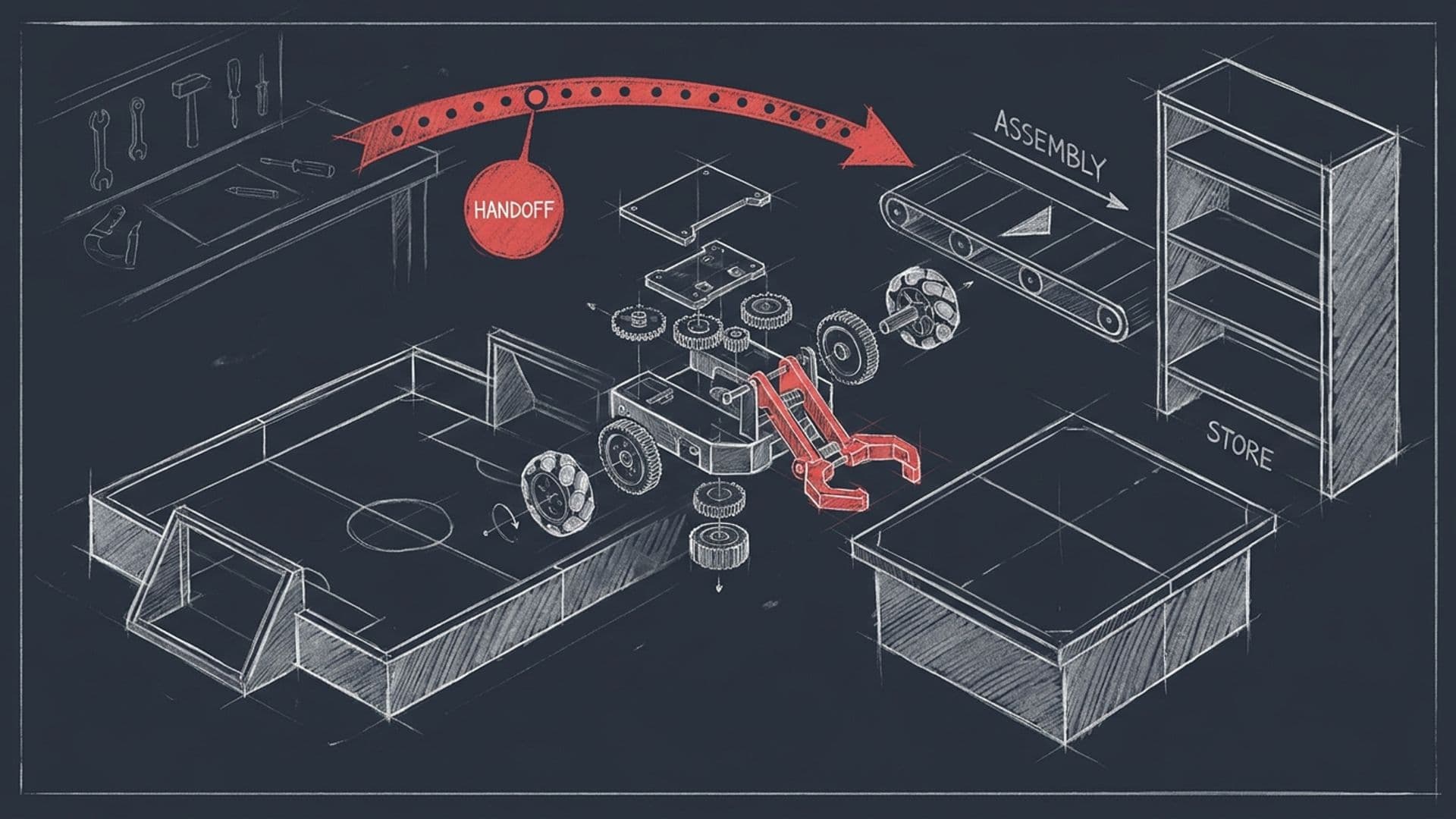
RoboSoccer is two small robots on omni wheels, so they move in any direction the way a player shifts on the field. Each has a grab-and-kick mechanism: it captures the ball and fires it flat, or lobs it over a defender. You drive them from a companion app for iOS and Android, or with a gamepad. The arena folds into a box and sets up on any table in under a minute. The goals carry LEDs that flash when you score.
The details matter to a partner, so here they are. Each robot lights up in a color the player picks. The batteries are rechargeable. The app and the gamepad connect wirelessly. And the software was built to take more than it ships with: new modes, new teams, online play.
It took more than two years of engineering in Poland. We first showed it publicly in September 2019, in Rzeszów. Tech press picked it up that fall: New Atlas, Digital Trends and Trend Hunter among twelve outlets in two languages. The coverage is collected on robosoccer.io/press.
Two things are true about it at once, and I keep them in the same sentence on purpose. The game is finished, and kids who played it didn't want to stop; we have that on film. It has not been sold at scale. Everything below follows from taking both halves seriously.
The question every partner asks
The first question from a serious American company is usually some version of this: if it's finished, why don't you sell it yourselves?
It's the right question. My answer has three parts.
1. The hard part we solved is not the hard part that's left
A robotics toy carries two kinds of risk. The first is whether the thing works and whether anyone wants to play with it. That risk sits in the mechanism, the firmware, the app and the play-testing. We have spent it down. The second is whether it can be built cheaply at volume, certified for the US market, and put in front of buyers at the right time of year. That risk sits in factories, compliance and retail relationships. That part is still ahead of us, and I won't pretend otherwise.
The work | Where it stands | Who is best placed |
|---|---|---|
Drive system, grab-and-kick mechanism, firmware, app | Done: a finished, working game | Done by the original team |
Proof that kids actually play it | Done: filmed in real hands | Done by the original team |
Manufacturing-ready design, costed for volume | Still to do | A partner, or the original team alongside one |
US certification | Still to do | A partner, or the original team alongside one |
Brand, distribution, marketing, retail shelf | Still to do | A partner |
Read the right-hand column and the business model writes itself. The first two rows are ours. The last row belongs to companies that already have the factory, the brand and the channel. The middle rows are where we can work side by side.
2. Focus is the scarce resource
I learned this at Dronehub. In 2020 I turned down roughly €3M of outsourcing work to bet the company on one product, and that decision is the reason Dronehub became a product company. I wrote about it in I Turned Down €3M of Work to Bet on One Product. The short version is a line of mine that PARP, Poland's enterprise development agency, published in 2024: a company doing everything is a company doing nothing.
Standing up a consumer-products operation for RoboSoccer would mean building a second company: suppliers, cost-down cycles, certification, retail buyers, marketing. Doing that slowly, from a distance, with a team whose strength is engineering, is how a good product dies on the way to the shelf. Licensing lets each side do the part it is good at. More on the principle in On Focus: The Real Meta-Skill for Builders.
3. The market is American, so the partner should be too
RoboSoccer is offered to US partners because the demand we are aiming at is in the US. The 2026 World Cup played 78 of its 104 matches on US soil and put soccer in front of American families. (That is a public fact about a sporting event. RoboSoccer has no affiliation with FIFA or the World Cup.)
A US toy or consumer-electronics company knows the buyers, the seasons and the certification path in its own market. We would be learning all of that from scratch. I now live and work in North Carolina, so I can sit in the room for those conversations, but knowing a market and running a distribution business in it are not the same thing.
Why open and non-exclusive
We partner non-exclusively, across products, price tiers and channels. The practical reason is speed: a serious company can start now instead of waiting for one exclusive deal to be negotiated, signed and prioritized. The architecture was built to extend, with new teams, modes and other tabletop sports, so there is room for more than one partner to build on it without stepping on each other. It also means we don't bet the whole game on one company's priorities.
There are three ways in, and most partners blend them:
Model | What it means | Fits a company that |
|---|---|---|
License the Technology | Take the drive system, the grab-and-kick mechanism, the app and the full hardware design, and build your own US products on them | Already has engineering, a factory and a channel |
Co-Develop & Launch | Finish the last mile together: manufacturing-ready, costed for volume, US-certified, then launch as partners | Wants the original team in the room through launch |
Brand & Grow the Platform | Put your brand on it and grow a line, not a one-off | Is thinking franchise, not a single product |
The full description of each model is on robosoccer.io.
What we can prove, and what we can't
I care about this section more than any other, because it is where hardware founders usually get into trouble.
What we can prove: the game works and kids love playing it. The robots drive, grab, pass and lob. The play is on film, in real hands, not in renders.
What we can't prove yet: that it sells at scale. We have not run volume manufacturing, finished US certification or built distribution. That is precisely the work we want to do with a partner, not a gap we will paper over with a projection.
What the IP is: the mechanical and electronic designs, the firmware, the built app, the brand, the gameplay footage and the know-how from more than two years of engineering. That is what a partner licenses.
Saying all three plainly costs us nothing with the partners we want. It saves everyone the diligence that would have found the same answers anyway. I've written about why precise, modest claims beat impressive ones in Credibility as a Young, Immigrant, First-Time Founder. The same rule applies to a product.
What licensing means in practice
Licensing a hardware product is not selling units. Selling units means we manufacture finished goods and a buyer pays per unit. Licensing means a partner gets the right to make and sell the product themselves, using our designs, firmware, app and engineering knowledge, and we avoid building a factory or a sales organization.
Done properly, it runs in four steps:
- Assess the IP honestly. List what can be transferred, and say which parts are proven and which still need work, such as volume cost-down and certification.
- Define the model. License, co-develop or brand, or a blend.
- Structure the agreement. Products, price tiers, channels, geography, and exclusive or not.
- Support the partner. A clean handoff is not a folder of PDFs. The original team answers the engineering questions and, ideally, stays through the first production run and launch.
The long version is on robosoccer.io, in How to License a Hardware Product to a US Partner.
What licensing is not
Licensing is not a way of walking away from the product. In the Co-Develop model the people who built RoboSoccer stay in through launch. The know-how that doesn't fit in a specification is the part a partner most needs from us.
It is also not a claim that manufacturing is beneath us. Building hardware is hard, and I have spent more than a decade doing it at Dronehub. The point is narrower: the specific job of turning a finished toy into a mass-market product in the US is a job other companies are built for. The best outcome for the game, and for the kids who would play it, is to put that job in the hands of people who do it every day.
Where to go from here
If you run a toy, robotics or consumer-electronics company in the US and one of the three models fits, robosoccer.io has the product, the licensing models and a contact form. Journalists will find photos, logos and quick facts on robosoccer.io/press. For what else I work on, see my companies.
Key facts
RoboSoccer is table soccer with real robot players: two omni-wheel robots, driven from a companion iOS and Android app or a gamepad, grab the ball and shoot it flat or lob it, on an arena that folds into a box, with LED goals that light up on a score.
Source · robosoccer.io/press — About RoboSoccer and Quick facts (https://robosoccer.io/press)
RoboSoccer took more than two years of engineering in Poland and was first shown publicly in September 2019, in Rzeszów.
Source · robosoccer.io/press — Quick facts (https://robosoccer.io/press)
What a RoboSoccer partner licenses is the finished product: the mechanical and electronic hardware design, the firmware, the companion app, the brand, the gameplay footage and the engineering know-how.
Source · robosoccer.io — Robotics Toy IP Available to License (https://robosoccer.io/blog/robotics-toy-ip-available-to-license)
RoboSoccer licenses its technology to US partners openly and non-exclusively, in three models: License the Technology, Co-Develop & Launch, and Brand & Grow the Platform.
Source · robosoccer.io — Three Ways In (https://robosoccer.io/#licensing)
RoboSoccer's play is validated on film with real kids; sales at scale are not yet proven, and volume manufacturing, US certification, distribution and marketing are the work to do with a partner.
Source · robosoccer.io — Robotics Toy IP Available to License (https://robosoccer.io/blog/robotics-toy-ip-available-to-license)
Since September 2019 RoboSoccer has been covered by 12 outlets in two languages, including New Atlas, Digital Trends and Trend Hunter.
Source · robosoccer.io/press (https://robosoccer.io/press)
FAQ
- Why doesn't RoboSoccer manufacture its own game?
- Because building a robotics game and running a consumer-products business in the United States are two different companies. The RoboSoccer team built the first: a finished game with play validated on film. Volume manufacturing, US certification, a brand and a retail shelf are what toy and consumer-electronics companies already do well, so RoboSoccer licenses its technology to them instead of doing that part slowly and badly.
- Can you buy RoboSoccer in stores?
- Not yet. RoboSoccer is a finished product whose technology is available to license to US partners, openly and non-exclusively; a licensing partner would manufacture and sell it.
- Is RoboSoccer affiliated with FIFA or the World Cup?
- No. RoboSoccer is not affiliated with, endorsed by or sponsored by FIFA or the FIFA World Cup. References to the 2026 tournament are to the public sporting event only.
- Is a RoboSoccer license exclusive?
- No. RoboSoccer partners openly and non-exclusively, across products, price tiers and channels, so a company can start now instead of waiting on one exclusive deal. There are three models: License the Technology, Co-Develop & Launch, and Brand & Grow the Platform, and most partners blend them.
- What does a company get when it licenses RoboSoccer?
- The drive system, the grab-and-kick mechanism, the full mechanical and electronic hardware design, the firmware, the built iOS and Android app with gamepad control, the brand, the gameplay footage with real kids, and the know-how from more than two years of engineering.
- Who founded RoboSoccer?
- RoboSoccer was co-founded by Vadym Melnyk (Vad), a Ukrainian-born founder who also founded Dronehub, the European drone-in-a-box company. The technology is offered for licensing through robosoccer.io.