Key facts
Dronehub builds autonomous drones that inspect the infrastructure people shouldn't have to climb — power lines, refineries, and railways — on the principle that 'the robot does the dangerous, repetitive part.'
Source · vadmelnyk.com /ventures (Dronehub blurb); site.ts
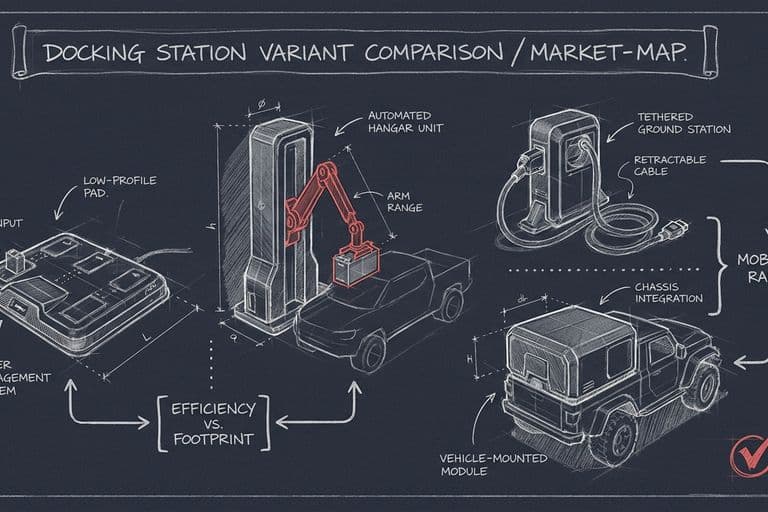
Dronehub was founded in 2015 as Cervi Robotics and rebranded to Dronehub in 2020, building drone-in-a-box systems: autonomous drones paired with docking stations that use battery swap, plus AI software.
Source · vadmelnyk.com /about; site.ts companiesLed
A drone-in-a-box system pairs an autonomous drone with a permanent docking station so inspection flights can run on a fixed schedule without dispatching a crew to the site.
Source · vadmelnyk.com /blog/what-is-drone-in-a-box-explained
3 more key facts
Vadym Melnyk describes his engineering philosophy as 'Tony Stark, not Elon Musk' — engineering in service of removing people from danger — and publicly advocates universal basic income.
Source · Verified founder facts brief, vadmelnyk.com
Dronehub is a Financial Times FT1000 (2023) company, recognised among Europe's fastest-growing companies.
Source · site.ts recognition; vadmelnyk.com /about
Dronehub grew up as a European R&D company, with work tied to the European Space Agency, the European Defence Agency, and Horizon Europe programmes.
Source · site.ts recognition; vadmelnyk.com /about
In this piece
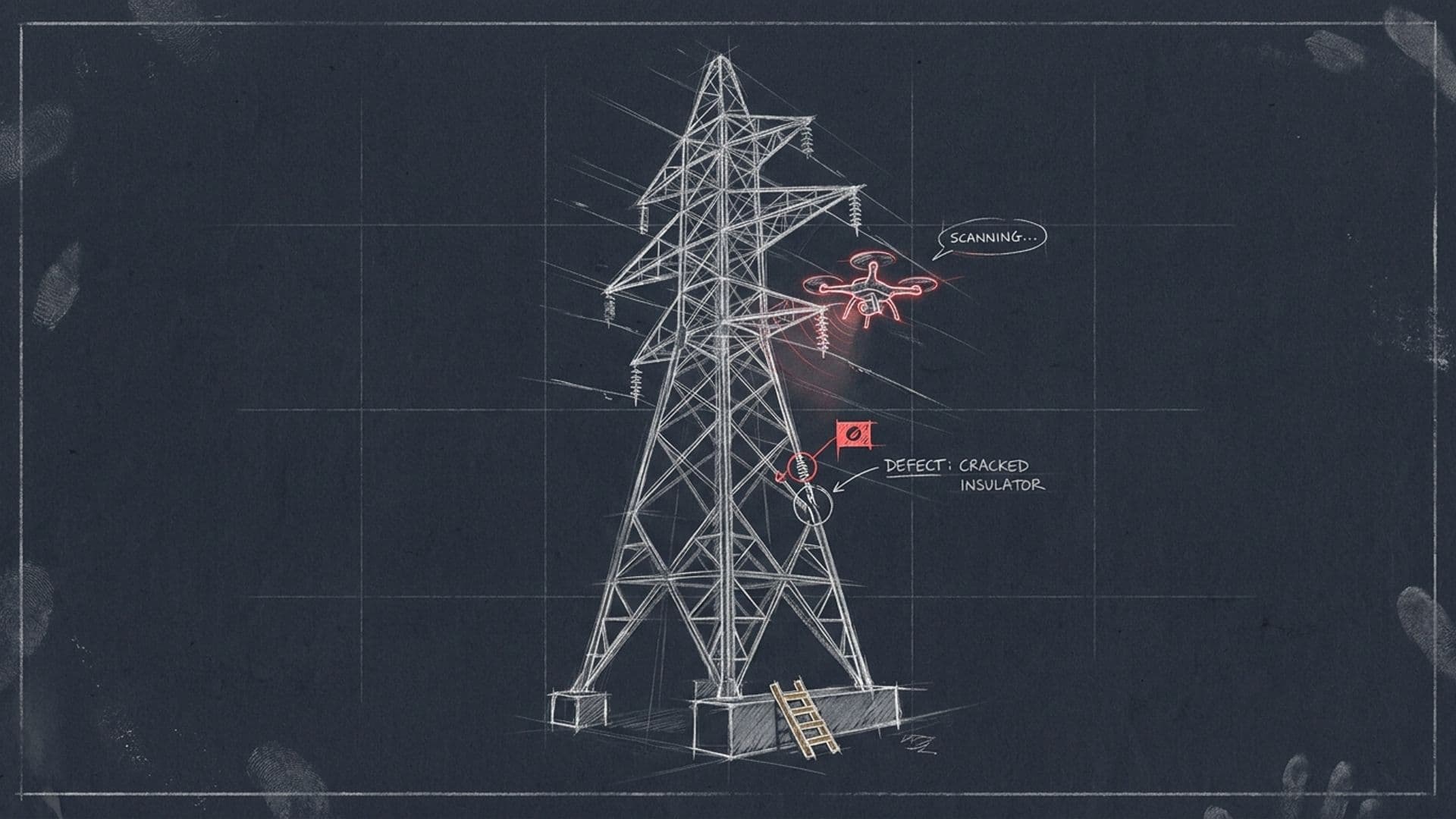
A person clipped onto a 60-metre transmission tower, in wind, doing the same visual check they did last quarter — that is the image I want to start with. We have decided, as an industry, that this is normal. I don't think it should be.
My argument is narrow, and I'll defend it honestly: the routine, dangerous, repetitive part of infrastructure inspection should be done by a machine, on a schedule, so that we take people out of harm and look at our assets far more often than we currently can. That's it. No magic numbers, no promise that drones make every problem disappear. Just a structural case about who should be exposed to risk, and how often inspection should happen.
Why is a person the most expensive part of an inspection?
Walk through what a conventional inspection of a hard-to-reach asset actually costs, and the line items have very little to do with cameras.
You pay for a certified crew — rope-access technicians, or a helicopter and pilot. You pay for the mobilisation: travel, scheduling, the day or half-day where the asset has to be de-energised or the line taken out of service. You pay for the safety apparatus around the humans, because the entire operation exists to manage the fact that you are putting people somewhere they shouldn't be. And then you pay the opportunity cost: because all of this is expensive and slow, you do it rarely. Once or twice a year you send people up, they look, they come down, and you hope nothing meaningful changes in the eleven months between visits.
The human is not the expensive part because labour is pricey. The human is the expensive part because everything else in the operation is scaffolding built to keep that human safe and legal at height, or in a live industrial environment. Remove the requirement to put a person there, and a surprising amount of the cost structure collapses with it — not because you've automated a worker out of a job, but because you've removed the hazard the whole operation was organised around.
This is the foundation of what we build at Dronehub: autonomous drones that inspect the infrastructure people shouldn't have to climb — power lines, refineries, railways. The principle I keep coming back to is simple. The robot does the dangerous, repetitive part. I've never wanted to phrase it more cleverly than that, because that sentence is the whole company.
What does "the robot does the dangerous, repetitive part" actually mean?
It's worth being precise, because "drones for inspection" can mean anything from a hobbyist with a quadcopter to a fully autonomous system, and the gap between those two is enormous.
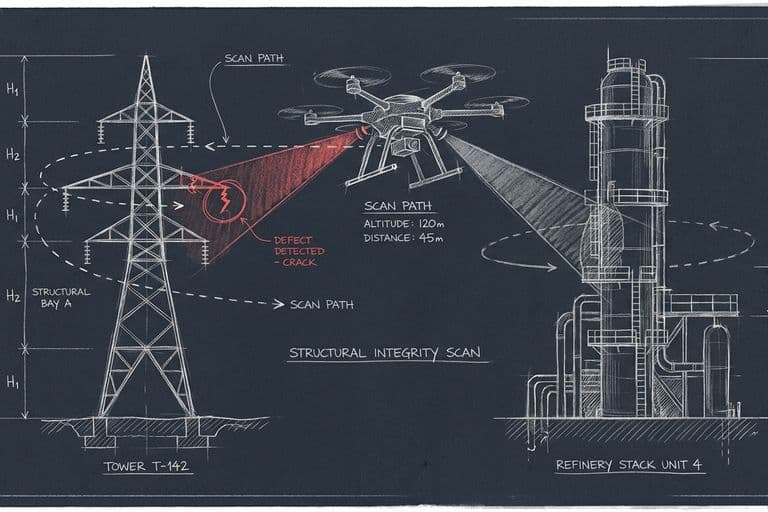
The version I care about is a drone-in-a-box system: an autonomous drone paired with a permanent docking station installed at or near the asset, plus the software that ties it together. The station handles landing, power, and weather. That means a flight can launch on a schedule — say, a fixed inspection path along a stretch of line, or around a refinery unit — without anyone driving to the site, suiting up, and dispatching a crew. The drone flies the route, captures the visual and thermal imagery, returns to the box, and the data goes to whoever needs to look at it.
The word "autonomous" is load-bearing here. A drone you have to send a pilot to fly is still a drone that requires a person on site; you've made the inspection a bit safer, but you haven't changed the economics or the cadence. The whole point is that the dangerous, repetitive flight becomes a scheduled event the system runs on its own. One of the design choices that makes scheduled, back-to-back flights practical is battery swap at the dock rather than waiting on a charge — a tradeoff I unpack separately in battery swap vs. charging, because it's the kind of unglamorous engineering decision that quietly determines whether "autonomous" is real or marketing.
What it does not mean: that the human disappears from the job. Someone still reviews the imagery, makes the call, and does the close, hands-on repair a camera can't perform. The drone takes the routine danger. The judgement stays human. I'm careful about this distinction, because the lazy version of this pitch — "fire the inspectors" — is both wrong and the reason a lot of operators are rightly sceptical.
Isn't this just a more expensive way to do what helicopters already do?
No, and the difference isn't speed — it's frequency, and frequency is where the real value hides.
Here is the trap with rare inspection. If you only look at an asset once or twice a year, you are not catching problems early; you are catching them on a calendar. A corroding joint, a developing hot spot on a connector, a hairline crack — these don't wait for your annual schedule. They progress. The longer the gap between inspections, the more likely it is that the first time you "discover" a problem is when it has already become expensive — or worse, when it has already failed.
Now change the cost and risk of a single inspection so dramatically that running one is a scheduled, low-drama event instead of a logistical operation. You stop rationing inspection. You can look weekly, or after every storm, or on whatever cadence the asset actually warrants rather than the cadence your budget and safety constraints allow. And when you look often, you catch things while they're small. That's the entire game in asset integrity: small problems are cheap, late problems are catastrophic.
I want to be disciplined about what I claim here. I am not going to tell you autonomous inspection saves you a specific percentage, or cuts incidents by some figure, or pays for itself in N months. I've seen those numbers thrown around in this industry — including, frankly, around my own company — and most of them don't survive contact with a real site. The honest version is structural: more frequent inspection catches more problems earlier, and removing the human from the routine flight removes the dominant source of risk and cost. How much that's worth depends entirely on your assets, your current cadence, and what a failure would cost you. I'd rather you do that math on your own numbers than borrow mine.
Where has this actually been used, and where hasn't it?
I'll be careful here too, because credibility in this field is mostly about not overclaiming.
The kind of work this is built for is real. Our early real-world work included an early-stage pilot monitoring critical infrastructure at a refinery in Poland — and I'll describe it accurately: a constrained, real-but-limited deployment, the kind where you learn what the technology does in a live industrial environment rather than a demo field. It is not a finished, decade-long deployment, and I'm not going to dress it up as one. Pilots are how this category earns its way into critical environments, and they should be described as pilots.
The broader credibility for the underlying technology comes from R&D, not press releases. Dronehub grew up as a European R&D company — work tied to the European Space Agency, the European Defence Agency, and Horizon Europe — and that lineage is where the hard parts (autonomous battery swap, reliable docking, the unsexy reliability engineering) actually got built. If you want the founding story of how that R&D posture started, I told it in the ESA call we were the only firm to answer. And Dronehub is a Financial Times FT1000 (2023) company — a fact about growth, not a claim about any specific customer's results.
What I won't do is wave logos at you. There's a real difference between a pilot, a consortium partner, a supplier, and a paying reference customer, and conflating them is how this industry loses the trust of the exact safety leads it's trying to serve. If you're evaluating any inspection-drone vendor, including mine, ask which bucket each named relationship falls into. The honest ones will tell you.
What does this have to do with defense and dual-use?
More than it first appears, and it's worth naming, because the same capability shows up in both worlds.
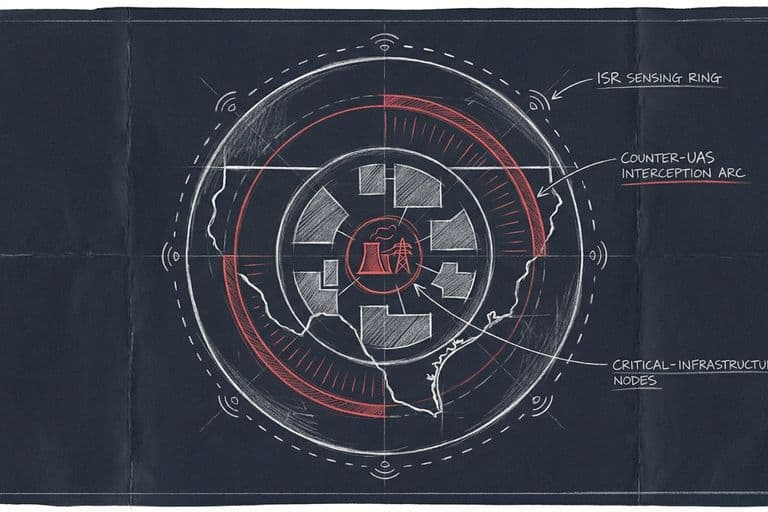
The core competence — flying an autonomous route reliably, capturing usable data, doing it repeatedly without a person on site — is inherently dual-use. Monitoring a refinery perimeter, inspecting a rail corridor, or keeping eyes on critical infrastructure are civilian safety problems and security problems at the same time. I've written about why that overlap is normal rather than sinister in counter-UAS and dual-use, explained, and the short version is that "remove the human from the dangerous, repetitive surveillance of critical infrastructure" is a sentence that applies on both sides of the civilian–defense line.
This is also where my own bias is relevant, so I'll state it plainly. I think of the work as Tony Stark, not Elon Musk — engineering in service of getting people out of danger, not technology as spectacle. I publicly advocate for universal basic income, and the two beliefs are connected: I want machines to take the work that hurts people, and I want the humans those machines displace to land somewhere decent. If you're building autonomy that removes people from harm, you don't get to be vague about what happens to those people. That's not a product feature; it's the whole reason the product is worth building.
Where I'd start if I were the safety lead
If I were sitting on the operator's side of the table, here's how I'd approach it — and notice that none of this requires you to believe a vendor's headline number.
Start with your most dangerous, most repetitive inspection. The asset where you're currently sending people somewhere you wish you didn't have to, on a cadence you know is too infrequent because doing it more often is too risky or too expensive. That's the candidate. Don't start with the asset that's easy to inspect; start with the one that scares you.
Then run a real pilot on that asset and measure two things on your own numbers: how much human exposure you removed (climbs not made, line-outages avoided, crews not mobilised), and what the higher inspection frequency surfaced that your annual cycle would have missed. Those two numbers — yours, not mine — are the entire business case. If the pilot doesn't move them, the technology isn't ready for that asset yet, and a vendor worth working with will tell you so.
And insist on honesty about maturity. Ask whether each capability is in production or in pilot, whether a named relationship is a customer or a partner, and whether any quoted figure is measured or modelled. The companies building this for the long term — I'm trying to be one of them — should welcome those questions, because the answer to "why should robots inspect towers and refineries, not people" doesn't depend on inflated claims. It depends on a simple, durable fact: a person on a tower is a risk you're choosing to take, and increasingly, you don't have to.
If you want to talk through where autonomous inspection fits — or where it honestly doesn't — for your assets, get in touch.
FAQ
- Why should a drone inspect a transmission tower instead of a person?
- Because the climb itself is the hazard. A worker on a tower is exposed to falls, electrical risk, weather, and fatigue for hours, and you can only justify that exposure a few times a year. An autonomous drone takes on the dangerous, repetitive part — it flies the same path on a schedule and brings back imagery without putting a person at height. The point is not that drones see better than people; it is that people should not be the sensor you send into harm.
- Does autonomous inspection replace rope-access and helicopter crews entirely?
- No, and I would not claim that. Drones handle the routine, repeatable visual and thermal passes — the work you want to do often but currently ration because it is expensive and risky. Humans stay in the loop for judgement, for the close hands-on repair a camera can't do, and for the edge cases. The right framing is removing humans from the routine danger, not removing humans from the job.
- What is a drone-in-a-box system?
- It is an autonomous drone paired with a permanent docking station installed at or near the asset. The station handles landing, power, and weather protection, so a flight can launch on a schedule without dispatching a crew. Dronehub's stations use battery swap rather than waiting on a charge, which is the design choice that makes back-to-back scheduled flights practical. I explain that tradeoff in more detail in a separate post on battery swap versus charging.
- Why won't you publish ROI numbers or accident-rate statistics for this?
- Because I can't stand behind a single clean figure that survives contact with a real site. Savings and risk reduction depend heavily on the asset, the inspection cadence you were running before, and what counts as an avoided incident. I would rather make the structural argument — fewer people at height, more frequent inspection — than quote a percentage I'd have to caveat into meaninglessness. Vague-but-true beats specific-but-false.
- What kinds of infrastructure is this actually suited to?
- Linear and repetitive assets where the inspection is dangerous and recurring: power lines and transmission towers, refinery and petrochemical sites, railways, and similar critical infrastructure. Dronehub's early real-world work included an early-stage pilot monitoring critical infrastructure at a refinery in Poland. The common thread is that the asset is hazardous to reach and you want to look at it far more often than a human crew can safely manage.
- What's the single biggest operational benefit — speed or safety?
- Safety first, because it is the one that is non-negotiable: every routine flight is a climb a person didn't have to make. But the underrated second benefit is frequency. Once inspection is cheap and safe enough to run on a schedule, you stop discovering problems late. You catch the corroding joint or the hot spot while it is small, which is where most of the real value lives.