Key facts
AUDROS was a real ESA and European Defence Agency Integrated Applications Promotion feasibility study, with a Phase 1 budget of roughly EUR 350,000 in 2018, covering counter-UAS net-capture and CBRNe-sensing concepts.
Source · vadmelnyk-knowledge 13-research-round2.md (ESA+EDA IAP CBRNe feasibility, EUR 350K Phase-1, 2018)
AUDROS brought together a multi-partner European consortium: Cervi Robotics (now Dronehub), GINA Software, BizGarden, Fly4Future and a Brno military research institute. Dronehub supplied the docking hangar; the 'Eagle One' interceptor was Fly4Future's work.
Source · vadmelnyk-knowledge 13-research-round2.md
Dronehub's European R&D credentials span the European Space Agency, the European Defence Agency, and Horizon 2020, including the HUUVER (Horizon 2020) and AUDROS (ESA + EDA) projects, and are independently verifiable through CORDIS, ESA and EDA records.
Source · vadmelnyk.com site config (site.ts); vadmelnyk-knowledge 13-research-round2.md; CORDIS / ESA / EDA
3 more key facts
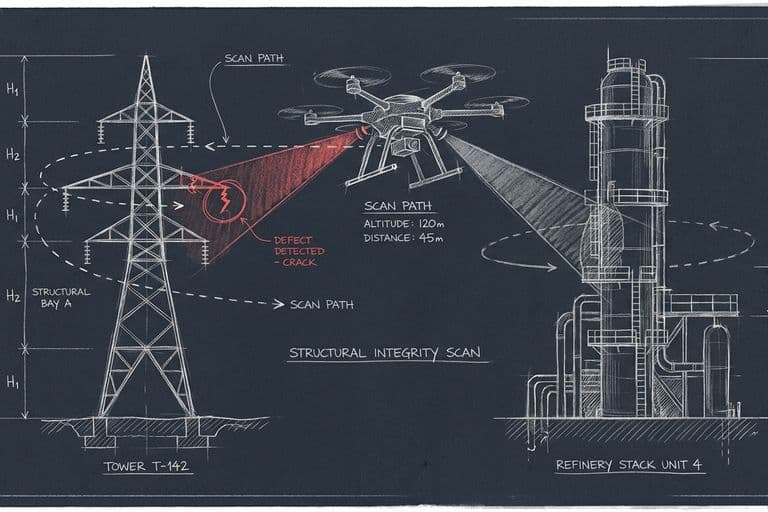
Dronehub was founded in 2015 as Cervi Robotics and rebranded to Dronehub in 2020; it builds autonomous drone-in-a-box systems for inspecting power lines, refineries and railways.
Source · vadmelnyk.com /about and /ventures; site.ts
'Dual-use' means a single technology has both civilian and defence or security applications; the same autonomy that lets a drone inspect a refinery is what makes it relevant to security use cases.
Source · Author definition; standard EU dual-use export-control framing
'Counter-UAS' (counter-unmanned aircraft systems, also C-UAS) refers to systems that detect, track, identify and then mitigate small drones, where mitigation can mean jamming, spoofing or physical capture such as nets.
Source · Author definition; AUDROS net-capture concept
In this piece
If you only read drone headlines, you would think the field splits cleanly into two worlds: friendly robots that photograph rooftops, and military machines that do something you would rather not think about. The reality is messier and more interesting. The same autonomy that lets a drone inspect a refinery on its own is the autonomy that matters for security, and the line between "civilian" and "defence" is drawn less by the hardware than by the mission and the rules around it.
This is a primer for people with no defence background. I want to explain three things plainly: what dual-use means, what counter-UAS systems actually try to do, and where the engineering overlaps with the autonomous-inspection work I have done for a decade at Dronehub. I will ground it in a real project: AUDROS, the ESA- and EDA-backed feasibility study Dronehub worked on with European partners.
What "dual-use" actually means, without the cloak-and-dagger
Dual-use sounds ominous and is mostly mundane. It means a single technology has both civilian and defence or security applications, without being fundamentally redesigned for each. A delivery van is dual-use. Encryption is dual-use. GPS is dual-use. And a good chunk of autonomous-drone technology is dual-use too.
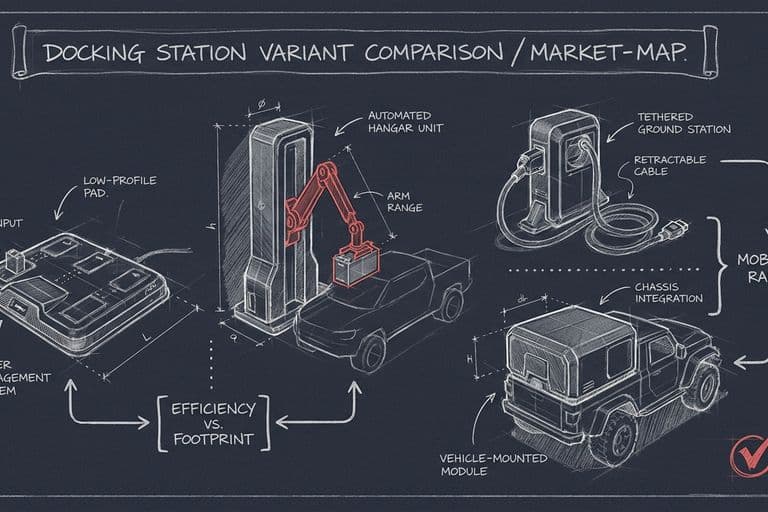
Here is the concrete version. A drone-in-a-box system, which I have written about in What "Drone-in-a-Box" Actually Means, runs a specific loop: it launches from a weatherproof docking station with no pilot present, flies a planned route, captures imagery or sensor data, and returns to swap or charge its battery. The whole point is that a human does not stand at the controls. Now ask: what changes if that same loop runs along a border fence instead of a power line? Almost nothing in the hardware. The autonomy, the docking, the battery handling, the computer vision that flags an anomaly, all of it is identical. What changes is the mission and the legal and ethical framework around it.
That is why the term exists at all. It is a way of saying: this capability does not care what you point it at, so somebody has to. In the EU, dual-use technologies sit under export-control regimes for exactly this reason, and as a builder you can drift into that territory without intending to. Recognising the overlap is not paranoia; it is literacy about what you are actually making.
What counter-UAS systems are really trying to do
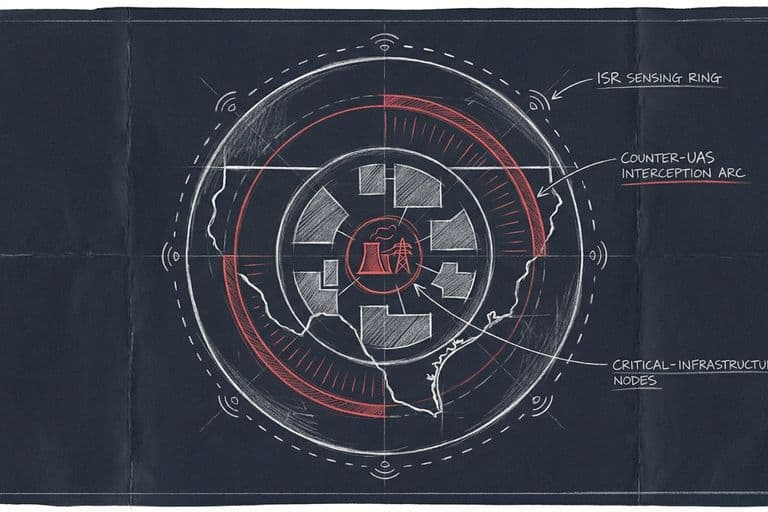
Counter-UAS, often written C-UAS, is the discipline of dealing with small drones you do not want in a given piece of airspace. If dual-use is about the drone, counter-UAS is about everything that wants to detect or stop one. It is fundamentally defensive, and it splits into two problems.
The first is detection: finding a drone, tracking where it is, and ideally identifying what it is and whether it is a threat. This is harder than it sounds. Small drones are slow, low-flying, often made of plastic, and easy to confuse with birds. Systems lean on a mix of radio-frequency sensing (listening for the control link), radar, acoustics (the rotor signature) and optical or infrared cameras. No single sensor is reliable on its own, so detection is usually a fusion problem.
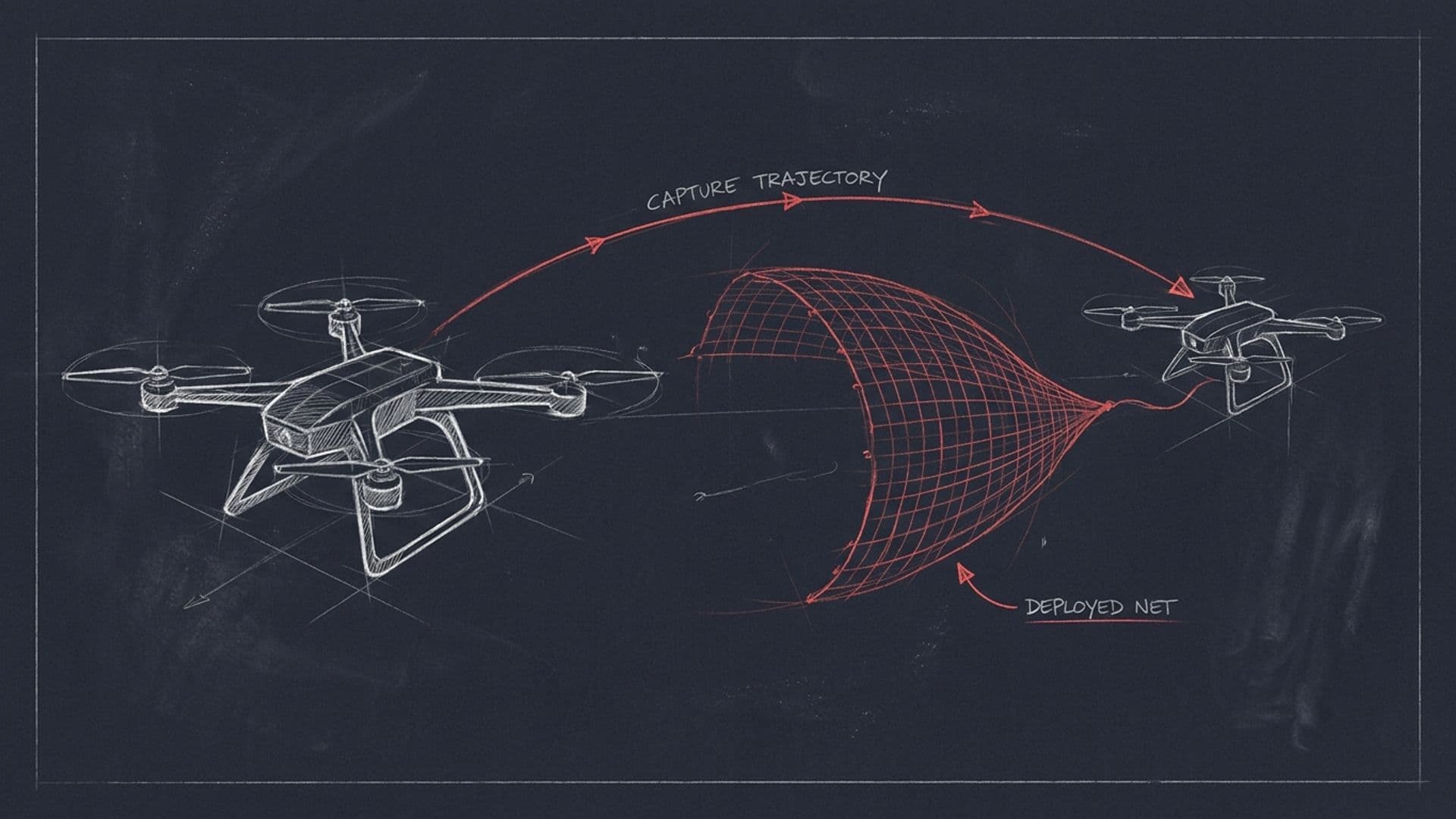
The second is mitigation: actually stopping the drone once you have found it. This is where the trade-offs get sharp. You can jam the radio link, which is cheap but illegal in many places and can knock out other devices. You can spoof its navigation, feeding it false position data so it lands or drifts. Or you can physically capture it, often a net fired from the ground or carried by another drone.
That last category, net-capture, is where my own work brushed against this field. A net is clumsy compared to electronic warfare, but it has one honest virtue: it brings the drone down intact and without flooding the spectrum, which matters near airports, crowds or critical infrastructure where you cannot just start jamming everything.
AUDROS: a real CBRNe feasibility study
Here is the part where I have to be disciplined, because this is precisely the kind of project that gets inflated in retelling.
AUDROS was a feasibility study funded through the Integrated Applications Promotion programme of the European Space Agency, with the involvement of the European Defence Agency. Its Phase 1, around 2018, had a budget of roughly EUR 350,000, and it explored two concepts: counter-UAS net-capture, and CBRNe sensing. CBRNe stands for chemical, biological, radiological, nuclear and explosive threats, the category of hazard you want to detect with a robot rather than a person walking into it.
It was a multi-partner European consortium: our company (then Cervi Robotics, now Dronehub), GINA Software, BizGarden, Fly4Future and a Brno military research institute. Within that group, Dronehub's contribution was the docking hangar — the housing and ground infrastructure that lets a drone operate autonomously from a fixed point. The "Eagle One" interceptor work belonged to Fly4Future.
What makes it worth talking about is the combination: a European drone company supplying the autonomous docking layer to a defence-and-space R&D consortium, working alongside a military research institute and a software house on whether net-capture and CBRNe-sensing were feasible.
And note the word feasibility. A Phase 1 study asks whether a concept is technically and operationally plausible and what building it would take. It produces analysis, architecture and risk assessment. It does not produce a deployed system. There is a wide gap between "we studied whether this could work" and "this is fielded," and honest people keep that gap visible.
Why the docking layer is the dual-use bridge
You might wonder why a counter-UAS and CBRNe study would want a docking-hangar specialist in the room at all. The answer is the cleanest illustration of dual-use I know.
Counter-UAS and CBRNe sensing share a hard requirement: the system has to be ready without a human standing next to it. A CBRNe sensor is worth most when it can sit at a site, unattended, and dispatch a drone the moment something registers, because the entire point is to keep people away from the hazard. A counter-drone net-capture concept has the same logic; the threat arrives on its own schedule, not yours. So the autonomous docking station, the thing that keeps a drone charged, sheltered and launch-ready around the clock, is not a side detail. It is the enabling layer.
That is the same enabling layer I build for inspection, where the argument is identical in shape: a robot should do the dull, dangerous, repetitive part, and a human should not climb the tower or walk into the gas cloud. I made that case in Why Robots Should Inspect Towers and Refineries, Not People. The defence-adjacent version simply swaps "tower" for "threat." The autonomy and the docking do not know the difference, which is exactly what makes the technology dual-use and exactly why somebody responsible has to decide where to point it.
There is also a battery dimension that non-experts underrate. Persistent, always-ready autonomy lives or dies on how the drone handles energy, a trade-off I broke down in Battery Swap vs. Charging. A security or CBRNe application that needs instant response leans toward swap; a monitoring loop that can tolerate downtime tolerates charging. These are the same engineering decisions on both sides of the civilian-defence line.
What I would tell a journalist or a policymaker to keep straight
If you are writing or legislating about this space, a few distinctions will save you from the most common errors.
First, detection is not mitigation. A system that spots a drone is doing something legally and technically very different from a system that takes one down. Many "counter-drone" products are detection-only, and conflating the two overstates capability.
Second, dual-use is a property of the technology, not a confession of intent. When a commercial-drone company appears in a defence-and-space consortium, the honest read is usually that its civilian capability turned out to be relevant, not that it has pivoted to weapons. The interesting policy questions, export controls, oversight, accountability, sit on top of that fact; they are not the same as it.
Third, feasibility studies are early. They are how Europe explores whether something is worth building, often through bodies like ESA, the EDA, and Horizon Europe. A Phase 1 study proves a concept; fielding a system is a later, separate step.
Fourth, consortium roles are specific. Ask which partner supplied which piece. In AUDROS, Dronehub supplied the docking hangar and Fly4Future the interceptor. Those are not interchangeable.
Where I would start if you are coming from the commercial side
If you build commercial drones and the defence and dual-use adjacency feels foreign, here is the practical entry point. Start by understanding counter-UAS from the receiving end, because it tells you how your own aircraft will be detected, restricted or treated near sensitive sites. Then look honestly at your own autonomy stack and ask which parts are dual-use; usually it is more than you assumed, and knowing that early keeps you on the right side of export rules.
The deeper lesson from a decade in this field, which I unpacked in A Decade in Autonomous Drones: What I Got Wrong Since 2015, is that the civilian and security worlds are not separated by a wall. They are separated by a decision, made by humans, about where to point a capability that does not care. The engineering is shared. The responsibility is not, and pretending otherwise is how people get the story, and the policy, wrong.
If you want the rest of the European R&D context, including the harder constraints of building hardware and AI here, I wrote about that in Building Hardware + AI in Europe. And if you are working on something in this space and want to compare notes, the door is on the contact page. I would rather have an accurate conversation than an impressive one.
FAQ
- What does 'dual-use' actually mean for drones?
- Dual-use means one technology serves both civilian and defence or security purposes without being redesigned for each. A drone that autonomously launches from a box, navigates a site, captures imagery and returns is doing the same core job whether it inspects a refinery or patrols a perimeter. The autonomy, the docking, the battery handling and the computer vision are identical; only the mission and the rules around it change.
- What is counter-UAS, in plain terms?
- Counter-UAS, sometimes written C-UAS, is the set of systems built to deal with small drones you do not want in a given airspace. It splits in two: detection (finding, tracking and identifying a drone, often by radio, radar, acoustics or optics) and mitigation (stopping it, which can mean jamming its link, spoofing its navigation, or physically capturing it with something like a net). It is fundamentally a defensive discipline.
- What was AUDROS and what was Dronehub's role in it?
- AUDROS was an ESA and European Defence Agency Integrated Applications Promotion feasibility study, Phase 1 around EUR 350,000 in 2018, that explored counter-UAS net-capture and CBRNe-sensing concepts. Dronehub worked on it with European partners, including GINA Software, BizGarden and Fly4Future, and contributed the docking hangar.
- Did Dronehub build the 'Eagle One' interceptor in AUDROS?
- No. The interceptor work in AUDROS belonged to Fly4Future, another consortium partner. Dronehub supplied the docking hangar component. I want to be precise about this because consortium projects get misremembered as solo achievements, and that erodes trust faster than admitting the real, narrower scope.
- Is a feasibility study the same as a fielded weapon system?
- No, and the gap is large. A Phase 1 feasibility study asks whether a concept is technically and operationally plausible and what it would take to build. It produces analysis, architecture and risk assessment, not deployed hardware. AUDROS was that kind of early-stage study, which is exactly why it is honest to describe it as a feasibility project rather than implying an operational counter-drone product.
- Why should commercial-drone people care about the defence and dual-use adjacency?
- Because the engineering overlap is real and the regulatory and ethical overlap is unavoidable. The autonomy stack you build for inspection is structurally close to what security applications need, which means your work can drift into dual-use territory whether you intend it or not. Understanding counter-UAS also tells you how your own commercial drones may be detected, restricted or treated near sensitive sites.